正在学习
6.9 Magnetic Quantities and Units
6.9 Magnetic Quantities and Units
Then, the magnitudes in a magnetic circuit (and their corresponding units) are shown now on:
Important Magnetic flux, Ф (Weber, Wb).
Magnetic flux is the set of lines of force passing through a magnetic circuit. These lines of force are always closed on themselves. The unit that we measure magnetic flux in the international system is the Weber (Wb).
Important Magnetic induction, B (Tesla, T).
Magnetic induction, or flux density, is the flux per unit area. This is what happens if the flux is evenly spread across the whole surface:
B=ΦS (6.1)
Important Magnetomotive force (MMF).
It is the work that would be required to carry a hypothetical isolated magnetic pole of unit strength completely around a magnetic circuit. Flux circulates in a magnetic circuit due to the application of magnetic force. A coil having N turns through which current I flows produces a magnetomotive force of:
Fmm=N·I (6.2)
The international system uses the ampere-turn as its unit of measurement (At).
Important Magnetic field strength (H).
Magnetic field strength or magnetizing force is the ratio of the applied magnetomotive force (MMF), in ampere-turns (At), to the length of the magnetic circuit consuming it.
We measure the length on the mean magnetic line, L, as.
H=FmmL (6.3)
The unit of measurement in the International System is (ampere-turn)/meter (At/m). The magnetic permeability of vacuum (μ0) is 4π-10–7 H/m, in the international system.
We use ferromagnetic materials to make electrical machines because it is important to keep the magnetic flux inside them.
Important Permeability (μ). The permeability of a material measures the ability of that material to conduct magnetic flux through it. Conversely, relative permeability (μr) quantifies the capacity to conduct flux with respect to vacuum. The relative magnetic permeability of air has a value of one.
Important Reluctance (ℜ). The reluctance of a magnetic circuit (in Ampere-turn/Wb) is the resistance of the magnetic circuit to the flow of flux through it. This is similar to that of "resistance" in an electrical circuit. The reluctance in a circuit of length L, constant cross section S and material of permeability μ is defined as:
ℜ = L/μ·S (6.4)
This expression shows that the higher the value of the permeability of the material, the lower the value of the reluctance and, the less resistance the circuit presents to the flux. Materials behave differently according to the flux density and magnetic field (Fig. 6.21). It includes B—flux density, H—magnetic field, μf—permeability of ferromagnets (and ferrimagnets), μp—permeability of paramagnets, μ0—permeability of free space (4π × 10⁻⁷ H/m), μd—permeability of diamagnets.
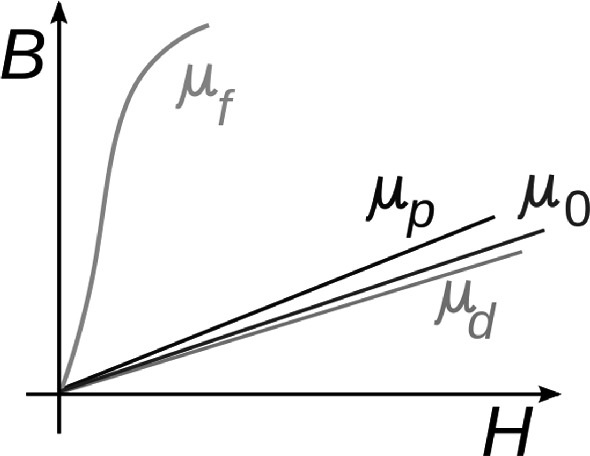
Fig. 6.21 B—flux density, H—magnetic field, μf—permeability of ferromagnets (and ferrimagnets), μp—permeability of paramagnets, μ0—permeability of free space (4π × 10⁻⁷ H/m), μd—permeability of diamagnets. Source From wikicommons under free to use license [20]
This is the reason for manufacturing electrical machines' magnetic circuits using ferromagnetic materials (logically excluding the air gap in rotating machines).
练习题
What is the SI unit used to measure magnetic flux?
A magnetic circuit has a magnetic flux of Wb passing through a cross-sectional area of m². If the flux is evenly distributed across the surface, what is the magnetic flux density ?
A coil has turns and carries a current of A. What is the magnetomotive force (MMF) produced by this coil?
Which of the following statements about magnetic quantities are correct?
Which of the following factors affect the reluctance of a magnetic circuit?
Magnetic flux lines are always closed on themselves, forming complete loops.
The higher the permeability of a material, the higher the reluctance of the magnetic circuit made from that material.
Ferromagnetic materials are used in electrical machines because they help keep the magnetic flux inside the magnetic circuit.
The magnetic permeability of vacuum in the International System has a value of ___ H/m.
The magnetomotive force produced by a coil with N turns carrying current I is calculated using the formula: Fmm = ___.
Explain why ferromagnetic materials are used to manufacture the magnetic circuits of electrical machines.
A magnetic circuit has a magnetomotive force of 500 At and a mean magnetic path length of 0.25 m. Calculate the magnetic field strength H and state its unit.
An electromagnet's magnetomotive force can be controlled by adjusting the current flowing through its coils, which is why electromagnets are preferred over natural magnets in electrical machines.
According to the B-H curve for magnetic materials, how does the permeability of ferromagnetic materials compare to that of paramagnetic and diamagnetic materials?
An electromagnet consists of a coil with 200 turns wound around a ferromagnetic core. If a current of 5 A flows through the coil, what is the magnetomotive force (MMF) produced?
Which of the following statements correctly explain why electrical machines use electromagnets with ferromagnetic cores instead of natural magnets? Select all that apply.
In an electromagnet excited by direct current, the magnetic flux lines are always closed on themselves, flowing from the North Pole to the South Pole outside the magnetic material.
The magnetomotive force (MMF) produced by an electromagnet is directly proportional to both the number of turns in the coil and the ___ flowing through it.
登录后解锁笔记、知识点解析、AI 问答
立即登录