正在学习
5.4 Power in a Purely Capacitive Circuit
5.4 Power in a Purely Capacitive Circuit
In this case the current that flows through the circuit leads the voltage π/2 radians (Fig. 5.4). Therefore, the instantaneous values of current and voltage are:
u = 2·U·sin ωt (5.17)
i = 2·I·sin(ωt + π/2) (5.18)
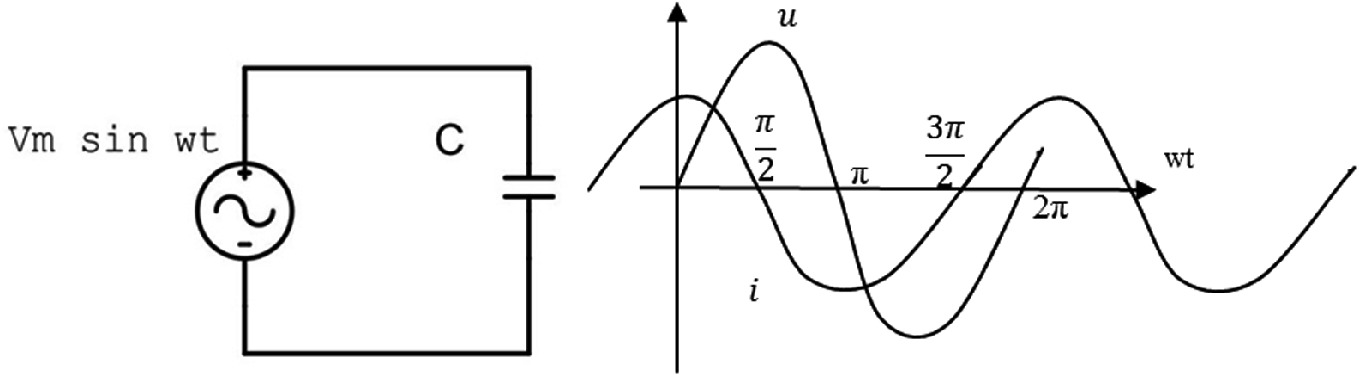
Fig. 5.4 Purely capacitive circuit.
In this instance, in order to find the instantaneous power, we multiply the instantaneous voltage and current as we see (Eq. 5.19).
p(t) = u(t)·i(t) = 2·U·I·sin ωt·sin(ωt + π/2) = U·I·sin 2ωt (5.19)
Then, the active power has twice the frequency of voltage and current waves.
Recalling the trigonometric functions:
sin(π/2 + θ) = cos θ
sin 2x = 2 sin x cos x
cos 2x = cos²x - sin²x
tan 2x = 2 tan x / (1 - tan²x)
As previously, we get the power curve. Once more, the capacitor's continuous charge and discharge process generate positive and negative cycles of instantaneous power. Then, we can plot the instantaneous power values in a purely capacitive circuit (Fig. 5.5).
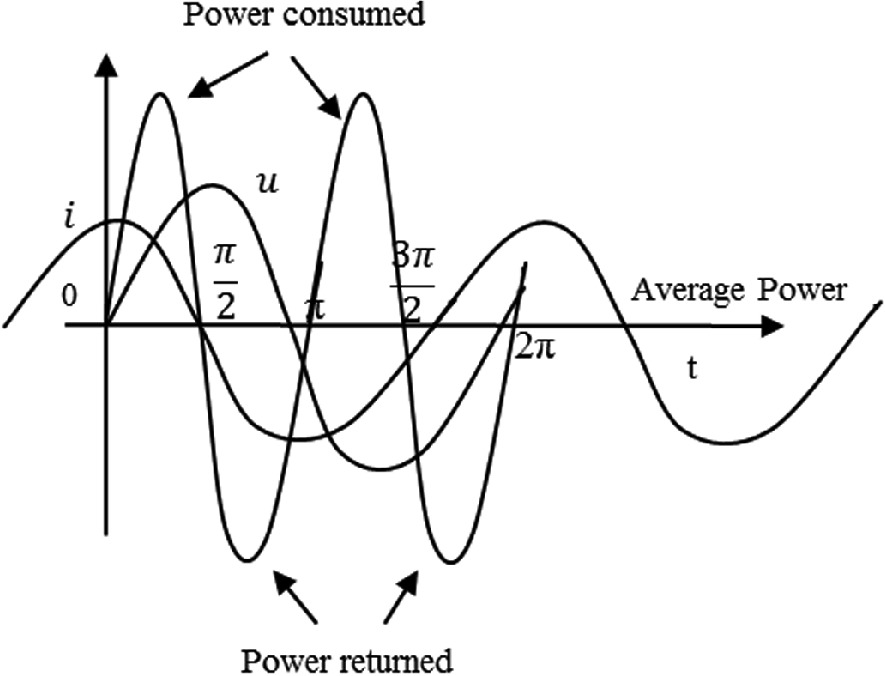
Fig. 5.5 AC power waveforms in a purely capacitive circuit.
Question What happens if p > 0? If p > 0, then capacitor stores energy.
Question What happens if p < 0? If p < 0, capacitor releases energy.
What kind of power does a capacitor generate? A capacitor does not generate active power but reactive power.
What is the active power?
Question The active power is:
P = 1/T ∫₀ᵀ U·I·sin 2ωt = 1/T ∫₀ᵀ U·I·2·sin ωt·cos ωt = 2·U·I/T ∫₀ᵀ sin ωt·cos ωt = 0 (5.20)
Remembering the trigonometric functions of:
sin 2x = 2 sin x·cos x
cos 2x = cos²x - sin²x
tan 2x = 2 tan x / (1 - tan²x)
If we compare the instantaneous power curves of the coil and the capacitor, we see that during the coil's energy discharge (negative power cycle), the capacitor charges with the same energy (positive power cycle). Consequently, we say that the reactive power of the capacitor is negative with respect to that of the coil, and thus their effects cancel each other out.
In a capacitor we have:
Q = UC·I = XC·I² (5.21)
We measure it in reactive volt-amperes (VAr).
练习题
In a purely capacitive circuit, what is the phase relationship between the current and the voltage?
The instantaneous power in a purely capacitive circuit is given by . What is the frequency of this power waveform compared to the voltage and current waveforms?
How does the reactive power of a capacitor compare to that of a coil (inductor)?
Which of the following statements correctly describe the behavior of instantaneous power in a purely capacitive circuit? Select all that apply.
Which of the following statements are true when comparing power in resistors, coils, and capacitors in AC circuits?
In a purely capacitive circuit, the active power is zero because the integral of over one complete period equals zero.
A capacitor in an AC circuit generates active power that can perform useful work.
The current in a purely capacitive circuit leads the voltage by radians, while the current in a purely inductive circuit lags the voltage by radians.
The reactive power in a capacitor is calculated using the formula ___, and is measured in reactive volt-amperes (VAr).
In a purely capacitive circuit, the instantaneous power is given by ___, which has twice the frequency of the voltage and current waveforms.
Explain why a capacitor does not generate active power in an AC circuit, even though instantaneous power is not always zero.
Using the instantaneous voltage and current for a purely capacitive circuit, derive the expression for instantaneous power and state its key characteristics.
In a purely resistive circuit, the instantaneous power is always positive or zero, while in purely inductive and capacitive circuits, the instantaneous power alternates between positive and negative values. What is the fundamental reason for this difference?
Which of the following statements correctly describe the active power (P) and reactive power (Q) in purely inductive and capacitive circuits?
In a purely inductive circuit, the current lags the voltage by π/2 radians, while in a purely capacitive circuit, the current leads the voltage by π/2 radians. This phase difference causes the reactive power of the capacitor to be negative with respect to that of the inductor, allowing their reactive effects to cancel each other when connected together.
The instantaneous power expression for a purely resistive circuit is , which is always positive. In contrast, the instantaneous power expressions for purely inductive and capacitive circuits are and respectively. The key difference is that resistors only ___ energy, while inductors and capacitors alternately store and release energy.
Explain why both purely inductive and purely capacitive circuits have zero active power, but a purely resistive circuit has non-zero active power. Use the concepts of energy storage and energy dissipation in your explanation.
登录后解锁笔记、知识点解析、AI 问答
立即登录