正在学习
5.3 Power in Circuits with Coil
5.3 Power in Circuits with Coil
Now we analyze the power in circuits with a single coil. We know that current delays to the voltage by 90 degrees, or π/2 radians (Fig. 5.3). Consequently, the instantaneous values of current and voltage are:
u=2·U·senωt (5.12)
i=2·I·senωt-π/2 (5.13)
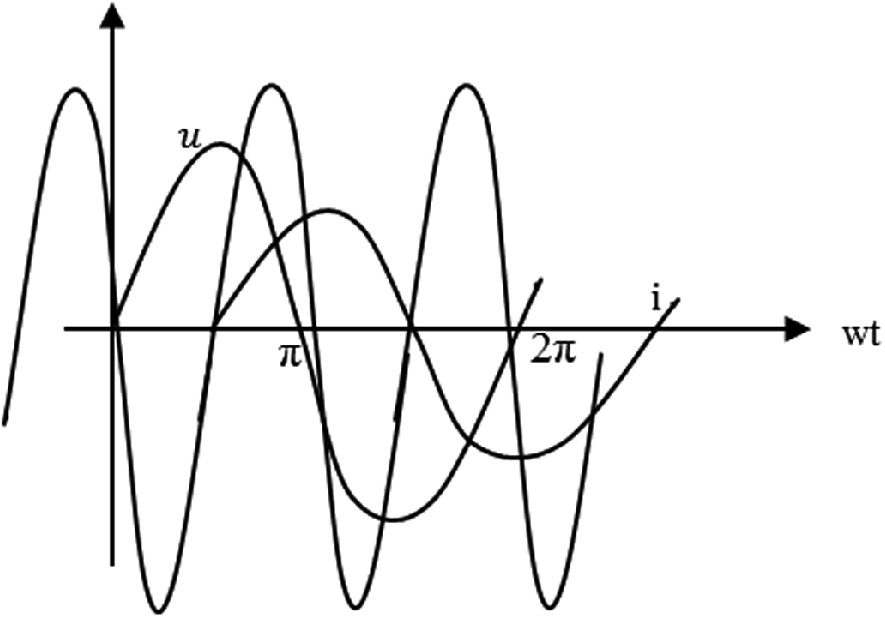
Fig. 5.3 Power curve in a purely inductive circuit.
Similarly, only by multiplying the voltage at any given instant and the current provides the power at that instant. Then, we plot the instantaneous power curve in this circuit (Fig. 5.3).
Now, let us clarify what this means. As the power is:
pt=ut·it=2·U·senωt·2·I·senωt-π2=2·U·I·senωt·senωt-π/2=-2·U·I·senωt·cosωt=-U·I·sen2ωt (5.14)
Recalling the trigonometric functions:
sen2x=2senxcosxcos2x=cos2x-sen2xtg2x=2tgx1-tg2x
If we look at the results, we see that energy has twice frequency that of the original.(Remember: w=2·π·f).
Question What is the behavior if P > 0?
If p > 0, then the inductance L acts as a receiver (absorbs and stores energy).
Question What is the behavior when P < 0? If p < 0, inductance L acts as a generator (it returns the energy to the circuit). Only by analyzing the graphical representation we see that the power is positive during the quarter cycle in which the coil is charged (the coil receives energy from the generator and acts as a receiver). In the next quarter cycle, the coil releases its stored energy back to the generator, making the instantaneous power negative. Because the average value of the power during a cycle is zero, it is accurate to state that a pure inductive circuit generates no active power.
Question What is the average circuit power in a pure inductive circuit? Due to the fact that the mean value of the power is null, a pure inductive circuit does not generate real power. But, is there power during the coil's operation if it does not consume any actual energy for its operation? Although the coil itself does not consume energy during the operation, the constant charging and discharging process results in current flowing through the wires. Power's constant fluctuation through the conductors is known as reactive power (Q).
P = -1/T ∫₀ᵀ UI sin 2ωt = 0 (5.15)
In a coil we have that:
Q = UL·I = XL·I² (5.16)
We measure it in reactive volt-amperes (VAr).
练习题
In a purely inductive circuit, what is the phase relationship between the current and voltage?
If the voltage source in a purely inductive circuit has frequency , what is the frequency of the instantaneous power?
What is the correct formula for reactive power in a coil?
Which of the following statements correctly describe the behavior of instantaneous power in a purely inductive circuit?
In a purely inductive circuit, the average value of power over one complete cycle equals zero.
In a purely inductive circuit, the instantaneous power is always positive, just like in a purely resistive circuit.
Reactive power is measured in watts (W), the same unit used for active power.
In a coil circuit, the current lags the voltage by ___ degrees, which equals radians.
The unit used to measure reactive power is the reactive volt-ampere, abbreviated as ___.
Explain why a pure inductive circuit has zero average active power, yet reactive power still exists during operation.
Compare the power behavior in a purely resistive circuit versus a purely inductive circuit. Explain why their average power values differ.
In a purely resistive AC circuit, the instantaneous power is always positive or zero, while in a purely inductive circuit, the instantaneous power alternates between positive and negative values. What is the fundamental reason for this difference?
Both resistors and pure inductors connected to AC sources have zero average power consumption over a complete cycle.
Which of the following statements correctly describe the differences between power in a purely resistive circuit and power in a purely inductive circuit?
The instantaneous power in a purely resistive AC circuit is given by , while the instantaneous power in a purely inductive circuit is given by . In both cases, the power oscillates at ___ the frequency of the source voltage.
登录后解锁笔记、知识点解析、AI 问答
立即登录