正在学习
4.2 Purely Resistive Circuit
4.2 Purely Resistive Circuit
When we apply a sinusoidal voltage source to a resistor, a current appears according to the characteristic or defining equation of the "resistive" element. This current generates heat due to the Joule effect. Slightly different, a circuit that contains a sinusoidal voltage source can also have resistors, coils, capacitors, among others (Fig. 4.3).
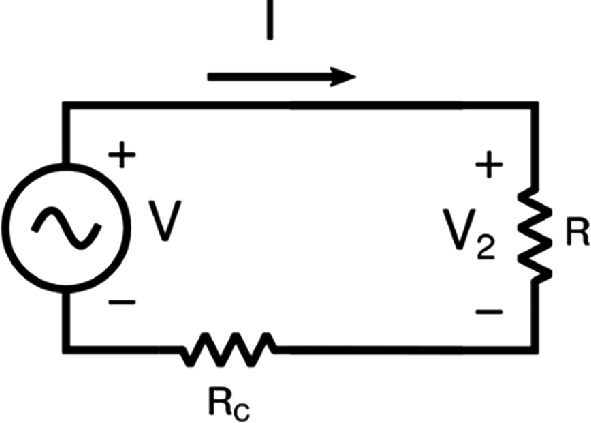
Fig. 4.3 Purely resistive circuit. Source Own elaboration
Only by dividing the instantaneous value of the voltage by the value of the resistance (Z=R), we get the instantaneous value of the electric current (Eq. 4.3). If we replace u with the sine function, we get:
(4.3)
Obviously, if the instantaneous voltage value equals the maximum value U₀, the result of dividing it by the resistance is the current I₀:
(4.4)
As a result, we express the instantaneous value of the current i, as:
(4.5)
We can plot the phasor diagram of voltage (U) and current (I) (Fig. 4.4). We graph these quantities as two vectors rotating at speed ω, counterclockwise. The Y-axis projection of voltage and current waves corresponds to the instantaneous values of current and voltage.
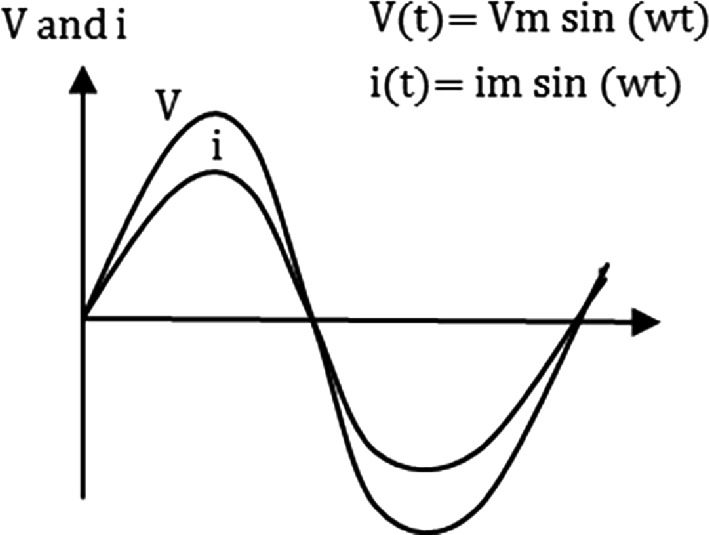
Fig. 4.4 Voltage and current waves in a resistive circuit. Source Own elaboration
As a result, it is possible to conclude that the current oscillates in tandem with the applied voltage. Specifically, the voltage and current fluctuate simultaneously (although with distinct amplitudes), resulting in a phase relationship between them (Fig. 4.5).
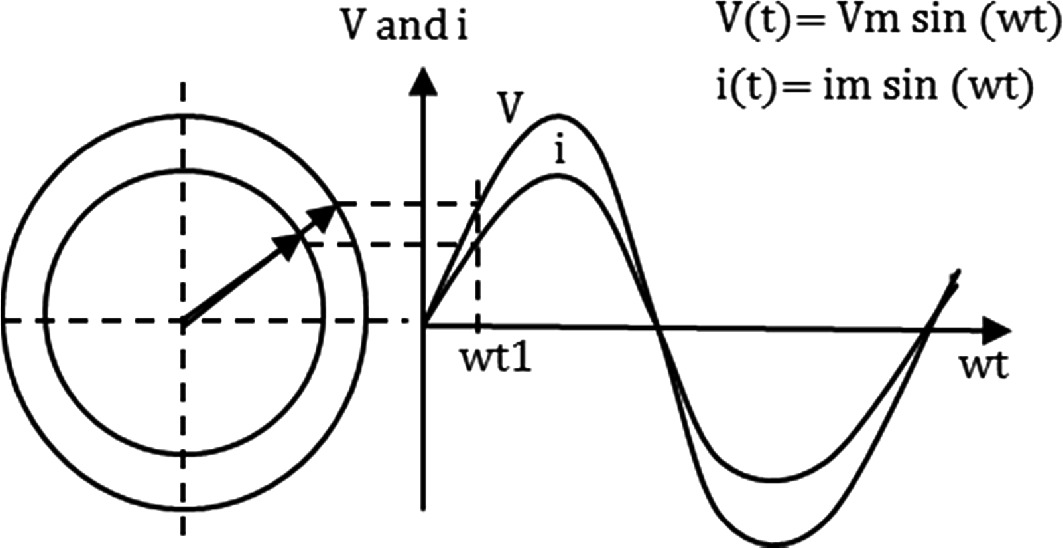
Fig. 4.5 Voltage and current Phasors. Source Own elaboration
For practical calculations, it is crucial to use the effective values of voltage and current, known as U and I. The rms values are proportional to the maximum values of current and voltage by √2, and we express it as
(4.6)
(4.7)
Substituting Eqs. 4.6 and 4.7 into 4.2 yields:
(4.8)
This brings us to Ohm's law:
(4.9)
When we have a circuit where a current with a rms value, I passes through a pure ohmic resistor, a voltage drop occurs. Then, we know it as the "resistance drop or active voltage drop", which is expressed as follows by Ohm's law (Eq. 4.10):
(4.10)
练习题
A sinusoidal voltage source with maximum value V is applied to a purely resistive circuit with . What is the maximum current in the circuit?
In a purely resistive AC circuit, what is the phase relationship between the voltage and the current?
If the RMS voltage in a resistive AC circuit is V, what is the maximum (peak) voltage ?
Which of the following statements correctly describe the phasor representation of voltage and current in a purely resistive AC circuit?
Select all characteristics that apply to a purely resistive AC circuit.
In a purely resistive AC circuit, the impedance Z is equal to the resistance R.
When a sinusoidal voltage is applied to a resistor, the resulting current generates heat due to the Joule effect.
In a purely resistive AC circuit, the current reaches its maximum value before the voltage reaches its maximum value.
The instantaneous current in a purely resistive AC circuit can be expressed as , where is the ___ and is the angular frequency.
Explain why the phase relationship between voltage and current in a purely resistive AC circuit differs from what occurs in a circuit containing an inductor.
In an AC circuit, Ohm's law is expressed as . For a purely resistive circuit with an RMS voltage of 230 V and a resistance of 46 Ω, what is the RMS current?
In a purely resistive AC circuit, the voltage and current are in phase because resistors do not produce self-induced EMF that opposes current changes, unlike inductors which generate a voltage proportional to .
While passive elements behave differently in DC and AC circuits, a purely resistive circuit maintains the same relationship between voltage and current in both cases. Specifically, the impedance Z equals ___ in a purely resistive AC circuit.
Which of the following statements correctly compare the behavior of resistors in DC and AC circuits? Select all that apply.
登录后解锁笔记、知识点解析、AI 问答
立即登录