正在学习
10.5 No-load Synchronous Generator
10.5 No-load Synchronous Generator
It is useful to distinguish between no-load and load scenarios when we analyze the voltage that the synchronous generator generates. A synchronous generator is in a no-load condition when its armature winding is disconnected. We see the functional diagram of a q-phase and no-loaded generator (Fig. 10.28).
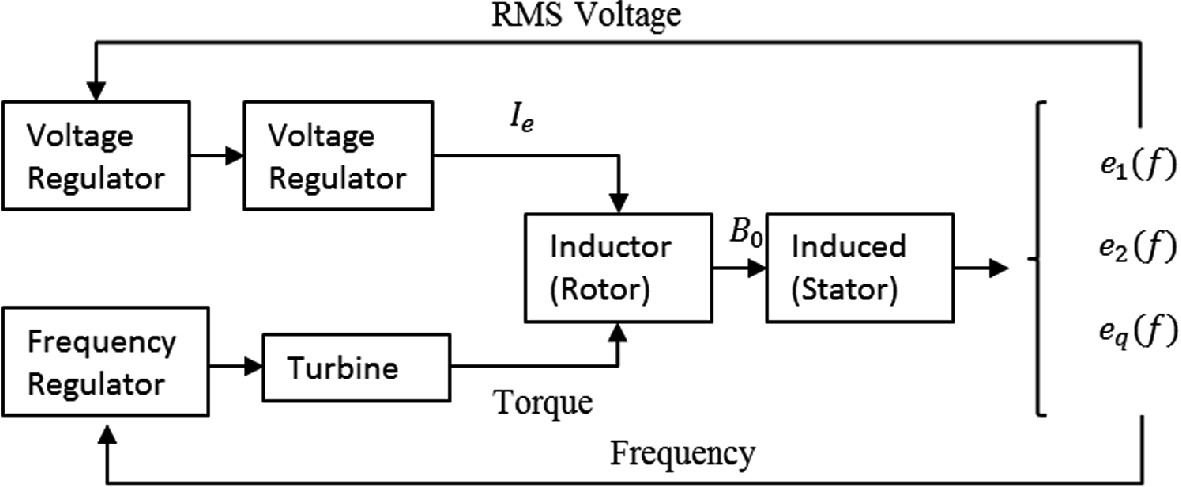 , , and . A frequency regulator connects to a turbine, influencing the inductor with torque and frequency. The system is controlled by RMS voltage and current , with a magnetic field between the rotor and stator.">
Fig. 10.28 Functional diagram of a q-phase no-load alternator.
Under these conditions, the magnetomotive force (Fmme) appears only because of the direct current (Ie) circulating through the inductor. This excitation generates flux circulation in the magnetic circuit of the synchronous machine and produces voltage e (t) in the stator's armature winding. Assuming the inductor generates a sinusoidal induction wave, the voltage in the armature winding is also sinusoidal. As previously mentioned, the frequency of the induced voltage is:
f=p·n60 (10.14)
The following expression provides the rms value of the induced no-load voltage e (t):
E0=4,44·N·Φ0·f (10.15)
It is important to note that, due to the absence of currents in the armature, the voltage is the same that the phase voltage (V) at the generator terminals.
练习题
A synchronous generator is considered to be in a no-load condition when:
A 4-pole synchronous generator rotates at 1800 rpm. What is the frequency of the induced voltage?
A 3-phase synchronous generator has 100 turns per phase, a flux per pole of 0.05 Wb, and operates at 50 Hz. What is the RMS value of the induced no-load voltage per phase?
In a no-load synchronous generator, which of the following statements are true about the magnetomotive force and voltage generation?
In a no-load synchronous generator, the terminal phase voltage equals the induced voltage because there are no currents in the armature windings.
In a no-load synchronous generator, the magnetomotive force is produced by both the excitation current in the rotor and the armature current in the stator.
If the inductor of a synchronous generator produces a sinusoidal induction wave, the resulting voltage in the armature winding will also be sinusoidal.
The RMS value of the induced no-load voltage in a synchronous generator is given by the formula: ___
The frequency of the induced voltage in a synchronous generator is calculated using the formula: ___ , where is the number of poles and is the rotational speed in rpm.
Explain why the terminal phase voltage of a no-load synchronous generator equals the induced voltage .
Describe how the rotating magnetic field in a synchronous generator induces an EMF in the stator windings, and state the formula for the RMS value of this induced voltage.
A 4-pole synchronous generator operates at no-load condition with a rotor speed of 1800 rpm. According to the frequency equation and the principle that each turn guarantees a complete emf cycle, what is the frequency of the induced voltage in the stator winding?
A synchronous generator operates under no-load conditions. Which of the following statements correctly describe the relationship between the excitation system and the induced voltage? Select all that apply.
The equation for the RMS no-load voltage of a synchronous generator is derived from the same fundamental principles as the RMS emf equation for N turns of a rotating loop, where represents the maximum flux embraced by each loop.
In a synchronous generator, the inductor is located on the ___ and the armature winding is located on the ___. Under no-load conditions, when the armature winding is disconnected, the magnetomotive force is produced only by the direct current circulating through the inductor.
Explain why the terminal phase voltage of a synchronous generator under no-load conditions equals the induced voltage , and describe how the sinusoidal nature of the induced voltage is achieved through the interaction between the rotor and stator.
登录后解锁笔记、知识点解析、AI 问答
立即登录