正在学习
8.3 Delta-Balanced Load
8.3 Delta-Balanced Load
When we have delta-connected loads (Fig. 8.3), they undergo both of the respective compound voltages. The current flows through every load.
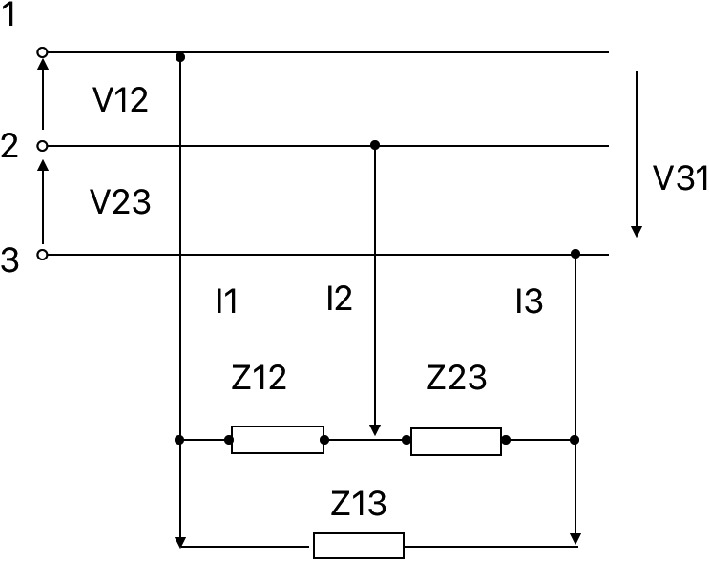
Fig. 8.3 Balanced load in delta. Source own elaboration
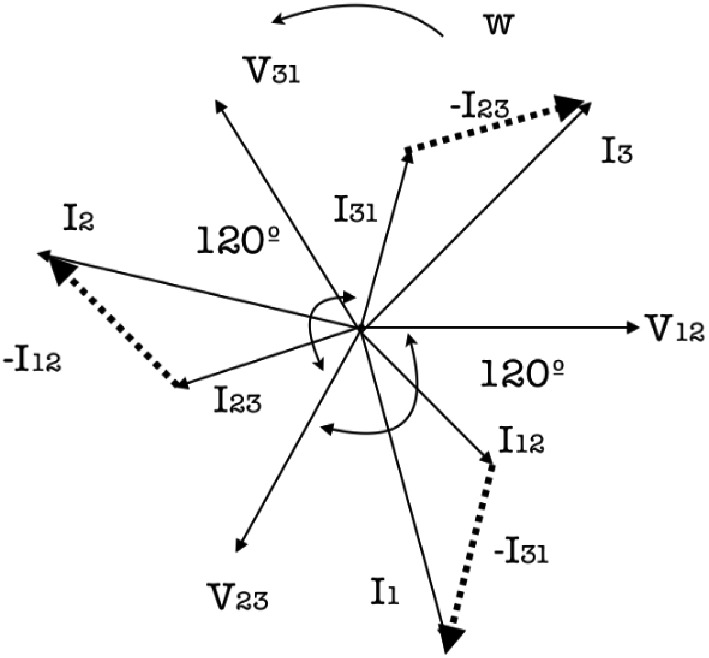 , , , , , , , , , and their negative counterparts. The vectors are spaced at 120 degrees apart, indicating phase differences. The diagram includes rotational direction marked by .">
Fig. 8.4 Phasor diagram with compound voltages. Source own elaboration
We call , , e , phase currents ().
Since this is a balanced system, we can write:
Z₁₂∠φ₁₂ = Z₂₃∠φ₂₃ = Z₃₁∠φ₃₁
Recalling Ohm's law for a balanced system we have:
Ī₁₂ = Ū₁₂ / Z₁₂∠φ₁₂ (8.18)
Ī₂₃ = Ū₂₃ / Z₂₃∠φ₂₃ (8.19)
Ī₃₁ = Ū₃₁ / Z₃₁∠φ₃₁ (8.20)
Keep in mind that because the compound voltages are 120° out of phase with one another, the currents will be at an angle of φ to each of the corresponding compound voltages and will also be 120° out of phase with one another. Since the voltage that we apply and the impedances have the same modular value, the currents will likewise be the same.
I₁₂ = I₂₃ = I₃₁ = I_f (8.21)
Then, three additional currents, I₁, I₂ and I₃ appear in the supply line to the loads. We call these currents as line currents (IL). For every node that appear in the delta load connections, we apply Kirchhoff's first to determine the correlation between these line currents and phase currents.
Node 1: Ī₁ = Ī₁₂ - Ī₃₁ (8.22)
Node 2: Ī₂ = Ī₂₃ - Ī₁₂ (8.23)
Node 3: Ī₃ = Ī₃₁ - Ī₂₃ (8.24)
Now, we draw a vector diagram with the compound voltages set at 120º intervals from each other (Fig. 8.4).
Assuming that the loads are inductive, we draw the phase currents lagging each of their respective compound voltages by an angle φ. If we draw the line currents by performing vector sum operations of their corresponding phase currents (refer to the relationships obtained above) we obtain:
Node 2: Ī₂ = Ī₂₃ - Ī₁₂ (8.25)
Node 3: Ī₃ = Ī₃₁ - Ī₂₃ (8.26)
Then, we have the line current vector diagram (Fig. 8.5). It shows the sum of −Ī₁₂ and −Ī₂₁.
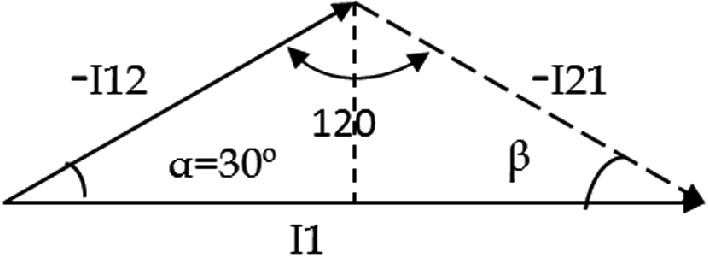
Fig. 8.5 Vector diagram with line currents.
We see that there exists a 30º angle between the phase and line currents.
An isosceles triangle appears where it is satisfied that:
α = β (8.27)
Using simple trigonometric, we have that:
180° = α + β + 120° (8.28)
This implies:
α = 30° (8.29)
Only by applying basic trigonometry we determine the relationship between phase currents and line currents (Fig. 8.5).
cos 30° = I₁ / 2I₁₂ → I₁ = 2·I₁₂·cos 30° (8.30)
I₁ = 2·I₁₂ · √3/2 = I₁₂·√3 (8.31)
Then, we conclude that:
IL = √3·If (8.32)
The line currents have the same modulus value and lag 120° with one another. They are √3 higher than the phase currents.
练习题
In a balanced delta-connected load, what is the relationship between line current () and phase current ()?
What is the phase angle difference between the line currents and phase currents in a balanced delta-connected load?
In a delta-connected load, which currents are classified as phase currents ()?
Which of the following statements are true for a balanced delta-connected load?
In a delta-connected load, each load element receives the compound (line-to-line) voltage.
In a delta-connected load, the relationship is obtained by applying Kirchhoff's current law at node 1.
In a delta-connected load with inductive loads, the phase currents lead their respective compound voltages by angle .
In a balanced delta-connected load, the line current magnitude is ___ times the phase current magnitude.
Using trigonometry, explain why the line current in a balanced delta-connected load is times the phase current.
In which three-phase load configuration does each load element receive the compound (line-to-line) voltage directly?
Which of the following correctly describe the relationships at the nodes of a balanced delta-connected load?
A balanced delta-connected load has phase currents of 10 A each. Calculate the magnitude of the line currents and explain the relationship between the two.
In a balanced three-phase system, how does the relationship between line current () and phase current () differ between star-connected and delta-connected loads?
Which of the following statements are true for both balanced star-connected and balanced delta-connected loads?
In a balanced delta-connected load, Ohm's law is applied using the ___ voltage across each impedance, whereas in a star-connected load, Ohm's law uses the phase-to-neutral voltage.
A balanced delta-connected load has phase currents of 10 A magnitude. If the compound voltage is 400 V and the power factor is 0.8 lagging, calculate the three-phase active power using the formula .
In a balanced delta-connected load, the line currents lag their respective phase currents by 30°, while in a balanced star-connected load, the line currents are in phase with their respective phase currents.
登录后解锁笔记、知识点解析、AI 问答
立即登录