正在学习
8.2 Star-Balanced Load
8.2 Star-Balanced Load
Now on, we analyze a three-phase voltage system with three star-connected loads (Fig. 8.1). Taking into account that it is a balanced nature system.
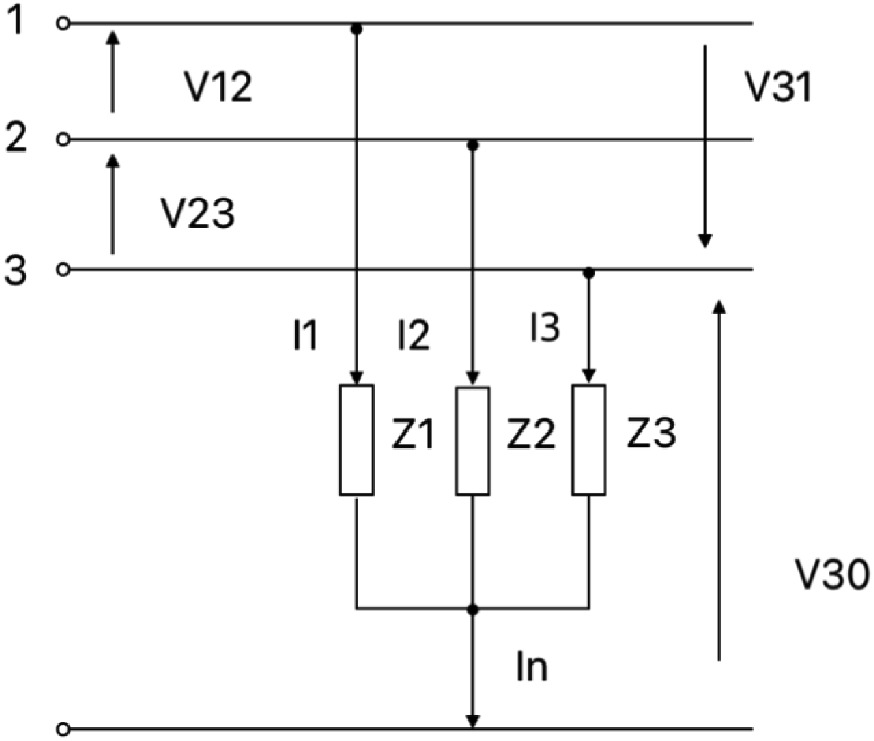
Fig. 8.1 Star balanced load. Source own elaboration
Then, we write for each of the loads:
Applying Ohm's law to each of these loads, we find the currents flowing through each phase:
Since the voltage is 120° out of phase, the system of currents is also 120° out of phase with each other, and has an angle φ regarding to each of their corresponding voltage. Since the impedance in the line and the applied voltage are equal, so does the current.
As we see in the vector diagram Fig. 8.4, it satisfies the following condition:
Question Under these circumstances, is it possible to eliminate the neutral conductor? If this is the case, it is possible to create an artificial neutral at the most common point of the star-connected loads, which makes it possible to maintain a single voltage between the phases and the neutral without using the neutral conductor. It is important to keep in mind that this is only possible in balanced load scenarios.
练习题
In a balanced star-connected three-phase load, which condition must be satisfied by the impedances?
In a balanced star-connected load, if the phase voltages are 120° apart, what is the phase relationship between the phase currents?
Under what condition can the neutral conductor be safely eliminated in a star-connected three-phase system?
Which of the following statements are true for a balanced star-connected three-phase load?
In a balanced star-connected load, the vector sum of all three phase currents equals zero.
An artificial neutral point can be created at the common junction of star-connected loads even when the load is unbalanced.
In a balanced three-phase star-connected system, each phase current lags or leads its corresponding phase voltage by the same angle .
In a balanced star-connected load, the phase currents have equal magnitudes expressed as: I_1 = I_2 = I_3 = ___
The neutral current in a balanced star-connected load is given by the equation: \vec{I_1} + \vec{I_2} + \vec{I_3} = \vec{I_N} = ___
Explain why the neutral conductor can be eliminated in a balanced star-connected three-phase load, and describe what happens at the common junction point of the three loads.
In a balanced star-connected three-phase load, if each phase impedance is and the phase voltage is , which statement correctly describes the relationship between line current and phase current?
A three-phase motor connected in star configuration requires a neutral conductor to maintain proper operation because the phase currents are 120° out of phase with each other.
Which of the following conditions must be satisfied for a neutral conductor to be safely eliminated in a three-phase star-connected system?
In a star-connected three-phase system, the line current equals the ___ current. When the load is balanced, the neutral current equals ___, which allows the neutral conductor to be eliminated.
登录后解锁笔记、知识点解析、AI 问答
立即登录