正在学习
7.3 Losses in Power Transformers
7.3 Losses in Power Transformers
The heat sources of a power transformer include transformer losses, hysteresis losses, and eddy current losses. Transformer no-load losses include hysteresis losses, which depend on re-magnetization factors such as quality, frequency, and flux density.
Eddy current losses, which depend on thickness, resistivity, frequency, and flux density, also contribute to transformer losses and can be represented (Fig. 7.5).
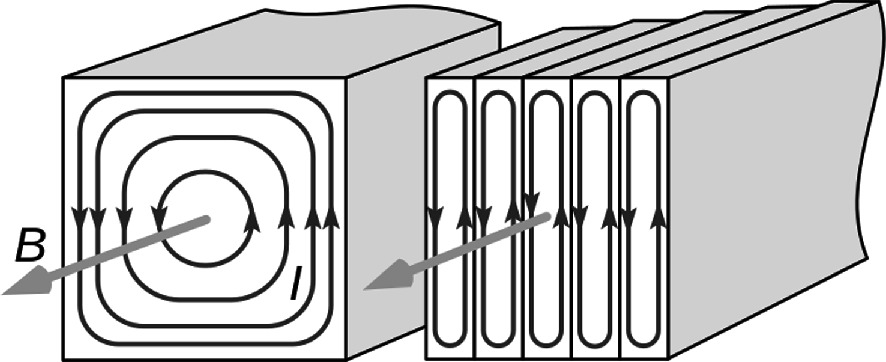
Fig. 7.5 Eddy current losses.
When the power transformer operates under load, it experiences several losses, including the i2r loss and the eddy current loss. The eddy current loss is a phenomenon that arises from metallic components that are under the flux that generates the load current in the windings and leads. The evacuation process entails circulating coolant (mineral oil) over the surface of the tank or vat, with some instances cooling fins and/or fans to enhance air circulation and facilitate heat dissipation.
练习题
Which of the following correctly lists the heat sources in a power transformer?
Eddy current losses in a power transformer depend on which of the following factors?
Which of the following factors affect hysteresis losses in a power transformer? Select all that apply.
When a power transformer operates under load, which of the following losses does it experience?
Hysteresis losses in a transformer are classified as no-load losses because they depend on re-magnetization factors such as quality, frequency, and flux density.
Eddy current loss under load conditions arises from metallic components that are under the flux generating the load current in the windings and leads.
The cooling system in a power transformer uses water as the primary coolant to dissipate heat from the tank surface.
The heat evacuation process in a power transformer entails circulating ___ (mineral oil) over the surface of the tank or vat.
Transformer no-load losses include ___ losses, which depend on re-magnetization factors such as quality, frequency, and flux density.
Explain why a power transformer requires a cooling system and describe how mineral oil facilitates heat dissipation.
The cooling system of a power transformer circulates mineral oil over the tank surface, sometimes with cooling fins and fans to enhance heat dissipation. This cooling is necessary because the transformer generates heat primarily from:
Eddy current losses in a power transformer arise from metallic components under the flux that generates load current in the windings and leads, and these metallic components are part of the active parts (magnetic and electric circuits) responsible for energy transmission.
Hysteresis losses, which depend on re-magnetization factors such as quality, frequency, and flux density, occur primarily in the ___ of the transformer, which consists of yokes connected by limbs.
Which of the following statements correctly describe losses in power transformers? (Select all that apply)
登录后解锁笔记、知识点解析、AI 问答
立即登录