正在学习
6.7 Generation of Magnetic Fields
6.7 Generation of Magnetic Fields
Magnetic fields usually appear from wire current, wire loop current, solenoid current, and earth current (Fig. 6.14).
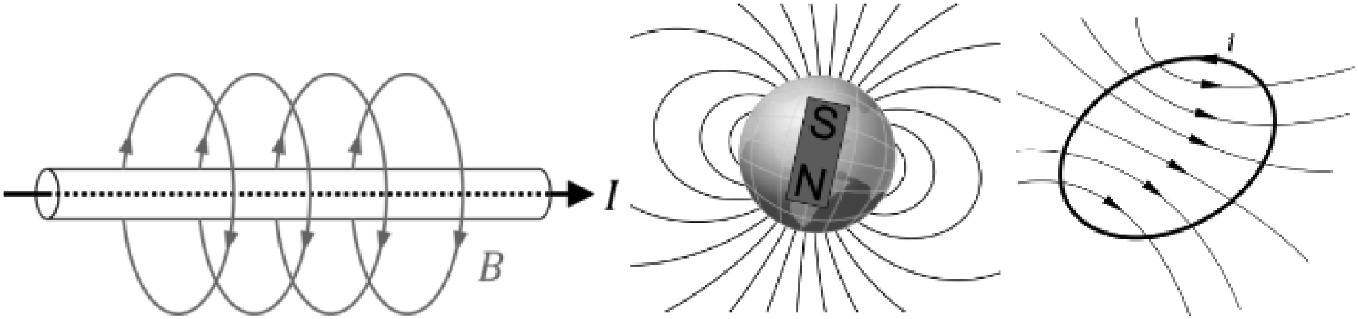 generates a magnetic field depicted by circular lines. In the center, a bar magnet labeled with poles and shows magnetic field lines emanating from the north pole and curving back to the south pole. On the right, an elliptical shape with arrows indicates the direction of the magnetic field lines.">
Fig. 6.14 Sources of magnetic fields: wire, earth, current.
There is always a magnetic field surrounding any moving electric charge. In some ways, this field is like the gravitational field. We define them as a way of acting on a charge or a body in space. We represent the magnetic field with force lines. These lines always flow from the North Pole to the South Pole outside of the magnet and from the South Pole to the North Pole inside (Fig. 6.15).
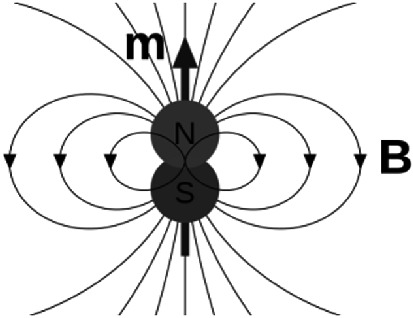
Fig. 6.15 Magnetic field lines of force.
Natural magnets or electromagnets generate magnetic fields. A natural magnet is an object that is surrounded by a magnetic field and that has the property of attracting iron, steel and, to a lesser extent, some other bodies. Strong shocks or a rise in temperature diminish these magnetic properties, which we see in natural magnets. Sometimes, they even vanish over time.
As a result, they are not very flexible when it comes to fitting the intended performance. For this reason, the magnetic fields that natural magnets generate lack the level of controllability that industrial applications often require. As a result, we do not commonly use them to generate the magnetic fields that electrical machines need for operation, except in some special applications. In an electromagnet, we have a set of sheets of magnetic material where a conductor is wound to form a coil of N loops (Fig. 6.16). An electric current passing through a winding produces an electromagnet.
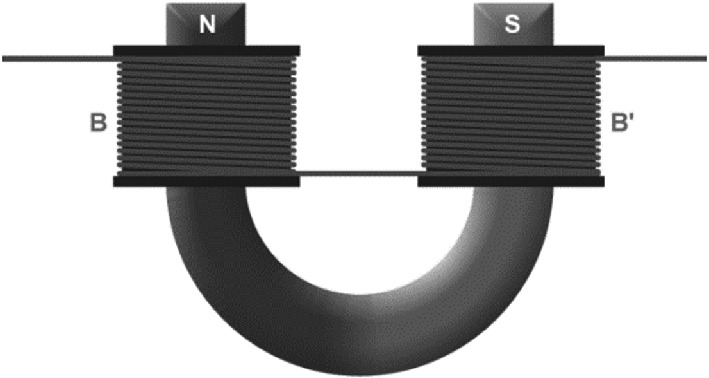
Fig. 6.16 Electromagnet.
The current flowing through the coils creates an electromagnet whose magnetic characteristics depend on the current flowing through its coils. This gives electromagnets a high controllability. This is due to the fact that controlling the current is adequate to control the properties of the magnetic field the electromagnet produces on demand. Right hand rule shows the positions of the North Pole and the South Pole for the direction of current flow (Fig. 6.17).
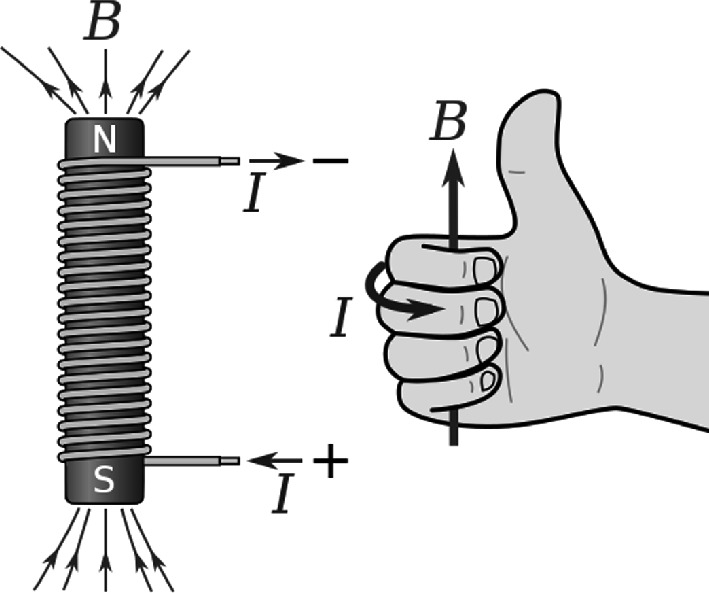
Fig. 6.17 Magnetic field created by the electromagnet.
We hold an electromagnet in the right hand, with your thumb extended and the tips of the other four fingers pointing in the direction of the current flowing through the wires. Now, the tip of the thumb indicates the direction of the magnetic lines of force. These lines of force also show the North Pole's position. This is because the lines of force go out at the North Pole and come in at the South Pole. This is the right-hand rule. Remember that changing the direction of current flow also changes the pole's position. Consequently, when we excite the electromagnet with direct current, the position of the poles remains constant in time.
Conversely, when an alternating current excites an electromagnet, the poles' positions shift each time the current's direction changes. Naturally, winding the conductor in the opposite direction on the magnetic material can also reverse the poles' position for the same direction of current flow through the wire.
Stated differently, the construction of the electromagnet involves reversing the direction of rotation of the coils. Designed by Belgian inventor Zénobe Gramme in 1871, a Gramme machine was used to generate power (Fig. 6.18). His innovation was to use many armature windings wound on a doughnut-shaped armature and switched with many segmented commutators to smooth the output waveform, generating constant DC power.
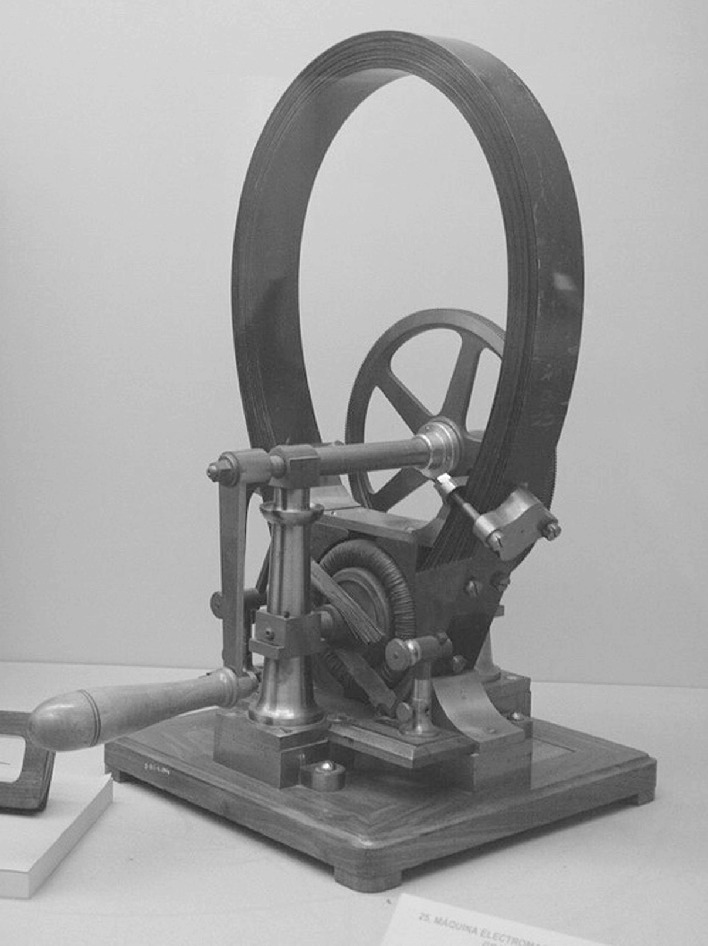
Fig. 6.18 Gramme machine. Source From wikicommons under free to use license [17]
In conclusion, because of their controllability, electromagnets are the means by which electrical machines create the magnetic field that they need for their operation.
练习题
Which of the following is NOT mentioned as a common source of magnetic fields in the text?
According to the right-hand rule for an electromagnet, if you grasp a coil with your right hand such that your fingers point in the direction of conventional current flow through the windings, what does your extended thumb indicate?
What is the primary reason electromagnets are preferred over natural magnets for electrical machine applications?
Which of the following factors can diminish or cause the magnetic properties of natural magnets to vanish? Select all that apply.
Which of the following can change the position of the North and South poles in an electromagnet? Select all that apply.
There is always a magnetic field surrounding any stationary electric charge.
Magnetic field lines flow from the South Pole to the North Pole outside of a magnet.
When an electromagnet is excited with direct current (DC), the positions of the magnetic poles remain constant over time.
According to the right-hand rule, when you hold an electromagnet with your right hand such that your curled fingers point in the direction of current flow, your extended thumb points in the direction of the ___ lines of force.
When an electromagnet is excited with ___ current, the poles' positions shift each time the current's direction changes.
Explain why electromagnets are the preferred choice for creating magnetic fields in electrical machines rather than natural magnets.
Describe how the magnetic field enables energy conversion in both generators and motors, and explain why electromagnets are essential for this process in rotating machines.
Why are electromagnets preferred over natural magnets for creating the magnetic fields needed in electrical machines like motors and generators?
Which of the following statements correctly describe the relationship between magnetic fields and energy conversion in rotating electrical machines?
When an electromagnet is excited with direct current, the position of the magnetic poles remains constant in time, which is suitable for DC machines, whereas alternating current causes the pole positions to shift each time the current direction changes.
Explain how the construction of an electromagnet (with a coil of loops wound on magnetic material) relates to its function in creating the magnetic field needed for a motor to convert electrical energy into mechanical energy.
In a generator, the rotor is turned by mechanical energy from a primary source, and the magnetic field created by an ___ makes it possible to convert this mechanical energy into electrical energy.
登录后解锁笔记、知识点解析、AI 问答
立即登录