正在学习
5.5 Power in RL Series Circuit
5.5 Power in RL Series Circuit
Question What do we mean by an RL circuit? When we refer to a circuit with R and L, it means that it can either be a circuit with these elements alone or one containing all three receiver components: C, R, and L. The latter implies that the voltage drop across the coil is greater than that across the capacitor, i.e., the inductive effect is more important than the capacitive effect. Both types of power appear in an R-L circuit.
We know that current delays φ degrees, so that:
u = 2·U·sin ωt (5.22)
i = 2·I·sin(ωt - φ) (5.23)
We have that the instantaneous power is:
p(t) = u(t)·i(t) = 2·U·I·sin ωt·sin(ωt - φ) = U·I·cos φ - U·I·cos(2ωt - φ) (5.24)
Recalling the trigonometric functions:
2 sin A cos B = sin(A + B) + sin(A - B)
2 cos A cos B = cos(A + B) + cos(A - B)
2 sin A sin B = cos(A - B) - cos(A + B)
We can build the power triangle of the power wave (Fig. 5.7). The mean value of power indicates the value of the active power:
P = 1/T ∫₀ᵀ p(t)·dt = U·I·cos φ (5.25)
Integrating this equation, we have two separate integrals:
P = 1/T ∫₀ᵀ [U·I·cos φ - U·I·cos(2ωt - φ)]·dt = 1/T ∫₀ᵀ U·I·cos φ dt - 1/T ∫₀ᵀ U·I·cos(2ωt - φ)·dt = I₁ - I₂
I₁ = 1/T ∫₀ᵀ U·I·cos φ dt = 1/T·U·I·cos φ·∫₀ᵀ dt = 1/T·U·I·cos φ·(T - 0)
I₂ = 1/T ∫₀ᵀ U·I·cos(2ωt - φ)·dt = 1/T·U·I·(1/2ω)·sin(2ωt - φ)|₀ᵀ = 1/T·U·I·(1/2ω)·[sin(2ωt - φ)]₀ᵀ = 1/T·U·I·(1/2ω)·[sin(2ωt - φ) - sin(0 - φ)] = 1/T·U·I·(1/2ω)·[sin(2ωt - φ) - sin(-φ)] = 0
We know that:
sin 2ωt = 0 → sin(2ωt - φ) = sin(-φ)
P = I₁ - I₂ = U·I·cos φ - 0
According to these equations, we can plot the vector diagram of the R-L series circuit (Fig. 5.6).
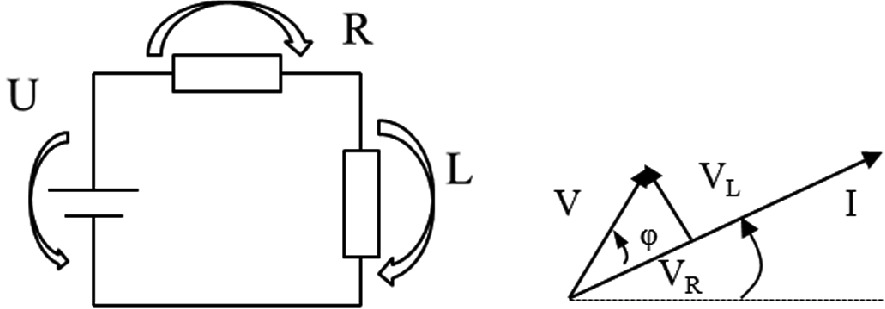
Fig. 5.6 Vector diagram of a R-L Circuit.
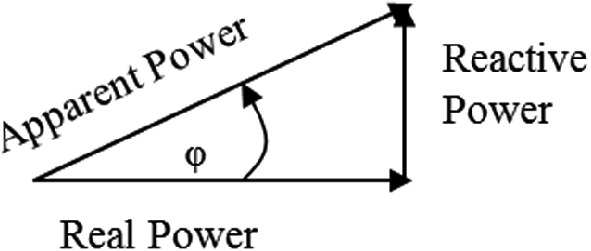
Fig. 5.7 Power-triangle in a R-L circuit.
Applying Kirchhoff second law to the circuit, we have that Fig. 5.6.
Ũ = ŨR + ŨL (5.26)
We get the power triangle by multiplying the voltage and current in the vector diagram (Fig.
练习题
In a pure inductive circuit, the average active power is zero because the inductor only stores and releases energy without dissipating it. However, in an RL series circuit, the active power is given by . What is the fundamental reason that an RL circuit has non-zero active power?
In both a pure inductive circuit and an RL series circuit, the instantaneous power oscillates at twice the frequency of the voltage and current, and the oscillating component has an average value of zero over one complete cycle.
Which of the following statements correctly describe reactive power in AC circuits?
In a purely capacitive circuit, current ___ voltage by radians, whereas in an RL series circuit, current lags voltage by an angle .
登录后解锁笔记、知识点解析、AI 问答
立即登录