正在学习
5.2 Power in a Purely Resistive Circuit
5.2 Power in a Purely Resistive Circuit
In AC circuits, we use the instantaneous values of voltage and current to find the instantaneous power. To better understand this concept, we plot curves based on the instantaneous power of receivers. As in DC circuits, we start by determining the current in the circuit. We will analyze the power in the resistive circuit (Fig. 5.1).
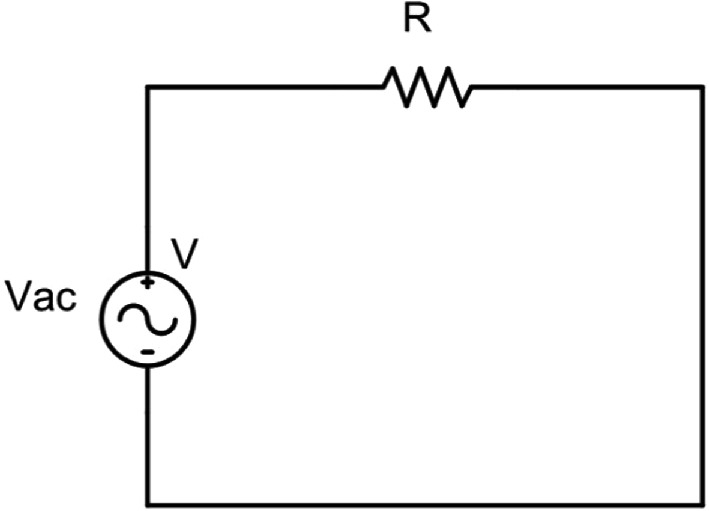
Fig. 5.1 Purely resistive circuit with AC voltage source.
The value of instant current is:
i=I0·senωt (5.3)
In addition, the instantaneous voltage function has the same frequency:
u=U0·senωt (5.4)
We can also express these equations as:
i=2·I·senωt (5.5)
u=2·U·senωt (5.6)
In order to find the power, we have to multiply voltage and current. Now we plot the voltage wave as well the power waveform in a resistive load (Fig. 5.2). When the voltage is zero, the power is also zero. Otherwise, the power waveform is always positive, because the resistor can only dissipate energy, not supply energy to the circuit. The resistor outputs power regardless of whether the voltage is positive or negative.
![The image consists of two X-Y charts. The top chart displays a sinusoidal wave representing voltage over time, with the y-axis labeled "Voltage [V]" and the x-axis labeled "Time [s]." The bottom chart shows a corresponding power wave, with the y-axis labeled "Power [W]" and the same x-axis. Both charts have grid lines for reference, and the waves demonstrate periodic behavior over a time span from 0 to 1.5 seconds.](/uploads/courses/bk_0d5a371b8bffd7a1/images/epub-f02898fa4ec1.png)
Fig. 5.2 AC power to its real.
We get the instantaneous power curve multiplying the sine function of current i=2·I·senωt by the sine function of voltage u=2·V·senωt. As we see, this curve is always positive.
Question What does this curve show about resistance? This graph illustrates that the resistor absorbs energy from the generator and converts it into heat.
Question What does the average value of this curve represent? The mean value of this power is the active power (P) or real power, and we measure it with a wattmeter.
In a resistor we know that power is:
P=R·I2W (5.7)
In this case, the instantaneous power equals the product of instantaneous current and voltage. Multiplying, we get
pt=ut·it=2·V·senωt·2·I·senωt=2·U·I·sen2ωt=U·I·1-cos2ωt (5.8)
Applying trigonometric identities, we know:
sen2u=1-cos2u2
P=1T∫0Tp·dt=U·I (5.9)
Then, we obtain the average power integrating the power over one cycle and dividing by the cycle time.
P=1T∫0Tp·dt=U·I·1-cos2wt·dt=UIT∫0Tdt-U·I·∫0Tcos2wtdt=UITt0T-UI2wsen2wt0T=U·IT·T=U·I (5.10)
Remember:
∫cos2xdx=12sin2xintegratingparts (5.11)
∫cos2xdx=12∫cosudu∫cosudu=sinuu=2x→dudx=2→dx=12du=2x→dudx=2∫cos2xdx=12sinu
Therefore, the most significant measure is the active power, which comes from the effective values of U and I.
练习题
In a purely resistive AC circuit, why is the instantaneous power waveform always positive or zero?
What is the average power (active power) in a purely resistive AC circuit with effective voltage and effective current ?
The instantaneous power in a purely resistive AC circuit can be expressed as . What does this expression reveal about the power frequency?
Which of the following statements are true about power in a purely resistive AC circuit?
In a purely resistive AC circuit, the instantaneous voltage function has the same frequency as the instantaneous current function.
In AC circuits, the instantaneous power is found by multiplying the instantaneous voltage and instantaneous current.
A resistor in an AC circuit can supply energy back to the generator when the voltage is negative.
The mean value of power in a resistive AC circuit is called the ___ power or real power, and it is measured with a wattmeter.
In a resistor, power can be calculated using the formula , where is resistance and is the ___ value of current.
Explain why the power waveform in a purely resistive AC circuit is always positive or zero, and contrast this with the power behavior of coils and capacitors.
登录后解锁笔记、知识点解析、AI 问答
立即登录