正在学习
4.5 Faraday's Law
4.5 Faraday's Law
Faraday discovered that when a wire coil enters a magnetic field, it generates an emf. The induced current generates a magnetic field that counteracts the magnetic field buildup in the coil. This is expressed as:
Emf = NΔΦ/Δt (4.41)
where N is the number of loops, Φ = BA is the magnetic flux, B is the external magnetic field, and A is the surface of the loop.
The negative sign represents Lenz's Law within the context of electromagnetic induction. As well reviewed, emf refers to the electromotive force that appears. The current through the circuit generates a flux and flux linkage, resulting in an emf, according to Faraday's and Lenz's Laws (Fig. 4.15).
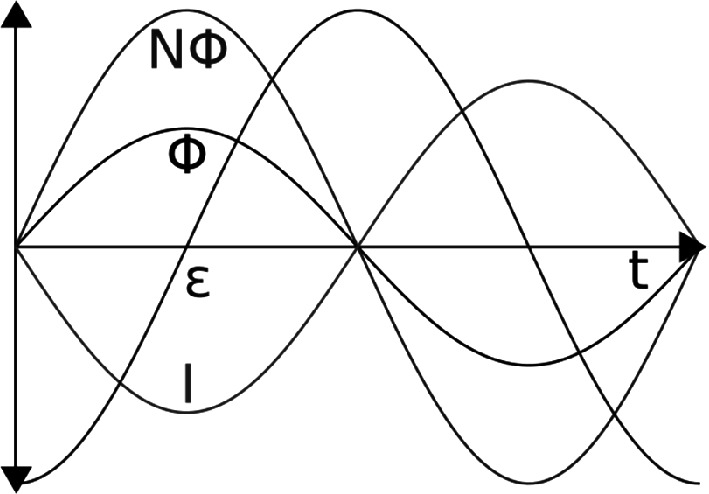
Fig. 4.15 Faraday's and Lenz's Law.
This creates a self-induced emf that, according to Lenz's law, opposes the action that caused it.
It resists changes in the current under all circumstances. According to Lenz's law, we can draw the relationship between current and induction in a coil (Fig. 4.16).
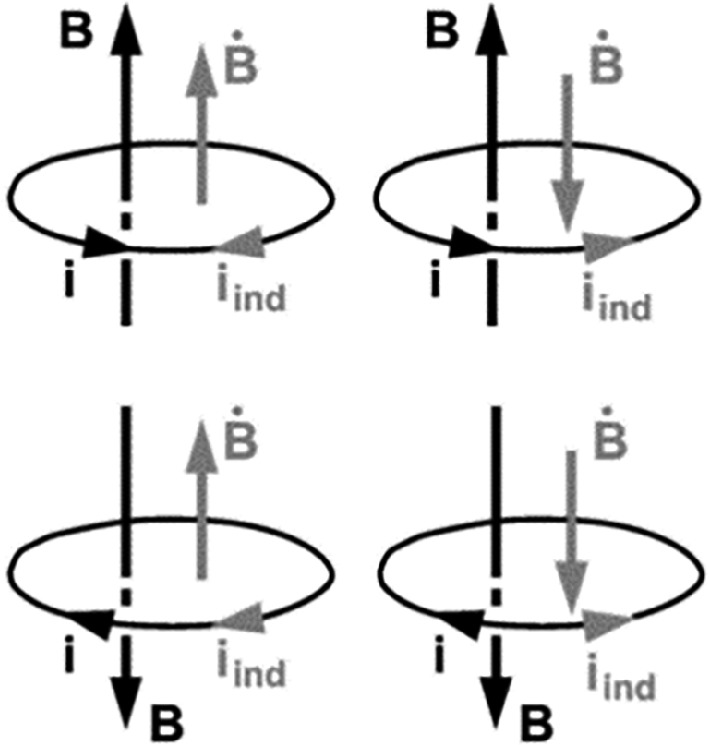 ). The top left loop shows an upward magnetic field and induced current. The top right loop shows a downward magnetic field and induced current. The bottom left loop has a downward magnetic field and induced current. The bottom right loop shows an upward magnetic field and induced current. Arrows indicate the direction of the magnetic field and induced current.">
Fig. 4.16 Induced current opposes primary current.
The magnetic field increases as the current increases. As a result, an opposing emf appears. This causes the electric current to lag behind the voltage. In this scenario, the coil absorbs energy in the form of an increasing magnetic field. Notice that, once the current has stabilized at its peak level through the coil, the self-induction emf is zero. However, as the current decreases, so does the field, resulting in a self-induction emf that resists the decreasing current.
Question What is the energy behavior of the coil during this phase?
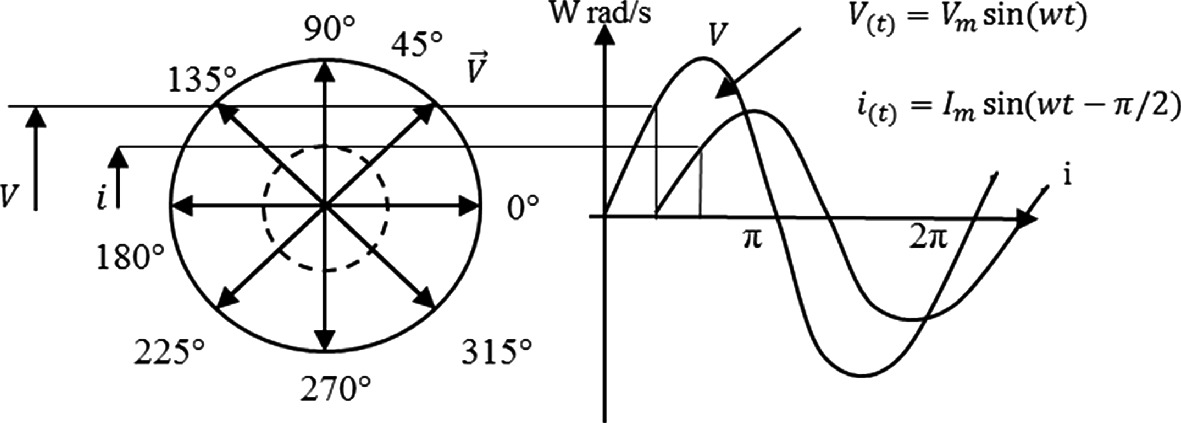
Now, the coil releases the energy it had stored in the previous quarter cycle to the generator as a diminishing magnetic field. This behavior differs from that of the capacitor, despite their similarities. Now, we plot the voltage and current waves travel in an inductive circuit (Fig. 4.17).
 and , illustrating voltage and current over time. The horizontal axis is marked with and key points at 0, , and .">
Fig. 4.17 Graph current opposes primary current.
We see in this vector diagram (Fig. 4.17) the electric current with a 90° delay with respect to the voltage. It is clear that as the current rise, the voltage reaches a peak, charging the coil.
What is the average power consumption value?
练习题
According to Faraday's Law, what is the correct expression for the induced emf in a coil with N loops?
A coil with 200 turns experiences a change in magnetic flux from 0.05 Wb to 0.02 Wb in 0.1 seconds. What is the magnitude of the induced emf?
In an inductive circuit, the current lags behind the voltage by what angle?
Which of the following statements correctly describe the energy behavior of a coil in an AC circuit?
According to Lenz's Law, which statements about the behavior of induced current are correct?
When the current through a coil has stabilized at its peak level, the self-induction emf is zero.
The induced current in a coil generates a magnetic field that reinforces the magnetic field buildup in the coil.
As the current through a coil decreases, the self-induction emf acts to further decrease the current.
The magnetic flux is defined as the product of the external magnetic field and the ___ of the loop.
In Faraday's Law equation , the negative sign that should appear represents ___ Law.
Explain why the current lags behind the voltage by 90° in a purely inductive circuit.
Describe what happens to the energy in a coil during one complete cycle of AC current, from when the current increases to when it decreases.
A coil with turns and inductance carries a time-varying current. According to Faraday's law, the induced emf is given by , while the self-induced emf formula states . What is the fundamental relationship between these two expressions?
In a purely inductive circuit, when the current reaches its peak value and stabilizes momentarily, the self-induced emf becomes zero because the rate of change of magnetic flux through the coil is zero at that instant.
Which of the following statements correctly explain why current lags voltage by 90° in a purely inductive circuit? Select all that apply.
In a purely inductive AC circuit, when the applied voltage follows , the current is given by . This phase relationship occurs because, according to Faraday's law, the self-induced emf ___ any change in current, causing the current to respond with a delay relative to the voltage.
登录后解锁笔记、知识点解析、AI 问答
立即登录