正在学习
4.1 Introduction. Ohm's Law in Steady State. Sinusoidal
4.1 Introduction. Ohm's Law in Steady State. Sinusoidal
Passive elements such as resistors, coils, and capacitors behave differently in direct current (DC) compared to alternating current (AC). The voltage sources that circuits can contain can be either direct or alternating sources (Fig. 4.1).
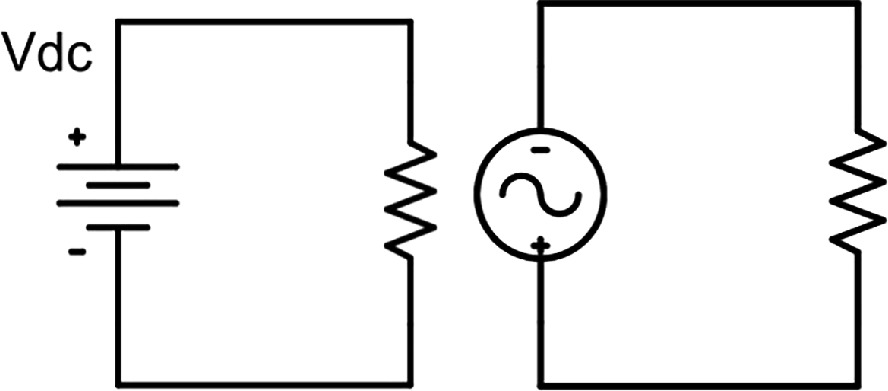
Fig. 4.1 Direct Current voltage source, and sinusoidal voltage source. Source Own elaboration
While in direct current the polarity remains constant in alternating current the polarity reverses at equal intervals of time. Because alternating current is variable, new phenomena will occur compared to direct current, particularly because of the use of coils and capacitors as receivers in circuits as we have seen in previous chapter. We can draw how a capacitor behaves in both alternating, and direct current (Fig. 4.2).
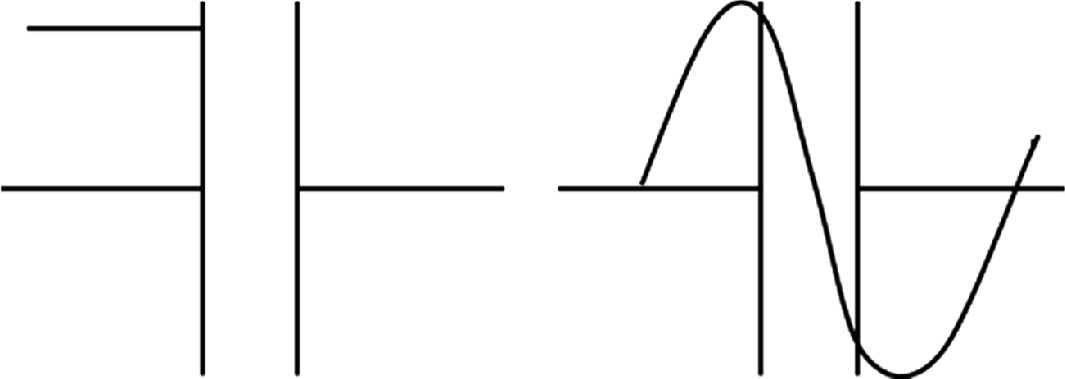
Fig. 4.2 Behavior of capacitors in DC and AC. Source Own elaboration
Question Why does a capacitor block DC but allow AC? We have to remember that the three passive elements (resistors, capacitors and coils) limit the current in a circuit, as described by Ohm's law for AC:
(4.1)
Although Ohm's law for alternating current (Eq. 4.1) use rms values, we can also use instantaneous values. Then, we have that:
(4.2)
Next, we look at how passive elements, resistors, coils and capacitors behave in alternating current.
练习题
Which statement correctly describes the polarity of direct current (DC)?
According to Ohm's law for alternating current using RMS values, what is the correct relationship between current , voltage , and impedance ?
Which three passive elements are studied for their behavior in alternating current circuits?
Which of the following statements correctly describe differences between direct current (DC) and alternating current (AC)?
The three passive elements (resistors, capacitors, and coils) limit the current in a circuit, as described by Ohm's law for AC.
New phenomena occur in alternating current circuits compared to direct current, particularly because of the use of coils and capacitors as receivers.
Ohm's law for alternating current can only be expressed using RMS values, not instantaneous values.
According to Ohm's law for AC using RMS values, the current equals voltage divided by ___
In alternating current, the polarity ___ at equal intervals of time, unlike direct current where polarity remains constant.
Explain why a capacitor blocks direct current (DC) but allows alternating current (AC) to pass through. Consider the transient behavior of capacitors in your explanation.
In a DC circuit, after the transient period has passed, a coil (inductor) behaves essentially as which of the following? How does this compare to its behavior in an AC circuit?
The self-induced EMF formula explains why an inductor presents impedance to AC current but behaves like a simple resistor (its internal resistance) in steady-state DC circuits.
Ohm's law for AC circuits is expressed as , where impedance is used instead of simple resistance . Which statement best explains why this modification is necessary?
Explain why studying the transient behavior of an inductor in a DC circuit (from the previous chapter) provides insight into how inductors operate in AC circuits.
登录后解锁笔记、知识点解析、AI 问答
立即登录