正在学习
3.6 Energy Stored by a Capacitor
3.6 Energy Stored by a Capacitor
Unlike a resistor, a capacitor stores energy rather than dissipates it. Recalling the equation of the capacitor action, we define the energy storage process as:
(3.14)
(3.15)
The process of energy storage in a capacitor follows a linear process (Fig. 3.16).
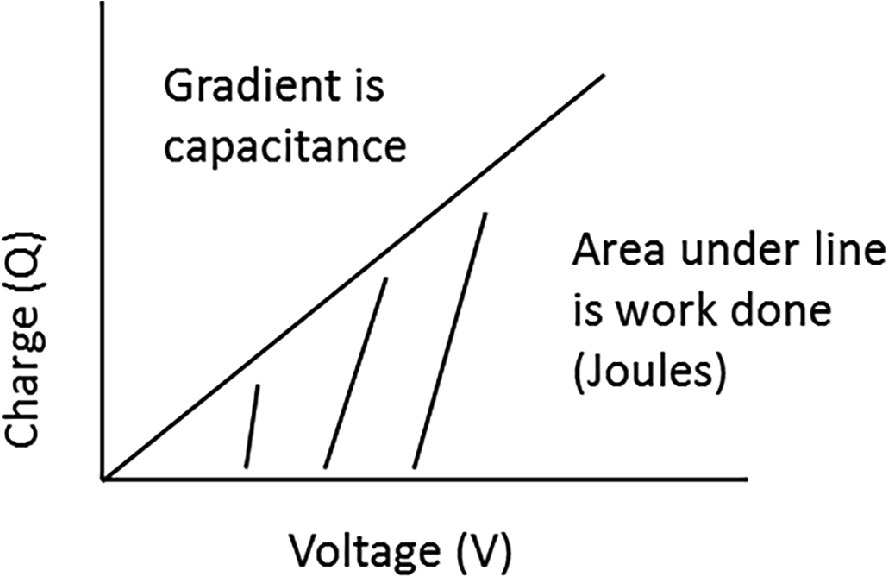
Fig. 3.16 Energy stored in a capacitor. Source Own elaboration
练习题
A capacitor with capacitance is charged to a voltage of . How much energy is stored in the capacitor?
A.
B.
C.
D.
What is the fundamental difference between a resistor and a capacitor in terms of energy handling?
A. Both components store energy equally well.
B. A resistor stores energy while a capacitor dissipates it.
C. A capacitor stores energy while a resistor dissipates it.
D. Neither component interacts with electrical energy.
The power relation for a capacitor is given by . If the voltage across a capacitor is increasing at a rate of when , what is the instantaneous power being stored?
A.
B.
C.
D.
Which of the following statements about energy storage in a capacitor are correct?
A. The energy storage process in a capacitor follows a linear process.
B. A capacitor dissipates energy as heat like a resistor.
C. The energy stored depends on both the capacitance and the square of the voltage.
D. The work done to charge a capacitor equals the area under the charge-voltage curve.
In the charge-voltage relationship graph for a capacitor, the gradient (slope) of the line represents the capacitance value.
The energy stored in a capacitor is directly proportional to the voltage across it (i.e., ).
The work done in charging a capacitor is represented by the area under the charge-voltage curve and is measured in joules.
The formula for the energy stored in a capacitor is ___ .
Using the relationship and the fact that the energy stored equals the area under the charge-voltage curve, explain why the energy formula contains a factor of .
A capacitor stores energy as voltage by accumulating charge between its plates. If the voltage across a capacitor doubles while the capacitance remains constant, how does the stored energy change? Explain your reasoning.
A capacitor with capacitance is charged to a voltage of . Using the relationship and the energy formula , what is the energy stored in the capacitor and the charge stored on its plates?
A. Energy = , Charge =
B. Energy = , Charge =
C. Energy = , Charge =
D. Energy = , Charge =
Which of the following statements correctly describe the relationship between the charge-voltage characteristic and energy storage in a capacitor? Select all that apply.
A. The gradient of the Q-V line represents capacitance.
B. The area under the Q-V line represents the work done in charging the capacitor.
C. The energy stored can be expressed as .
D. The Q-V relationship is linear for an ideal capacitor.
E. The energy stored is proportional to the square of the voltage.
In an R-C circuit, when a capacitor is fully charged, the potential difference across the capacitor equals that of the source, and the energy stored is given by . If the capacitor has and the source voltage is , the maximum energy stored is ___ J.
When a capacitor discharges through a resistor in an R-C circuit, the energy stored in the capacitor decreases as the voltage decreases according to , where the voltage follows the discharge equation .
Explain why a capacitor stores energy rather than dissipates it like a resistor, and describe what happens to this stored energy when the capacitor discharges through a resistor.
登录后解锁笔记、知识点解析、AI 问答
立即登录