正在学习
3.5 Capacitor Behavior
3.5 Capacitor Behavior
This section reviews the charging progress of a capacitor connected in series to a resistor in a closed circuit. We call this an R–C circuit because it includes a resistor and a capacitor (Fig. 3.15). Closing switch S results in a zero potential difference across the capacitor and the resistor immediately sees the generator voltage. Then, the capacitor starts charging and distributes voltage between both elements for a period of time.
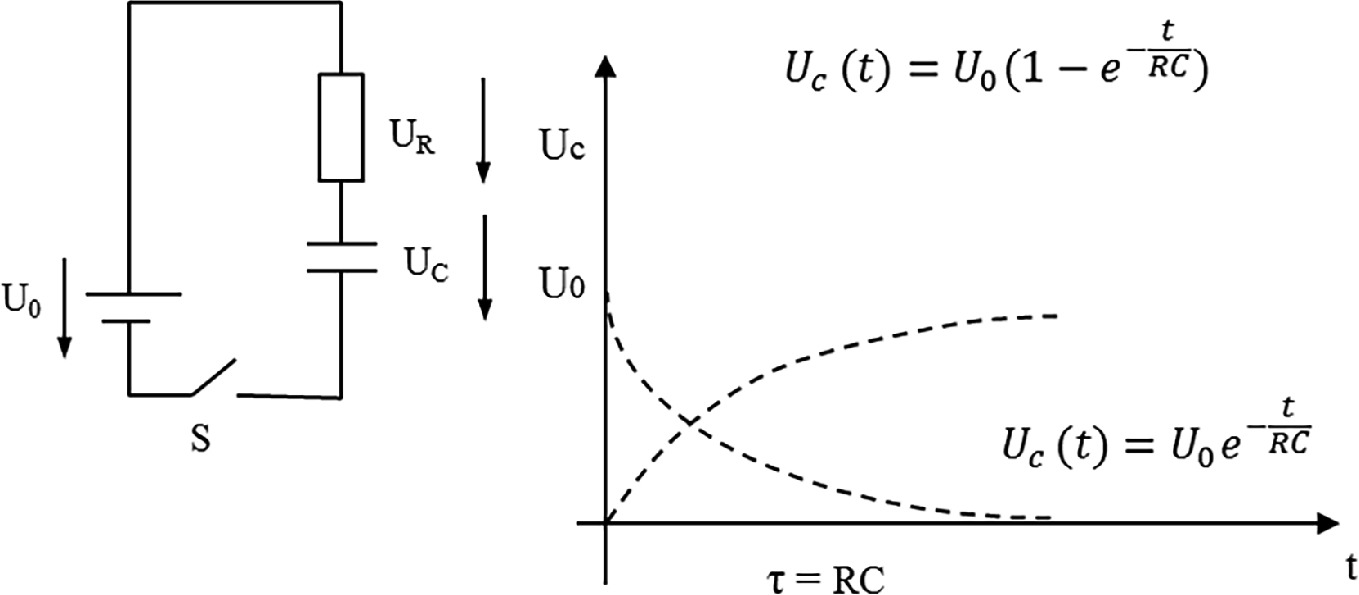 and a switch . On the right, a graph illustrates the charging and discharging curves of the capacitor. The voltage across the capacitor is shown as , and the voltage across the resistor is shown as . The x-axis represents time , and the y-axis represents voltage. The graph highlights the exponential behavior of the voltages over time.">
Fig. 3.15 Charging and discharging a capacitor via a resistor. Source Own elaboration
What determines the charging time of a circuit with a capacitor is the moment at which the fully charged capacitor cancels the current flowing through the circuit. At this point, the potential difference across the capacitor equals that of the generator emf, while the voltage drop across the resistor is zero. The values of the resistor and the capacitor determine the time it takes to charge the capacitor. U expresses the charging voltage of the capacitor (Eq. 3.12). We can graph the voltage at the capacitor's terminals that this equation shows (Fig. 3.15):
u = U0·(1 - e^(-1/RC)) (3.12)
where U0 is the Generator voltage, R is the resistance, C is the capacitance, and e is the base of the napierian logarithms whose value is 2.71828.
Unlike other mentioned quantities, whose value remains constant and written with a capital letter (E, I, R, etc.), we write the potential difference of the capacitor u in lowercase because it is a variable quantity.
A similar process to the charging process occurs when a charged capacitor with a voltage of E connects to a resistor through a switch and discharges. The discharge time relies on the same factors as its charging counterpart. In this case, we find the capacitor's voltage during discharge using the following equation:
u = E·e^(-τ/RC)
where we define:
τ = RC (3.13)
The time constant is the product of resistance, and capacitance (RC) as we see in the equations above.
The time that the capacitor takes to gain 63% of the complete charge during the process, or to release 63% of the full charged capacitor is the same. We also see that the maximum charge and discharge level are attainable only when time reaches infinite (Eq. 3.12). After five-time constants, the voltage between the capacitor's ends is close to the final value (E or 0). Depending on the process, we consider the charging or discharging process. Capacitors store energy as voltage, because they accumulate charge between its plates, and release it when a consumption circuit is connected, resulting in a net zero-energy consumption process.
练习题
In an R-C circuit, what happens immediately after closing switch S when the capacitor is initially uncharged?
What is the time constant τ of an R-C circuit with resistance and capacitance ?
According to the capacitor charging equation , what percentage of the final voltage does a capacitor reach after one time constant?
Which of the following statements about the time constant in an R-C circuit are correct?
When a capacitor is fully charged in an R-C circuit, the potential difference across the capacitor equals the generator emf, and the voltage drop across the resistor is zero.
A capacitor can reach its maximum charge level in exactly five time constants during the charging process.
The potential difference across a capacitor during charging is written with a lowercase letter (u) because it is a variable quantity that changes with time.
The discharge voltage equation for a capacitor is , where represents the ___ of the charged capacitor before discharge begins.
In the charging equation , the term represents the base of the ___ logarithms with a value of approximately 2.71828.
Explain why capacitors are said to store energy as voltage and describe what happens during the charging and discharging processes in terms of energy.
In an R-C circuit connected to a DC generator with voltage , what is the current flowing through the resistor immediately after closing the switch S, and why?
A capacitor with capacitance is connected in series with a resistor to a DC voltage source. What is the time constant of this R-C circuit?
In an R-C charging circuit, when the capacitor is fully charged, the voltage across the resistor equals the generator voltage, while the voltage across the capacitor is zero.
When a capacitor with capacitance is fully charged to voltage , the total charge stored on its plates is ___.
Which of the following statements correctly describe the behavior of a capacitor in an R-C circuit? Select all that apply.
Explain why the potential difference across a capacitor during charging and discharging is written with a lowercase letter (u) while other quantities like generator voltage (U₀) and resistance (R) are written with capital letters.
登录后解锁笔记、知识点解析、AI 问答
立即登录