正在学习
2.2 Ohm's Law
2.2 Ohm's Law
Ohm's experiment in 1826 showcased that a two- or three-fold increase in the potential difference in an electric circuit led to a corresponding increase in the current.
Thus, it follows that the current and potential difference in any conductor will be directly proportional to one another as long as other variables remain constant. In general, the ratio of the voltage V and the current I need not be a constant. This ratio is a constant that we call resistance R, denoting the resistance of the element that follows Ohm's law.
These experiences were embodied in Ohm's law, which states:
Definition
The electric current (I) that flows through a conductor between two points is directly proportional to the voltage across the two points (V). The resistance (R) is the proportionality constant and we measure it in ohms (Ω).
The scientific contribution of this law lies in its ability to generalize to any variety of electrodynamics circuit.
Question Which elements are not taken into account in the lumped circuit abstraction? The following will not be considered in this case: the electromagnetic effects and the emf induction in the conductor because of external magnetic fields. Ohm's law applies to both DC and AC circuits and the elements of a circuit have to verify Ohm's law (Fig. 2.1).
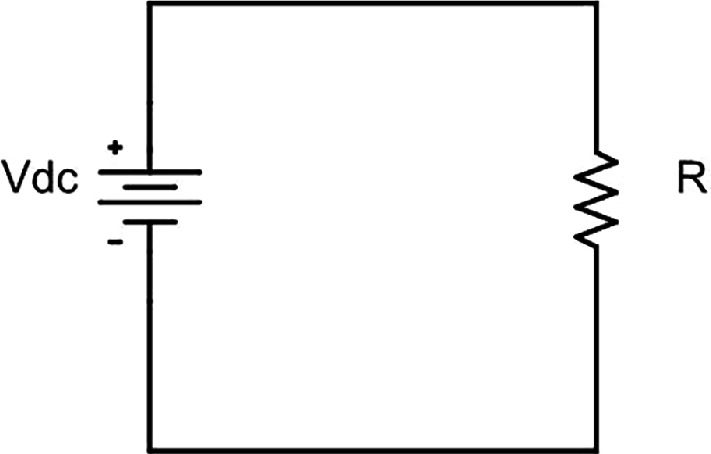
Fig. 2.1 Closed circuit with resistance and voltage source.
Source Own elaboration
The potential difference is directly proportional to the current. During this chapter we will find an answer to questions like. What is the scientific contribution of this law? Which elements are not taken into account? What are the circuits that will be used for?
练习题
A resistor has a resistance of . If a voltage of is applied across it, what is the current flowing through the resistor?
According to Ohm's experiment, if the potential difference across a conductor is doubled while other variables remain constant, what happens to the current?
Which of the following effects are explicitly excluded in the lumped circuit abstraction used with Ohm's law?
Which of the following statements about Ohm's law are correct?
For an element that follows Ohm's law, the ratio remains constant regardless of the applied voltage.
Ohm's law applies only to direct current (DC) circuits and cannot be used for alternating current (AC) circuits.
According to Ohm's law, if the voltage across a conductor is tripled, the current through it will also triple, assuming the resistance remains constant.
According to Ohm's law, the resistance is measured in ___.
The mathematical expression of Ohm's law for calculating current is I = \frac{U}{___}.
Explain why materials with more free electrons (like copper) have lower resistance than materials with fewer free electrons, relating this to Ohm's law.
A voltage of is applied across two identical-sized wires, one made of silver and one made of iron. According to the resistivity values (Silver: , Iron: ) and Ohm's law, which statement is correct?
Which of the following statements correctly describe the relationship between material properties and Ohm's law behavior?
The lumped circuit abstraction used in Ohm's law analysis assumes that electromagnetic effects and emf induction from external magnetic fields can be ignored.
Explain why applying a voltage (potential difference) to a conductor results in current flow, connecting the concepts of external energy and Ohm's law.
登录后解锁笔记、知识点解析、AI 问答
立即登录