正在学习
1.1 Introduction
1.1 Introduction
In this chapter, we review the model that allows us to study the problem of electrical machines with elements that make up electrical circuits and the associated quantities. It is common that electric or electronic engineering students separately start learning electrostatics, electrokinetics, magnetostatics, and electro magnetism in order to gain a complete understanding of the phenomena regarding to electricity and magnetism. For a deep understanding of these concepts please refer to a complete electromagnetism foundations course.
Warning Electricity VS Electrical Engineering.
It is challenging to distinguish clearly between the content of electricity and that which pertains to electrical engineering. This is because understanding electrical phenomena is necessary to apply their governing laws. The field of electricity entails knowledge of these phenomena to comprehend the world around us. Electricity is modeled with equations that define the phenomena. Specially, it highlights the Maxwell equations for modeling the electromagnetic phenomena. Conversely, electrical engineering focuses on applying these equations for practical applications. The field of electricity encompasses the study of the phenomena resulting from electric charges and their interaction. Nevertheless, in order to understand the electrical engineering rely on, this book reviews the most outstanding concepts and equations that describe interactions that occur in the widespread electrical machines that we daily interact with.
Definition (Electrostatics VS electrokinetics) Electrostatics is the branch of electrical engineering that investigates charged particles at rest. It also encompasses the study of electric fields that do not change over time. In contrast, electrokinetics is the branch of physics that deals with the motion of charged particles.
Definition (Electric force) It is one of the "fundamental forces of nature" that exists between bodies bearing electric charges that are not equal. Bodies with unlike charges experience mutual attraction; those with like charges repel mutually. Electric charges and magnetic monopoles provoke fields, E, B (Fig. 1.1) either electrostatic and magnetostatic or electromagnetic.
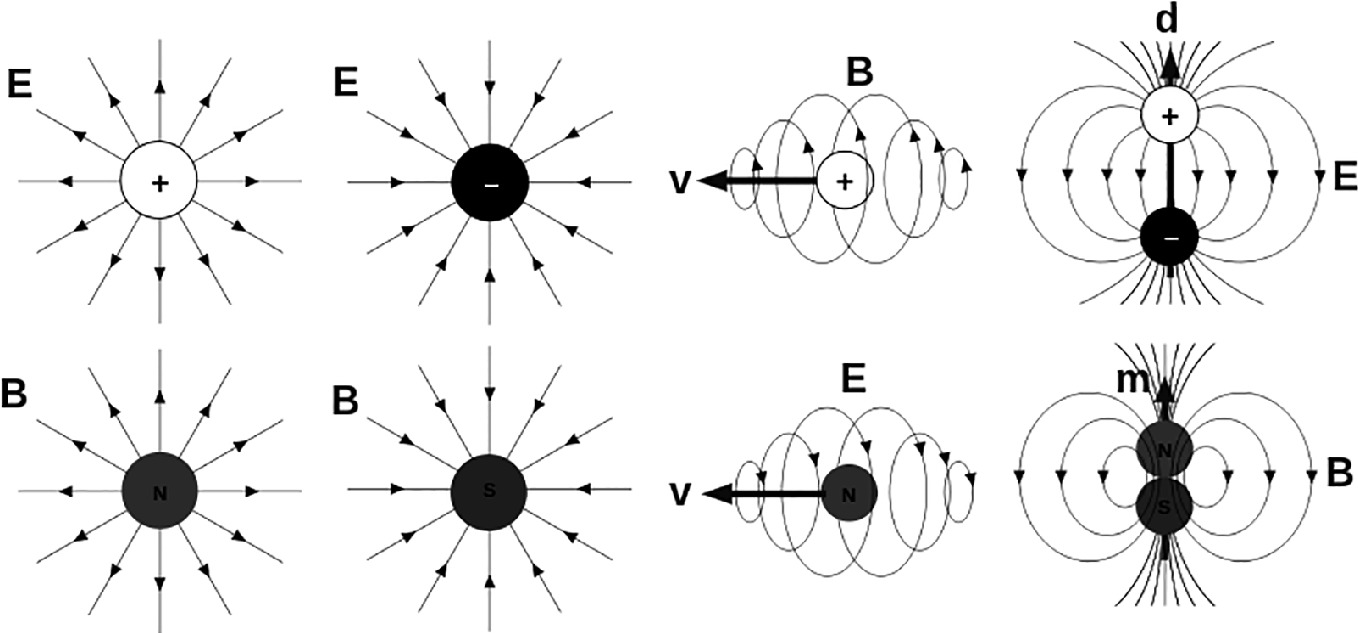
Fig. 1.1 Fields caused by electric charges and magnetic monopoles. From wikicommons under free to use license [1]
Definition (Coulomb's Law) Coulomb's law states that the attracting or repulsive electrostatic force between two charges is directly proportional to the product of their magnitudes and inversely proportional to the square of the distance between them (Eq. 1.1). When a charge is stationary, or static, it produces electric forces on other charges in its region of space.
F=kq1·q2r2 (1.1)
Being the proportionality constant, k, often called Coulomb's constant, depending on the medium. The vector form of the electrostatic field between charges of the same polarity is repulsive (Fig. 1.2).
k=9·109N·m2·C-2
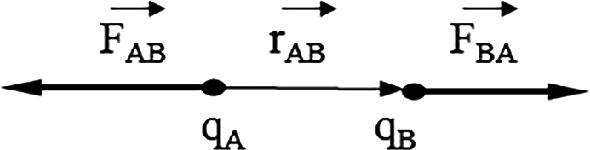 and , with arrows indicating forces and distance. The force acts on due to , and acts on due to . The distance between the charges is represented by .">
Fig. 1.2 Repulsive electrostatic force between two charges. Source Own elaboration
登录后解锁笔记、知识点解析、AI 问答
立即登录