正在学习
11.2.4 Projection Pursuit Regression
11.2.4 Projection Pursuit Regression
When the dimension of the predictor variables becomes moderately large, the set of approximating models also can become very large. This is a problem known as the curse of dimensionality. Choosing between models in this situation becomes problematic, as does implementation of many of the procedures. Projection pursuit regression, introduced by Friedman and Stuetzle (1981), is a simplified approach that aims to capture the gains from allowing for the estimation of a flexible function without encountering the problems that arise from the curse of dimensionality. The approximation they consider takes the form
where is a nonlinear function of the linear index, , with different values of the “weights” for each term. Typically the predicted variable is first demeaned, giving an estimate for . An iterative approach is used to building the model, starting with one term and adding terms until the gain from additional terms becomes smaller than a user-defined threshold for the minimum required improvement in the insample MSE.
To construct the first term, an initial guess at is made and is constructed using this guess. Next, a nonparametric model is fitted to explain by . Given this model, is estimated by minimizing the sum of squared residuals . The procedure is then repeated to obtain the second term replacing with . Computational gains arise because the nonparametric procedure is a function only of a univariate series regardless of the dimension of . As with most of these ad hoc procedures, a wide range of variations exist and the actual nonparametric methods used to construct estimates of vary from application to application.
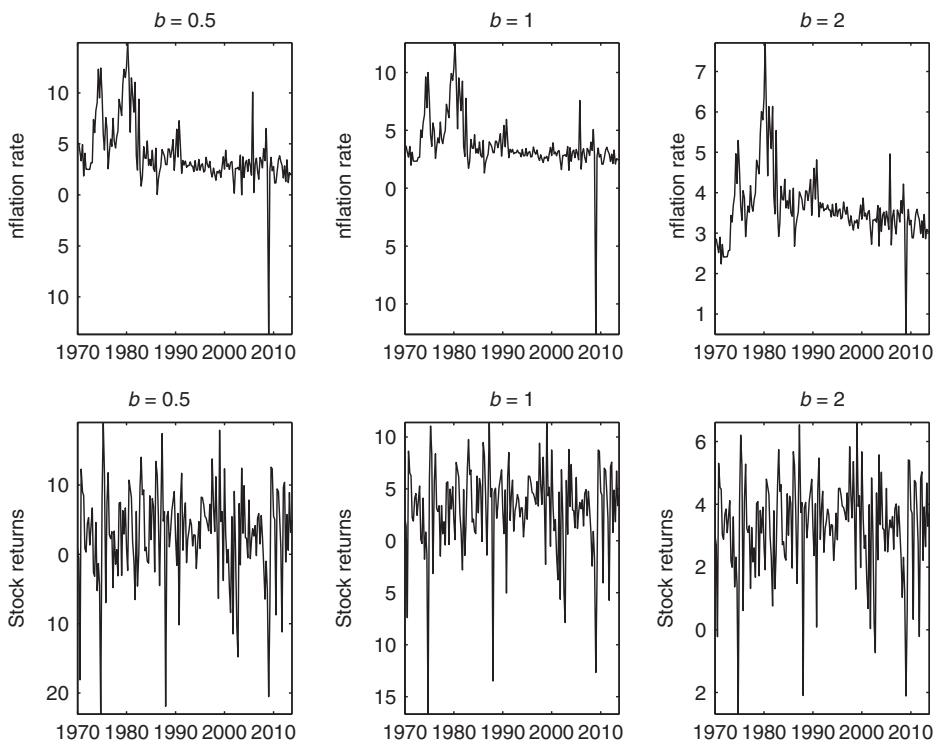
Figure 11.1: Kernel forecasts of inflation (top) and stock returns (bottom) for three different choices of bandwidth.
练习题
What is the main problem addressed by projection pursuit regression when the dimension of predictor variables becomes moderately large?
Who introduced projection pursuit regression?
Which of the following are true about the approximation form in projection pursuit regression?
In projection pursuit regression, the model is built iteratively by starting with one term and adding terms until the gain from additional terms becomes smaller than a user-defined threshold.
In constructing the first term of projection pursuit regression, an initial guess at is made and is constructed. A nonparametric model is then fitted to explain by . The is estimated by minimizing the sum of squared residuals . The term represents the estimated ___.
Explain the procedure for constructing the second term in projection pursuit regression.
Computational gains in projection pursuit regression arise because the nonparametric procedure depends on the dimension of .
Which of the following statements about variations in projection pursuit regression are correct?
How does projection pursuit regression address the curse of dimensionality compared to cubic spline models?
What is the role of the user-defined threshold in the iterative approach of projection pursuit regression?
Which of the following statements correctly describes the relationship between projection pursuit regression and the curse of dimensionality?
Which of the following are true about the construction of terms in projection pursuit regression? (Select all that apply)
Explain how projection pursuit regression addresses the issue of the curse of dimensionality compared to spline models, particularly when the dimension of increases.
登录后解锁笔记、知识点解析、AI 问答
立即登录