正在学习
2.2.1.5 Piecewise Asymmetric Loss
2.2.1.5 Piecewise Asymmetric Loss
A general class of asymmetric loss functions can be constructed by letting the loss function shift at a discrete set of points, :
Here for . It is common to set , choose and assume that both pieces of the loss function satisfy the usual loss properties so that the loss is piecewise asymmetric around 0 and continuous (but not necessarily
Right-skewed linex loss with 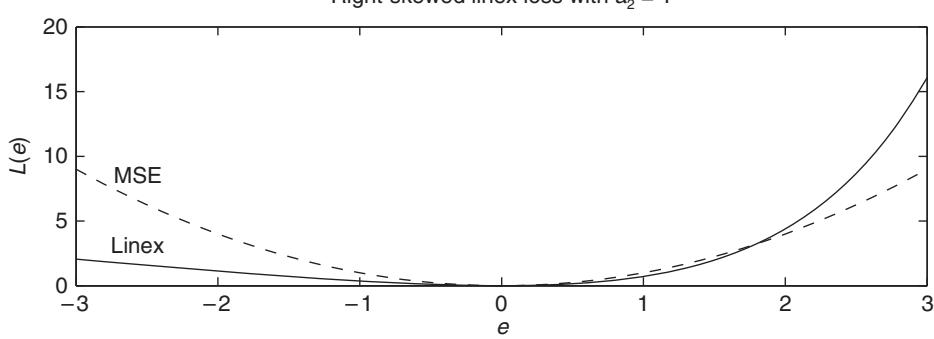
Left-skewed linex loss with 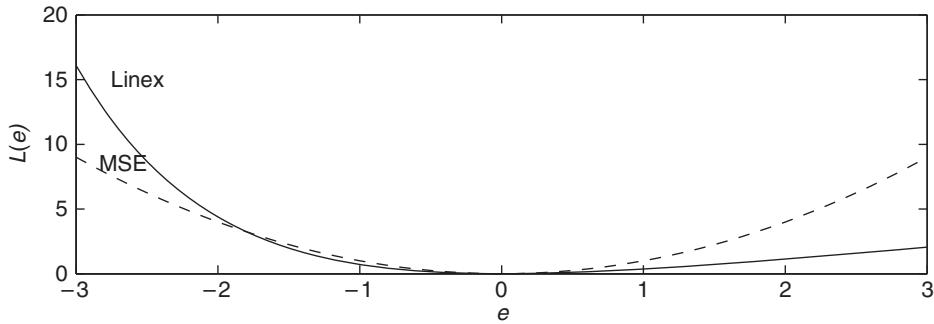
Figure 2.2: MSE loss versus Linex loss for different values of the Linex parameter,
differentiable) at 0. Lin-lin loss in (2.13) is a special case of (2.15) as is the asymmetric quadratic loss function
considered by Artis and Marcellino (2001), Newey and Powell (1987) and Weiss (1996).
A flexible class of loss functions proposed by Elliott, Komunjer, and Timmermann (2005) sets and in (2.15), while and where is a positive integer, and . This gives the EKT loss function,
where is an indicator function that equals 1 if , otherwise equals 0. Letting α deviate from 0.5 produces asymmetric loss, with larger values of α indicating greater aversion to positive forecast errors. Imposing and MAE loss is obtained. More generally, setting reduces to lin-lin loss since the loss is linear on both sides of 0, but with different slopes. Setting and gives the MSE loss function which is therefore also nested as a special case, as is the asymmetric quadratic loss function (2.16) for . Hence, the EKT family of loss functions nests the loss functions in (2.11), (2.12), (2.13), and (2.16) as special cases and generalizes many of the commonly employed loss functions.
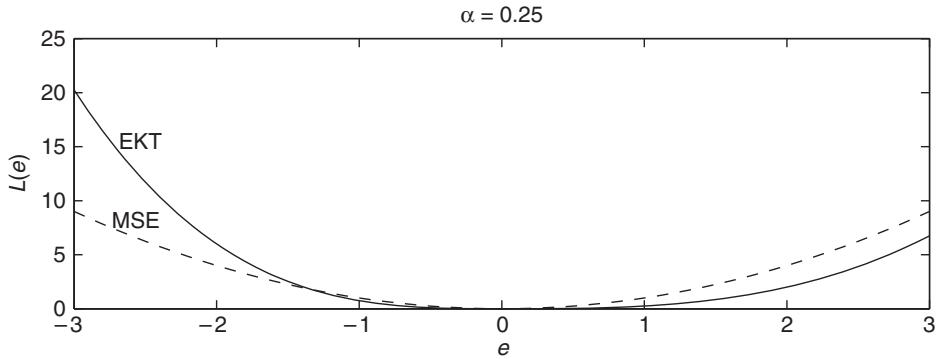
α = 0.75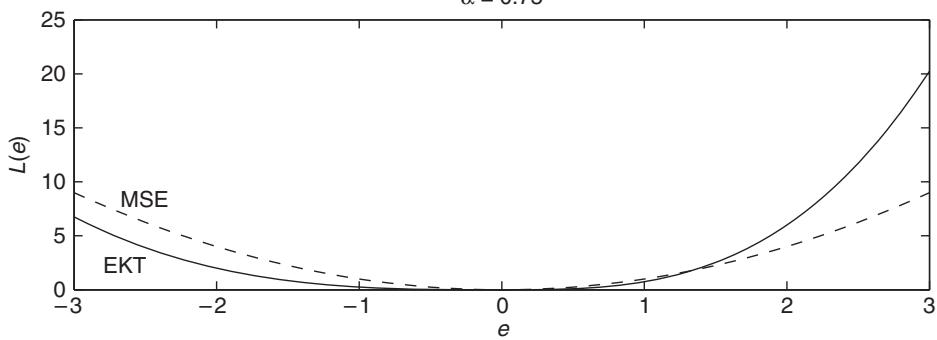
Figure 2.3: MSE loss versus EKT loss with p=3 for different values of the asymmetry parameter, α.
Figure 2.3 plots the EKT loss function for p = 3, α = 0.25 (top) and (bottom). Compared with MSE loss, substantial asymmetries can be generated by this loss function.
Empirically, the EKT loss function has been used to analyze forecasts of government budget deficits produced by the IMF and OECD (Elliott, Komunjer, and Timmermann, 2005), the Federal Reserve Board’s inflation forecasts (Capistrán, 2008), as well as output and inflation forecasts from the Survey of Professional Forecasters (Elliott, Komunjer, and Timmermann, 2008).
练习题
What is the condition for the points in the general form of piecewise asymmetric loss function?
What is a common setting for the piecewise asymmetric loss function?
What is the asymmetric quadratic loss function for ?
Which of the following are properties of the EKT loss function?
The EKT loss function nests the MSE loss function as a special case.
The EKT loss function is symmetric when .
The EKT loss function is given by , where is an indicator function that equals 1 if , otherwise equals ___.
The asymmetric quadratic loss function is defined as for and for . For this function to be asymmetric, must be in the interval ___.
Explain how the EKT loss function generalizes many commonly employed loss functions.
What empirical applications have used the EKT loss function?
Consider the EKT loss function with and . Which of the following statements is correct?
Which of the following loss functions are nested as special cases of the EKT loss function ?
The EKT loss function with and produces greater aversion to positive forecast errors compared to negative forecast errors.
Explain how the EKT loss function generalizes the asymmetric quadratic loss function.
登录后解锁笔记、知识点解析、AI 问答
立即登录