正在学习
2.2.1.2 Absolute Error Loss
2.2.1.2 Absolute Error Loss
Rather than using squared error loss, which results in increasingly large losses for large forecast errors, the absolute error is preferred in some cases. Under mean absolute error (MAE) loss,
α = 0.75
α = 0.5, MAE loss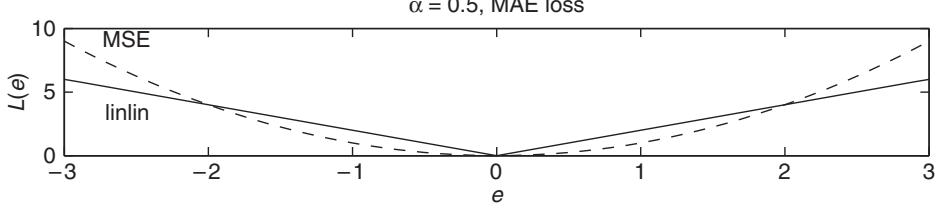
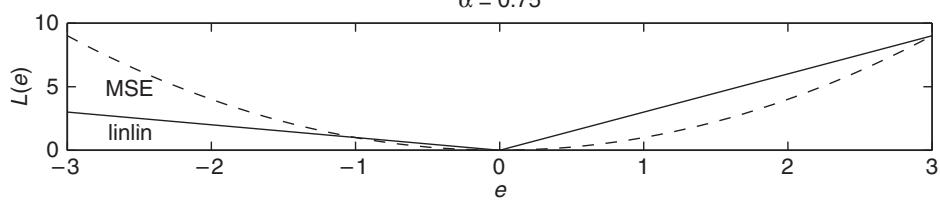
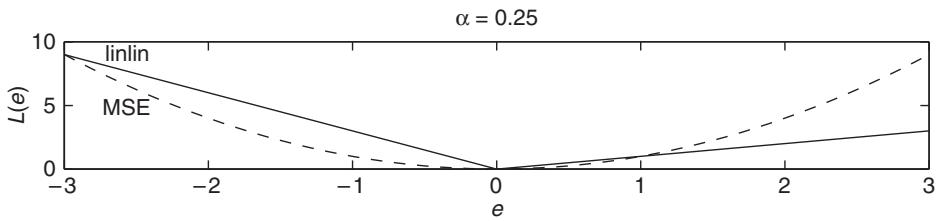
Figure 2.1: MSE loss versus lin-lin loss for different values of the lin-lin asymmetry parameter, α.
Like MSE loss, this loss function satisfies the three Granger properties listed in (2.3). The loss function is symmetric, bowl shaped, and differentiable everywhere except at 0. It is again unbounded. However, the penalty to large forecast errors increases linearly rather than quadratically as for MSE loss.
2.2.1.3 Piecewise Linear Loss
Piecewise linear, or so-called lin-lin loss, takes the form
for . Positive forecast errors are assigned a (relative) weight of while negative errors get a weight of . The greater is α, the bigger the loss from positive forecast errors, and the smaller the loss from negative errors. Again, this loss function forms a homogeneous class for all positive values of . It is common to set , so that the weights are normalized to sum to 1.
Lin-lin loss clearly satisfies the three Granger properties. Moreover, it is differentiable everywhere, except at 0. Compared to MSE loss, this loss function does not penalize large errors as much. MAE loss arises as a special case of lin-lin loss , in which case (2.13) simplifies to (2.12).
Figure 2.1 plots lin-lin loss against squared error loss. The middle window shows the symmetric case with , and so corresponds to MAE loss. Small forecast errors are costlier under MAE loss than under MSE loss, while conversely large errors are costlier under MSE loss. The top window assumes that so negative forecast errors are three times as costly as positive errors, reflected in the steeper slope of the loss curve for . In the bottom window, and so positive forecast errors are three times costlier than negative errors.
2.2.1.4 Linex Loss
Linear-exponential, or Linex, loss takes the form
Linex loss is differentiable everywhere, but is not symmetric. Varian (1975) used this loss function to analyze real estate assessments, while Zellner (1986a) used it in the context of Bayesian prediction problems.
The parameter controls both the degree and direction of asymmetry. When , Linex loss is approximately linear for negative forecast errors and approximately exponential for positive forecast errors. In this case, large underpredictions are costlier than overpredictions of the same magnitude, with the relative cost increasing as the magnitude of the forecast error rises. Conversely, for , large overpredictions are costlier than equally large underpredictions.
Although Linex loss is not defined for , setting and taking the limit as , by L’Hôpital’s rule the Linex loss function approaches squared error loss:
Figure 2.2 plots MSE loss against Linex loss for and (bottom). Measured relative to the benchmark MSE loss, large positive (top) or large negative (bottom) forecast errors are very costly in these respective cases. This loss function has been used in many empirical studies on variables such as budget forecasts (Artis and Marcellino, 2001) and survey forecasts of inflation (Capistrán and Timmermann, 2009). Christoffersen and Diebold (1997) examine this loss function in more detail.
练习题
What is the formula for the absolute error loss function?
Which of the following properties does the absolute error loss function NOT satisfy?
What is the formula for the piecewise linear loss function when ?
What happens to the penalty for large forecast errors in the piecewise linear loss function compared to MSE loss?
What is the formula for the Linex loss function?
What does the parameter control in the Linex loss function?
Which of the following are properties of the absolute error loss function? (Select all that apply)
Which of the following are true about the piecewise linear loss function? (Select all that apply)
The Linex loss function is symmetric.
In the piecewise linear loss function, a higher value of increases the loss from positive forecast errors and decreases the loss from negative errors.
The absolute error loss function is defined as , where ___.
The Linex loss function approaches squared error loss as ___.
Explain the significance of the parameter in the piecewise linear loss function.
Describe the behavior of the Linex loss function when .
Which of the following are Granger properties satisfied by the absolute error loss function? (Select all that apply)
Which of the following statements are true about the comparison between piecewise linear loss and MSE loss? (Select all that apply)
Which of the following statements correctly describes the relationship between the MAE loss function and the piecewise linear (lin-lin) loss function?
Which of the following properties are shared by both the MAE loss function and the piecewise linear (lin-lin) loss function?
The Linex loss function is symmetric and penalizes large errors linearly.
登录后解锁笔记、知识点解析、AI 问答
立即登录