正在学习
16.2.3 Fixed-Proportion Estimation Window
16.2.3 Fixed-Proportion Estimation Window
Rather than using a fixed-length window to estimate the parameters of the forecasting model, a fixed proportion of the data can be used. For example, the most recent 50% of the data could be used for parameter estimation. This has the advantage that the number of observations used for parameter estimation increases as the sample grows, thus dampening the effect of parameter estimation error. The data weights for this case take the form
Like the rolling (fixed) window method, this method relies on only one parameter, namely the value of λ, the proportion of the data sample used for estimation. This method is less widespread in applied work than the rolling window method, but is sometimes used in analytical work to characterize the sampling distribution of various test statistics.
16.2.4 Fixed Estimation Window
The fixed window estimation method includes only the first ω¯ observations to once and for all estimate the parameters of the forecasting model used to generate all subsequent forecasts. Newer data that could be used to reestimate the parameters of the forecasting model are ignored and instead the same parameters are used indefinitely. The fixed window weights can be written as
For linear regression models, the fixed window regression coefficients take the form
This method is typically employed when the costs of estimation are very high and reestimating the model with new data is prohibitively expensive or impractical in real time. Figure 16.3 illustrates this case.
16.2.5 Exponentially Declining Weights
In the presence of model instability, it is common to discount past observations using weights that get smaller, the older the data. A simple scheme for doing this is to use
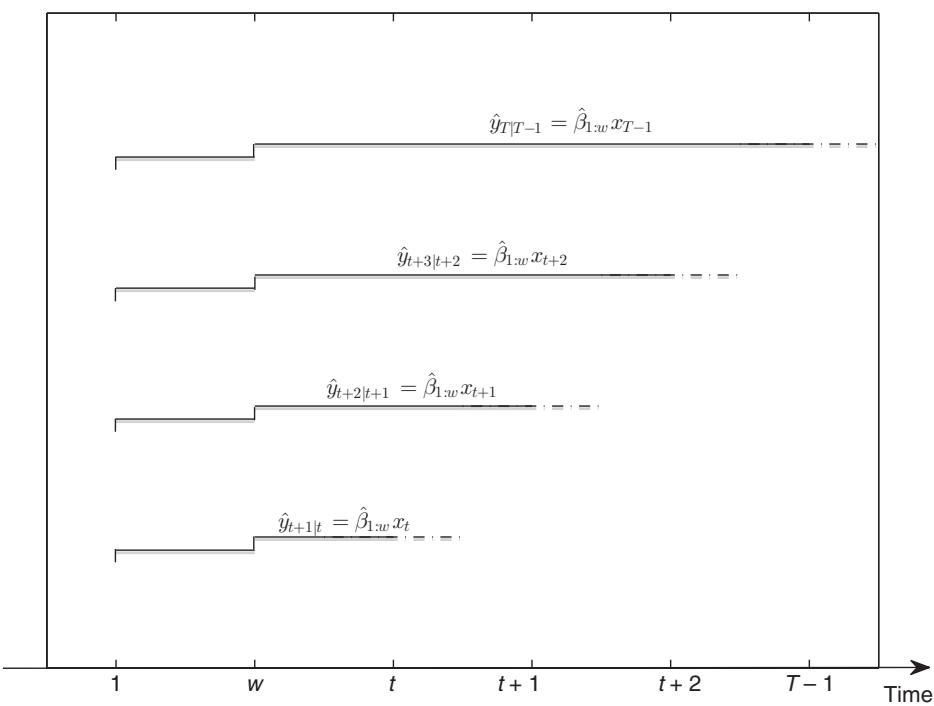
Figure 16.3: Estimation sample under a fixed estimation window.
exponentially declining weights of the following form:
where . Notice that the most recent observation gets a weight of , the previous data point gets a weight of , two-period-old data are weighted by , and so forth.
This method is sometimes referred to as discounted least squares as the discount factor, puts less weight on past observations.
练习题
In the fixed-proportion estimation window method, what determines the range of data used for parameter estimation?
What is the primary advantage of using a fixed-proportion estimation window over a fixed-length window?
Which of the following are true about the fixed estimation window method? (Select all that apply)
The fixed estimation window method is more commonly used in analytical work than in applied work.
In the exponentially declining weights method, the weight for the most recent observation is ___$.
Explain why the fixed-proportion estimation window method is less widespread in applied work compared to the rolling window method.
What is the form of the weights in the exponentially declining weights method for observations older than the current time ?
Which of the following are characteristics of the fixed estimation window method? (Select all that apply)
The exponentially declining weights method puts more weight on older observations than on recent ones.
Why might the fixed estimation window method be preferred in situations where estimation costs are very high?
登录后解锁笔记、知识点解析、AI 问答
立即登录