正在学习
9.5 CONDITIONAL FORECASTS
9.5 CONDITIONAL FORECASTS
Scenario forecasting offers a way to compute forecasts conditional on the future values taken by some of the variables in a forecasting model. Fixing the future values of a subset of the variables has two effects on the forecasts. First, and most obviously, the fixed variables no longer have to be predicted, but are assumed known (conditioned on). Second, because these variables have a joint distribution under the forecasting model, the conditional distribution of the remaining variables given the fixed variables will typically change.
Waggoner and Zha (1999) consider conditional forecasts in situations where restrictions are imposed on the future values of a set of endogenous variables which are part of a model for an vector, . For the special case where y follows a VAR(1) process, their setup reduces to
where, for
Forecasts from (9.47) are most easily generated by rewriting the model as
Waggoner and Zha show that out-of-sample forecasts for period given information at time T , take the form
where K and M can be characterized in recursive form:
with . The first two terms in (9.48) capture the usual predictive dynamics from a model. For unconditional forecasts, the third term involving the impulse response matrices, , would be 0. For forecasts that condition on future values of , this condition need not hold. For example, if we constrain the j th element of to some range , it follows from (9.48) that this amounts to constraining the sum of weighted shocks so that
and hence the expectation of future values of , conditional on this range information, is no longer 0.
Alternatively, we can consider hard conditions which restrict elements of to single values ,
where vec is a weighting matrix that stacks the impulse responses, and is the number of future shocks, ε. Under the restrictions in (9.49), Waggoner and Zha (1999, Proposition 2) establishes that the one-step conditional distribution of given the vector of parameters, a; all observed data up to time and assuming Gaussian shocks, denoted by ; is Gaussian:
where and are the restricted (conditional) mean and variance of
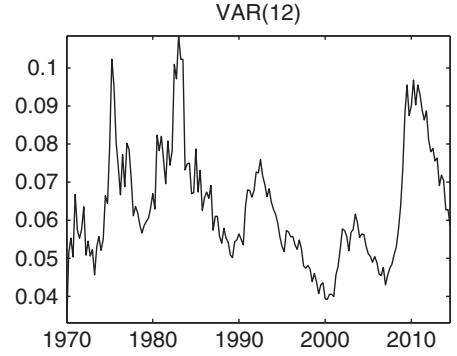
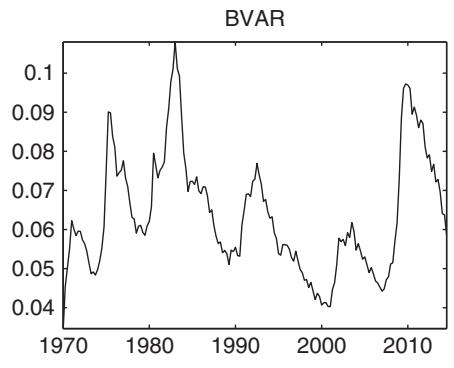
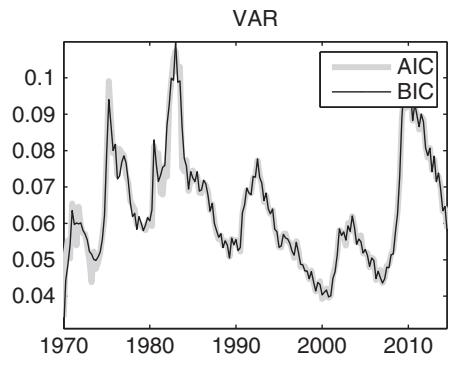
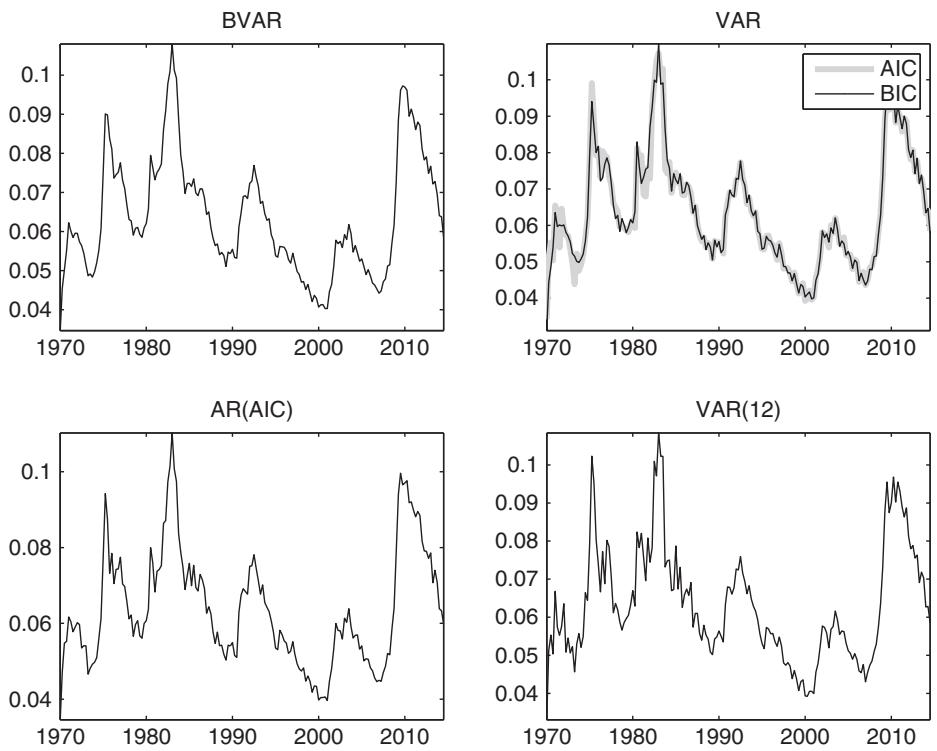
Figure 9.2: Recursive forecasts of the unemployment rate. The figure shows forecasts of the unemployment rate generated by a Bayesian VAR (BVAR), VARs with lag length selected by the AIC or BIC information criteria, a univariate AR with lag length selected by the AIC, and a VAR with 16 lags.
Waggoner and Zha propose a Gibbs sampler that can account for parameter estimation errors in generating these conditional forecasts. Given a starting value for the parameters, , the procedure first uses (9.50) and (9.51) to generate values given . Using these values, it then generates draws from . This is repeated a large number of times to obtain a set of out-of-sample forecasts that account for estimation error.
练习题
In scenario forecasting, what happens to the fixed variables in the forecasting model?
What is the form of the VAR(1) process setup according to Waggoner and Zha?
What is the rewriting of the VAR(1) model for forecasts?
What are the components of the out-of-sample forecasts form for period ?
For unconditional forecasts, the third term involving the impulse response matrices, , would be 0.
For forecasts that condition on future values of , the expectation of future values of , conditional on this range information, remains 0.
The hard conditions restrict elements of to single values using the equation ___.
Explain the effect of constraining the j-th element of to a range on the sum of weighted shocks.
What is the one-step conditional distribution of under hard conditions, and what are its properties?
Which of the following are true about the properties of the restricted (conditional) mean and variance of under hard conditions?
What is the recursive form of in the out-of-sample forecasts form?
Which knowledge points are combined in the question about the properties of the restricted (conditional) mean and variance of under hard conditions?
In a VAR(1) model, when generating conditional forecasts, which of the following statements is true regarding the shock term ?
Which of the following are key components in the out-of-sample forecasts form for a VAR(1) model, as described by Waggoner and Zha?
In the context of Waggoner and Zha's conditional forecasts in a VAR(p) model, imposing hard conditions on future values of variables leads to a Gaussian one-step conditional distribution of the forecasted variables, assuming Gaussian shocks.
In a VAR(1) model, the term represents the ___ matrix, which captures the dynamic relationship between the current and lagged values of the variables.
登录后解锁笔记、知识点解析、AI 问答
立即登录