正在学习
8.3.3 Refinements to the Markov Switching Model
8.3.3 Refinements to the Markov Switching Model
So far we assumed that transition probabilities were constant. However, this may not be a good assumption in some empirical applications. Fortunately it is straightforward to relax this assumption. One approach is to use probit or logit specifications to
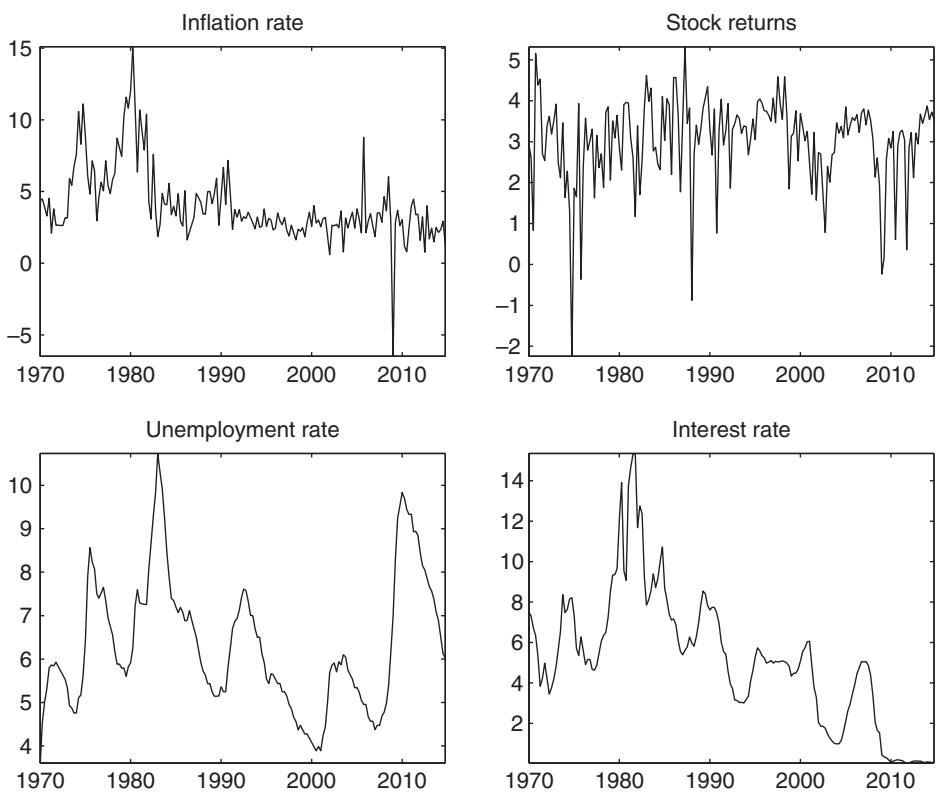
Figure 8.4: Recursive out-of-sample forecasts based on the two-state Markov switching models.
capture time-varying transitions,
for some . Such time-varying transition probabilities allow the Markov switching model to adjust its persistence to the state of the economy. If multistep forecasts are warranted, then the dynamics in must also be modeled. See also Diebold, Lee, and Weinbach (1994) and Filardo (1994) for work on regime switching models with time-varying transitions.
A second approach, suggested by Durland and McCurdy (1994) is to let the state transition probabilities depend on the duration of the current state. Define the duration variable,
Then state-dependent transitions can be modeled as follows (see Durland and McCurdy (1994)):
This model keeps track of durations up to length τ . For example, the probability of remaining in a recession could be a declining function of how long the recession has lasted if for this state.
The idea of Markov switching is quite general in the sense that it can be applied to all or a subset of the parameters of most time-series models. For example, one can allow for regime switching models in the dynamic specification of an ARMA model, in the variance of the innovations, or in the effect of other predictors on the outcome. For example, Haldrup and Nielsen (2006) introduce regime switching in the parameters of an autoregressive fractionally integrated model for electricity prices in the Nordic countries, a special case of which is
where ind N(0, 1), is a regime-dependent lag polynomial with roots outside the unit circle, and is a regime-dependent fractional integration parameter. Fractional integration allows for a slower decay in the model’s autocorrelation pattern as compared to a stationary model.
Empirically, Markov switching models have been used extensively in economics and finance to model variables such as exchange rates, stock returns, bond prices, GDP growth, inflation, and unemployment dynamics. In applications to returns on equities or currencies it is often found that the regimes are mostly identified by volatility differentials, although studies such as Guidolin and Timmermann (2006) and Guidolin and Timmermann (2008) that use multiple asset classes and multiple states have found sufficient power to reject that mean returns are the same across different regimes. Applications to interest rates have found evidence of regimes in the dynamics of real rates, inflation expectations, and the inflation risk premium; see, e.g., Ang, Bekaert, and Wei (2008). In the context of exchange rate forecasting, Dacco and Satchell (1999) provide a discussion of why Markov switching models can fit the data well, but sometimes perform poorly when used to forecast out-ofsample. Gray (1996) and Marcucci (2005) develop Markov switching models that can accommodate GARCH effects within the regimes to predict interest rate dynamics and stock market volatility, respectively. For a recent summary of regime switching models, see Ang and Timmermann (2012).
练习题
Which of the following correctly represents the time-varying transition probability using a probit specification?
What is the form of the time-varying transition probability using a logit specification?
Which of the following are necessary for multistep forecasts in Markov switching models with time-varying transitions?
The state transition probabilities in the Durland and McCurdy model depend on the duration of the current state.
The probability of remaining in a recession increases with the duration of the recession if in the Durland and McCurdy model.
The general form of the state-dependent transition probability in the Durland and McCurdy model for is . The form for is .
The Markov switching idea can be applied to the dynamic specification of an ___ model.
Explain how the Markov switching model can be applied to the variance of the innovations in a time-series model.
What is the significance of the regime-dependent fractional integration parameter in the autoregressive fractionally integrated model?
Which of the following are empirical applications of Markov switching models?
In applications to returns on equities or currencies, what primarily identifies the regimes?
Which of the following are findings from applications of Markov switching models to interest rates?
What is a potential issue with Markov switching models in the context of exchange rate forecasting?
Which of the following models accommodate GARCH effects within the regimes?
What is the key difference between TAR/STAR models and Markov switching models in determining the regime?
How does the first-order homogenous Markov chain assumption affect transition probabilities in Markov switching models?
Which of the following are true about the two-state Markov switching model's forecasts of future regime probabilities?
Consider a two-state Markov switching model where the transition probabilities depend on the duration of the current state. If the duration exceeds a threshold , which of the following correctly describes the transition probability formula?
Which of the following statements are true regarding the application of Markov switching models to time-series models?
In a Markov switching model, if the transition probabilities are constant, the probability of remaining in the same regime depends only on the previous regime and not on the duration of the current state.
登录后解锁笔记、知识点解析、AI 问答
立即登录