正在学习
7.5.1 Exponentially Weighted Moving Average
7.5.1 Exponentially Weighted Moving Average
The exponentially weighted moving average (EWMA) model computes a moving average of yt using exponentially declining weights over the entire history of the data. The forecast, or “trend,” is
We can motivate this as a weighted average, , where the scaling factor is chosen to ensure that the weights sum to 1 (Abraham and Ledolter, 1983). The sequence of forecasts is ,
The EWMA model in (7.45) relates to the simple smoothing method (7.44) in the sense that they are equivalent in the limit as To see this, note that
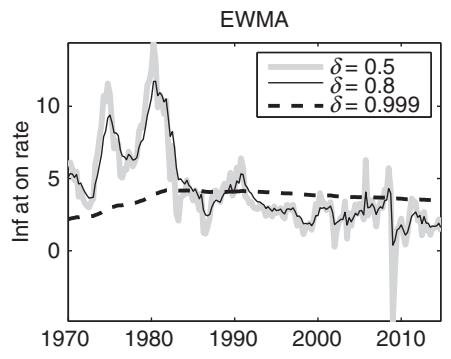
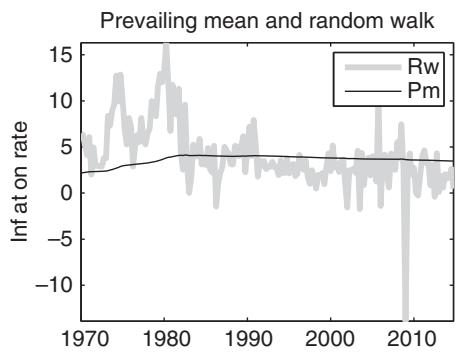
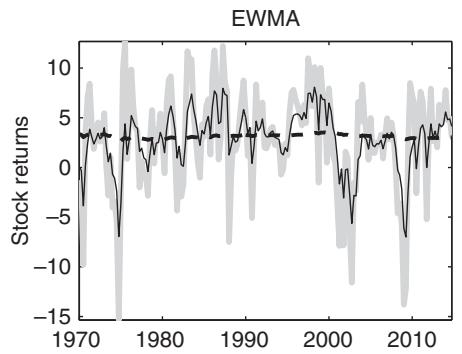
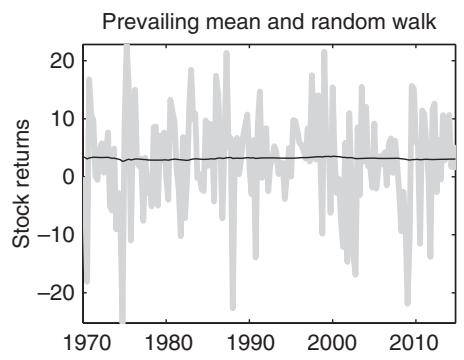
Figure 7.6: Forecasts of the inflation rate and stock returns generated by exponentially weighted moving average (EWMA) models with different smoothing factors (δ).
Since , lim , and so we have, approximately,
which is identical to (7.44).
Figure 7.6 shows forecasts of the quarterly rate of inflation and quarterly stock returns generated by three EWMA models with , and 0.999. The bigger is , the smoother the forecast as the weights are spread out more evenly on past observations. In fact, comparing these forecasts with the random walk forecast and the prevailing mean shown in the right window of the figure, it is clear that the EWMA forecasts get increasingly similar to a random walk forecast, the smaller is δ, while the EWMA forecasts increasingly resemble the prevailing mean forecast, the closer is δ to unity.12 Given the importance of δ to the forecast, one might use methods such as cross validation to select this parameter optimally, i.e., to generate the smallest average loss, given the loss function. We consider this in an empirical application in chapter 8.
7.5.2 Discounted Least Squares
Brown (1962) considered the discounted least squares loss function,
as an estimator for the mean of a series. The first-order condition for computed at time t, is
which can be rearranged to give
This is identical to the EWMA model in (7.45).
Hence the discounted least squares path for the means (which can be employed as the forecasts) is the same as that for the EWMA and hence approximately the same as the simple updating formula (7.44).
练习题
What is the formula for the exponentially weighted moving average (EWMA) forecast ?
In the EWMA model, what is the role of the scaling factor ?
What is the sequence of forecasts for the first few values of in the EWMA model?
Which of the following statements are true about the equivalence of the EWMA and simple smoothing methods?
The bigger the value of , the smoother the forecast in the EWMA model because the weights are spread out more evenly on past observations.
The EWMA forecasts get increasingly similar to a random walk forecast as approaches 1.
The discounted least squares loss function is given by . The first-order condition for is . Rearranging this condition gives , which is identical to the EWMA model formula ___$.
In the EWMA model, the forecast is a weighted average of past observations with weights . The scaling factor ___$ is chosen to ensure that the weights sum to 1.
Explain how the value of affects the smoothness of the forecast in the EWMA model.
How does the EWMA model relate to the simple smoothing method in the limit as ?
Which of the following statements correctly describes the relationship between the Exponentially Weighted Moving Average (EWMA) model and the simple smoothing method as ?
The discounted least squares path for the means, which can be employed as the forecasts, is the same as that for the EWMA and hence approximately the same as the simple updating formula (7.44).
登录后解锁笔记、知识点解析、AI 问答
立即登录