正在学习
3.1 OPTIMAL POINT FORECASTS
3.1 OPTIMAL POINT FORECASTS
The forecaster’s objective is to use data—outcomes of the random variable Z—to predict the value of the random variable Y. We next show how this can be formalized in the context of the forecaster’s loss function.
3.1.1 Expected Loss
The forecaster’s objective can be reduced to finding a decision rule that will be used to “choose” a value for the outcome of Y. The forecast is the decision rule. The notion of closeness of the forecast to the outcome is to make the loss small “on average,” i.e., across different values of Y. For any decision rule we would like a forecast to minimize expected loss,
Here the expectation is computed over the unobserved outcome, Y, holding Z constant. This expected loss is a function of the forecast rule, Z, and the parameters of the conditional distribution of Y given This explains why expected loss is a function of θ and the chosen forecasting rule, f . A sensible decision rule has low risk and hence minimizes expected loss.3
Using the conditional density for Y given Z, denoted , the expected loss in (3.1) can be written as
This is the expected loss that we attempt to control and minimize.
When the expected loss exists, it follows from (3.2) that an optimal point forecast, , satisfies4
Closed-form solutions to (3.3) can be established for many commonly used loss functions.
Example 3.1.1 (Optimal forecast under mean squared error (MSE) loss). Under MSE loss, , and the risk in (3.2), reduces to
Since the first term in (3.4) does not involve the forecast and the second term is nonnegative, the optimal forecast rule is to set
which is thus the general form of an optimal forecast under MSE loss. The conditional mean will be a function of the underlying parameters, θ , and the data, z, or a subset thereof. Setting does not guarantee that the outcome, will be close to the forecast, , since there is no guarantee that a particular outcome, is close to its conditional mean. However, on average y will be close to the conditional mean and hence the forecast in (3.5) makes sense.
Under MSE loss we can derive the optimal forecast without exploiting the differentiability of this loss function. More generally, provided we can pass differentiation through the integral (with respect to y), an optimal forecast must solve
and so an optimal forecast, , solves
This expression can be used to derive the optimal forecast rule. In some cases a closed-form solution will be available, although for complicated loss functions or densities we may not be so lucky.
Example 3.1.2 (Optimal forecast under MSE loss, continued). Under MSE loss, , so the first-order condition in (3.6) becomes
Hence, , and the optimal forecast is the conditional mean given the data, z, the forecasting model, and its parameters, θ , as in Example 3.1.1.
While the conditional mean is the most frequently used prediction rule, it is typically not the optimal rule under asymmetric loss, as the next example shows.
Example 3.1.3 (Optimal forecast under lin-lin loss). The expected loss under lin-lin loss , where is an indicator function that equals 1 and otherwise equals 0, is given by
Differentiating (3.7) with respect to f (z) yields the first-order condition for an optimal forecast,
where . This simplifies to
and is the quantile function for Y given Z. If as with MAE loss, the optimal forecast is the median of the predictive distribution of Y . This makes intuitive sense since positive and negative forecast errors are assigned identical weights in the symmetric case. As α decreases towards 0, the optimal forecast moves further to the left of the tail of the predicted outcome distribution. This happens because negative forecast errors (overpredictions) are now penalized more heavily than positive errors, and so the optimal forecast gets shifted to the left to reduce the likelihood of overpredictions. For example, the optimal forecast is no longer the median of Y but instead the first quartile of the distribution of Y .
As an illustration, figure 3.1 plots the optimal forecast as a function of α for a standard normal random variable, N(0, 1). Even though the predicted variable has a mean of 0, the optimal forecast is large and positive for large values of α. This corresponds to imposing strong penalties on positive forecast errors, so as to reduce the chances of observing such errors. Conversely, the optimal forecast is strongly negative for values of α close to 0.
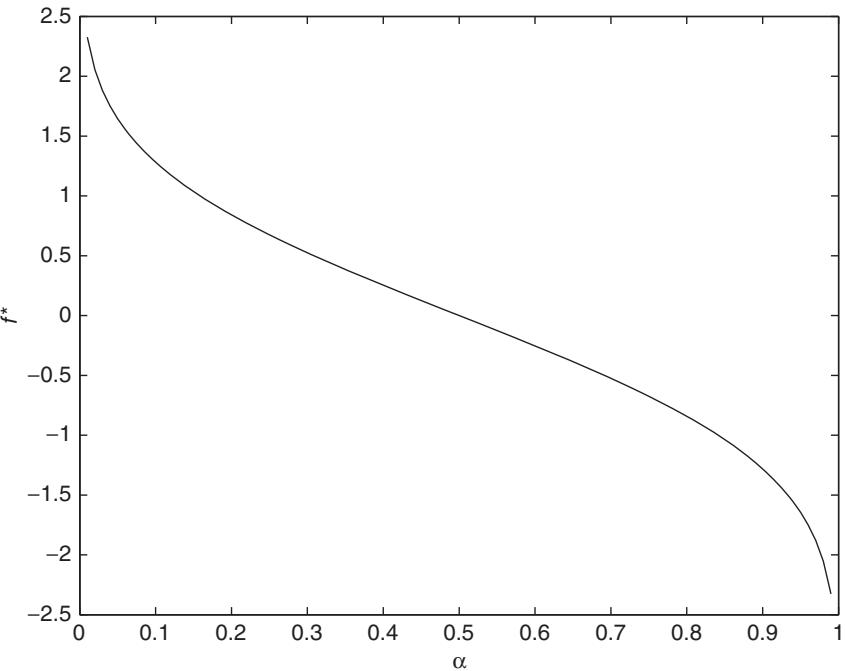
Figure 3.1: Optimal point forecast, , of a standard normal random variable, N(0,1), under the lin-lin loss function for different values of α.
Linex loss is another case where we can hope to get a closed-form solution for the optimal forecast, particularly when combined with distributional assumptions such as (conditional) normality of the outcome.
Example 3.1.4 (Optimal forecast under Linex loss). For the Linex loss function,
and so
where is the moment generating function for Y conditional on Z which we assume exists and a is a parameter of the loss function. We want to minimize this, holding constant. Differentiating with respect to f (z) under the integral gives the first-order condition
and so the closed-form solution for the optimal decision rule is
As we shall see in Example 3.2.1, this can be distinctly different from the conditional expectation of Y given z, E [Y|z].
练习题
What is the forecaster's main objective?
What is the formula for expected loss in terms of the conditional density?
Which of the following are components of the optimal point forecast definition?
Under MSE loss, the optimal forecast rule is to set .
The general form of an optimal forecast under MSE loss is ___$.
Explain the first-order condition for an optimal forecast under MSE loss.
What is the optimal forecast under lin-lin loss?
The expected loss under lin-lin loss involves integrating over the positive and negative parts of the error separately.
Which of the following are true about the optimal forecast under MSE loss?
What is the role of the first-order condition in deriving the optimal forecast rule?
Which of the following correctly defines the forecaster's objective in terms of expected loss?
Select all the statements that are true about the optimal point forecast under MSE loss.
The expected loss under lin-lin loss can be differentiated with respect to to find the optimal forecast .
Under MSE loss, the optimal forecast rule is to set ___YZ = z$.
登录后解锁笔记、知识点解析、AI 问答
立即登录