正在学习
A. Refine Your AI Collaboration (4)
A. Refine Your AI Collaboration (4)
1 James Clear, Atomic Habits: An Easy & Proven Way to Build Good Habits & Break Bad Ones, Avery, 2018.
- Enhancing Team Performance by Thinking with AI
Companies are exploring diverse strategies to harness AI’s potential. Some are racing to understand how adding AI to products or services could make them more useful to customers. Others are redesigning business processes to delegate entire tasks or even workflows to AI. But as we’ve seen throughout this book, people across every part of the organization could also pull AI in dynamically throughout their day to boost their performance and creativity across a wide range of work.
Using AI responsibly at work involves complex considerations around governance, privacy, security, and potential bias. Deep exploration of these topics is beyond this book’s scope, but this chapter provides a brief introduction to how to help teams advance on their learning journey to use AI as a collaborator and thought partner.
When teams learn to Think with AI together, they don’t just understand the technology better—they develop collective intelligence that helps them spot opportunities, avoid pitfalls, and drive innovation more effectively. This collaborative approach not only boosts performance but helps to build the organization’s AI capabilities—all while maintaining heavy human oversight. Even with this oversight, however, it is critical to coordinate with teams responsible for AI governance and compliance from the beginning.
To help get you started, I’ll walk you through some of the ways I’ve seen teams effectively use AI in their work. Then, I’ll share some approaches that I’ve found particularly effective for groups learning to collaborate with AI.
How Can AI Serve Your Team?
Here are some of the ways AI can support team performance:
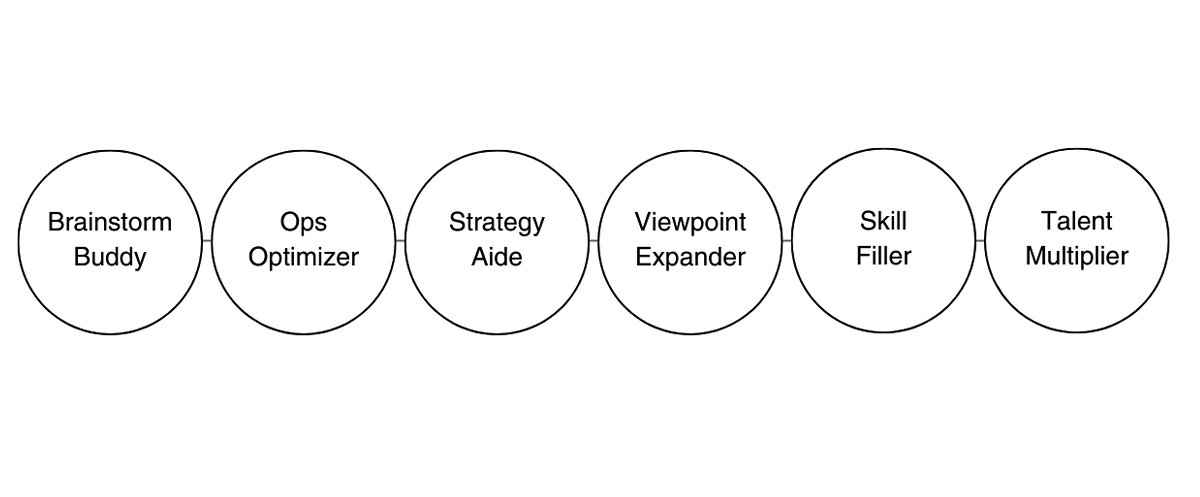
Brainstorm Buddy: Inviting AI to brainstorms can give your team’s collective imagination a turbo boost. Before a brainstorm, AI can analyze vast amounts of data and generate key questions to kickstart the conversation. During the session, set up a side screen with AI ready to chime in with ideas or answer questions as they arise. It can help evaluate concepts from multiple perspectives, provoke new lines of thinking with unexpected questions, or offer those wild ideas that humans might hesitate to voice. AI can also provide structure, ensuring all aspects of a problem are considered, while offering rapid feedback to refine ideas. It can synthesize a discussion or transform whiteboard notes into visual infographics.
Ops Optimizer: Identify areas where AI can serve as operational support for your team’s routine tasks. By codifying your team’s standards and best practices into AI tools,[i] you create always-ready assistants to develop materials or analyze and synthesize content, helping your team move work forward efficiently. Teams have used this approach to run marketing materials through compliance checks, draft project briefs, identify key takeaways and next steps from meetings, create optimized meeting agendas, and prepare quarterly update slides.[ii] This AI-powered operational support frees up human team members to focus on higher-level tasks while maintaining consistency and efficiency in routine work.
Strategy Aide:Your team can leverage AI to support strategic thinking and planning processes. By integrating AI into high-level tasks, you can accelerate decision-making, enhance analysis, and uncover angles your team might overlook. AI can assist in conducting SWOT analyses, developing risk assessments and running simulations, drafting crisis management plans, evaluating brand positioning strategies, generating novel product concepts, and performing in-depth market analyses—and just about anything else.[iii] When used responsibly, AI allows your team to approach strategic work with a broader perspective and more robust data-driven insights to support informed and innovative strategies.
Viewpoint Expander:Teams can leverage AI to expand their viewpoints, surfacing insights that may have been missed and uncovering blind spots. By applying AI as a sort of synthetic perspective that can adopt any role or viewpoint, teams can enhance their analytical capabilities and drive more comprehensive, well-rounded outcomes. For instance, teams can complement human analysis by using AI to identify gaps or missed points in their deliverables, and I’ve seen teams use this as a standard final check before considering a piece of work complete. AI can also evaluate materials from various stakeholder perspectives, helping teams create more resonant content for diverse audiences. As a “neutral” third party,[iv] AI can assess the pros and cons of different options or surface critical questions in decision-making processes, leading to more thorough evaluations. The applications are vast: from reviewing marketing materials and preparing for negotiations to analyzing new market strategies and product designs.
Skill Filler:AI can fill in for expertise in areas where your team’s talent is limited, helping your organization to operate with more agility. Especially as domain-specific tools become more sophisticated, they can provide a range of specialty skills on demand, making it possible to quickly expand your team’s capabilities. While AI may not always be capable of completing a project entirely, it can often make significant headway on specialized tasks. These range from language translation and image or video generation to data visualization, coding, social media content creation, technical writing, and SEO optimization. This rapid infusion of skills enables teams to take on more end-to-end projects that were previously out of their scope or to offer a wider range of services.
Talent Multiplier: And finally, when each team member understands how to individually tap into AI for a brain boost, it can elevate the entire team’s performance. When used well, each person on your team has on-demand access to a smart, tireless thought partner, ready to jump in when needed to spark fresh ideas and unravel complex challenges. This AI boost can magnify each person’s individual strengths, allowing team members to more fully apply their unique talents and expertise to their work—in other words, to be even better at what they do best. While it’s not a magic solution, it can be a powerful tool for unlocking more of each person’s potential within the team.
练习题
Which of the following is NOT a way AI can enhance team performance?
What is a key consideration when using AI responsibly at work?
What are some benefits of teams thinking with AI together? (Select all that apply)
AI can only be used as a Brainstorm Buddy during the initial stages of a brainstorming session.
AI can serve as an ___ to develop materials or analyze and synthesize content, helping teams move work forward efficiently.
How can AI support strategic thinking and planning processes within a team?
Which of the following is a way AI can expand a team’s viewpoints?
What are some tasks that AI can fill in for when a team lacks expertise? (Select all that apply)
Teams should coordinate with AI governance and compliance teams only after they have fully integrated AI into their workflows.
Explain how AI can be used as a Viewpoint Expander in team settings.
What is a key benefit of using AI as a Brainstorm Buddy?
AI can assist in conducting ___ analyses to support strategic thinking and planning.
AI as an Ops Optimizer can only be used for marketing-related tasks.
Which of the following are responsibilities when using AI responsibly at work? (Select all that apply)
When using AI as a Brainstorm Buddy during a team brainstorming session, which of the following is NOT a recommended practice to ensure responsible and effective use?
How can the Open Invite practice enhance brainstorming sessions when using AI?
登录后解锁笔记、知识点解析、AI 问答
立即登录