正在学习
14. Step Two: Align (3)
14. Step Two: Align (3)
You could even experiment with asking open-ended questions to expand your thinking. For example, copy any notes or drafts you have into an AI chatbot and ask, “What other questions should I be asking myself to help me visualize this person?”
Visualizing the perfect cognitive companion is a powerful exercise to bring the support you need to life. You now have a focal point to guide your experimentation to get AI to truly serve you.
Experiment to Drive Solutions
In this next stage, Experiment, you will actively engage with AI to find solutions to your AI Challenge. Your goal is to identify your first breakthrough use case—an “aha” discovery of how AI can become an indispensable tool in your life.
People often ask me for “the” prompt to get to a breakthrough. While there are some tried-and-true places to start for many common challenges, there is not a one-size-fits-all roadmap to breakthroughs. This is because everyone’s needs are unique. That’s why this stage is about you dedicating time free from distractions for freeform exploration.
So set aside some time and take the plunge to go explore! Your AI Challenge will be your guiding star as you experiment. Put this on a sticky note by your monitor, write it on your whiteboard, print it out and put it on your fridge, or whatever else you typically do to keep a thought front and center.
Work through a creative and iterative collaboration with AI to uncover results, a journey that demands patience, persistence, and an open mind. While it’s personal and often unpredictable, there are some basic principles that can guide you to success:
Experiment with a range of tools. Try meeting your AI Challenge by returning to the AI tools you played with in Step One: Activate, and experiment with a few different tools. Also, research whether there are AI tools and solutions that were designed specifically to help with your particular need. If these domain-specific tools are available, give them a try, but also run your challenges through at least two frontier model AI chatbots.
Use good principles of AI-human communication. Interact with the tools following the principles of AI-human communications outlined in Chapter Twelve.
Don’t reinvent the wheel. Research how others have tackled AI challenges similar to yours, especially when you encounter obstacles. There are people all over the world experimenting with using AI for virtually every conceivable application, and it’s likely someone has already discovered, tested, and documented their use of AI for a challenge similar to yours. Search the internet to find relevant videos, tutorials, and guides.
Lean heavily on AI at every step along the way. Leverage AI as a collaborator throughout your process, from initial brainstorming to prompt crafting and analyzing results. Experiment with AI assistance when you’re unsure of next steps or want to test or evolve your thinking; you can even ask AI to do the work of a particular step for you. For example, start a chatbot conversation by throwing it your AI Challenge question verbatim.
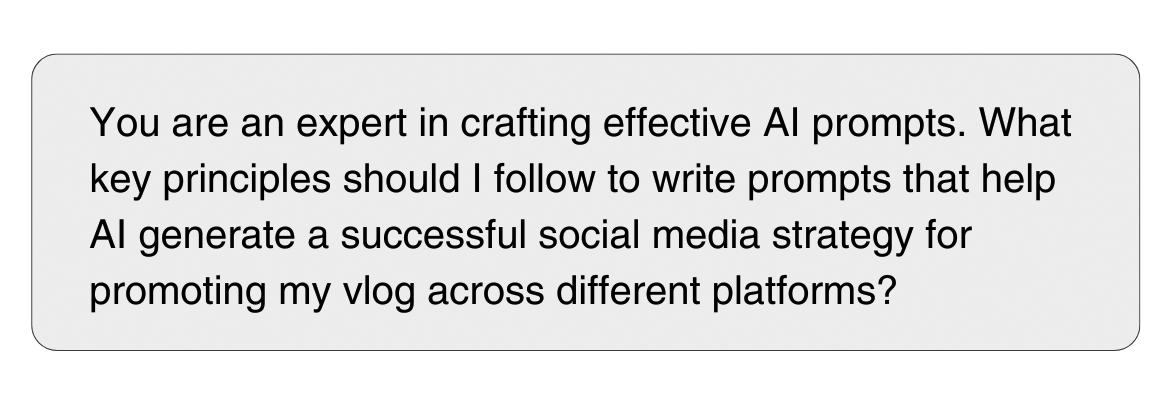
If you like the responses, ask the AI to write a prompt for you.

Turn to AI to continue to brainstorm ideas, suggest your next steps, conduct research, or analyze results. Simply go to a chatbot and “think out loud” by telling the AI why you are stuck and asking for suggestions to help you break through.
Set aside a small budget. The free versions of publicly available chatbots will absolutely get you started. But I highly encourage you to set aside at least a modest budget to try out the more advanced models and robust functionality or give you access to domain-specific tools. Without a little bit of spend, you are not going to see how AI is truly capable of helping you.
Persist. If you aren’t getting good results from the tools one day, try a different approach, a different tool, or even revisit the work on another day. Achieving tangible results requires focused and deliberate practice. You might find your first breakthrough in ten minutes, or it might take you a few hours. I think of this investment as similar to when a new team member joins your organization. There is a period in which you are gauging their capabilities, and you work together to discover how they can best support you to achieve your goals. But it typically takes some initial time and patience to establish a productive working relationship. The same principle applies here.
While humans are still better at most tasks, AI is rapidly advancing and now matches or surpasses the average person’s performance in a growing number of areas. As you experiment with solving your AI Challenge, it’s critical to understand that AI has a “jagged frontier.” This means that there are some things it’s very good at and some things that it’s just terrible at—and it’s very difficult to accurately predict on which side a particular task will fall.
That’s why it will be extremely important to explore various facets of your challenge to uncover where AI truly shines. In some cases, AI might help you attack your entire challenge, and in others, it may only be able to support you by helping with a small task. Only through trial and error will you discover which aspects of your AI Challenge can be effectively addressed by AI—the technology might excel in one area while falling short in another. Note that there are some AI Challenges that may just not be a fit with the tools right now—they simply aren’t good enough yet in some areas. In this case, go back and grab another challenge from your list and try again.
However, by the time you’ve got through a couple of experiments and have had some substantive dialogues with AI, you’ll likely have found at least a spark or a glimmer of what today’s tools can do for you. Keep pushing, exploring, and experimenting—always keeping your focused AI Challenge at the forefront of your mind—until you achieve a breakthrough.
You’ll know you’ve hit on something truly valuable if, once you’ve had a breakthrough, you don’t want to give it up—if your AI were shut off, you’d feel like you would need it back.
You Got to a Breakthrough! Now What?
First of all, congratulations—this is a key milestone in developing AIQ! Now, take a moment to reflect on your experience. Consider both what led to the inspiration for this breakthrough and any concerns that arose. Think about unexpected insights or novel approaches that emerged and how this breakthrough might apply to other areas of your life or work. Reflect on moments where the AI sparked new ideas, and imagine future possibilities this could lead to. What lessons can you apply to future AI Challenges to achieve quicker breakthroughs next time? Are there ethical considerations you need to explore before applying or leveraging the results? Could your breakthrough benefit others, and if so, how might you share it effectively?
Next, document your success. Start a file with a copy of the effective prompts, and if possible, preserve the conversation in your AI tool. Label it clearly so it’s easy to continue your work in the future.
In our next chapter, we’ll go deeper into how to leverage this breakthrough to get even further in the quest to make AI serve you.
练习题
What is the primary goal of the Experiment stage in the AI alignment process?
There is a one-size-fits-all roadmap to achieving breakthroughs with AI because everyone’s needs are similar.
To keep your AI Challenge front and center, you should put it on a sticky note by your monitor, write it on your whiteboard, print it out and put it on your fridge, or use any other method to keep the thought ___.
What are some basic principles for experimenting with AI?
Explain why it is important to experiment with a range of tools when working with AI.
What should you do if you encounter obstacles while experimenting with AI?
You should only rely on AI for the final steps of your process, not the initial brainstorming or prompt crafting.
To see how AI is truly capable of helping you, it is recommended to set aside at least a ___ budget to try out more advanced models and robust functionality.
Why is it important to persist in experimenting with AI, even if initial results are not satisfactory?
What are some ways to leverage AI as a collaborator throughout your process?
What does understanding AI's jagged frontier help you realize?
It is unnecessary to explore various facets of your AI Challenge because AI will either fully solve it or not be able to help at all.
How does the concept of AI's jagged frontier relate to the process of exploring various facets of your AI Challenge?
When experimenting with AI to solve your challenge, which of the following is NOT a recommended approach according to the principles of experimenting with AI?
Which of the following are key principles for experimenting with AI to drive solutions to your AI Challenge? (Select all that apply)
It is recommended to reinvent the wheel when encountering obstacles while experimenting with AI to solve your challenge.
When experimenting with AI, it is critical to understand that AI has a 'jagged frontier,' meaning it is very good at some tasks but terrible at others, and it is difficult to predict ___ a particular task will fall.
登录后解锁笔记、知识点解析、AI 问答
立即登录