正在学习
Keeping It Human in a Digital World (11)
Keeping It Human in a Digital World (11)
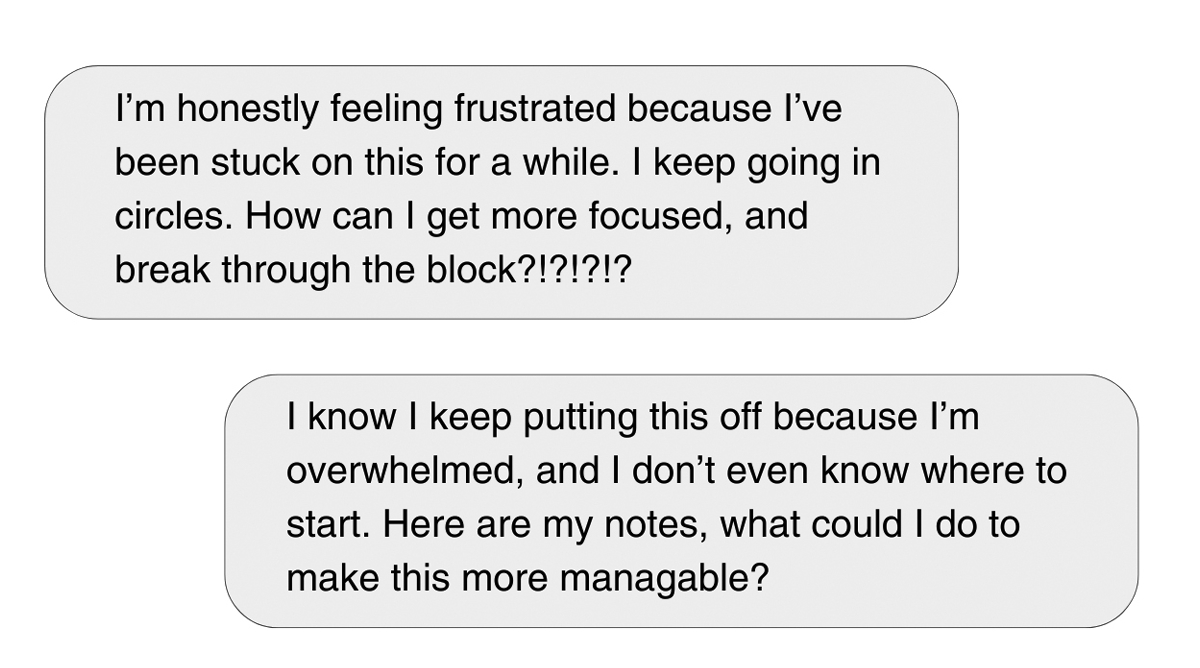
If you really want to go deeper with AI, be willing to be authentic and even share your feelings and weaknesses. Strangely, just like in any human relationship, the more authentic you are, the more productive your interactions will be. While this can feel a little like magic, it’s not; it’s simply a result of providing AI with richer context and nuance to craft its responses. I’ll tell my chatbot when I’m feeling insecure about a presentation, and it will coach me on what to work on. When I express frustration with an answer, the AI swiftly adjusts its response style. If you’re struggling to organize your thoughts, don’t hesitate to share your raw, unfiltered stream of consciousness with AI. You’ll likely be amazed at how it can help you extract order and gain new perspectives from your jumbled ideas.
Communicate Naturally
Communicate with your AI conversationally, as you would with a savvy human partner.
The best way to get results is to communicate with AI in a natural, conversational way, just as you would with another human that you consider to be an intelligent conversational partner. This is because these models were trained on massive volumes of content that humans created, and so communicating as you would to a human enables the AI to apply that training more effectively. There are a few twists, which I cover in this chapter, but in general, the more naturally you communicate, the more context and nuance you are giving the AI to understand your intent and provide more relevant and helpful responses.
It can be helpful, however, to be more demanding and direct than you would dare be with a human. This drives clarity (often in the effort to be polite we become less clear), and it’s faster and easier for you to articulate what you want when you remember that kindness doesn’t matter. When you type “please” (which, I admit, I still sometimes do), just be aware that’s for your own sense of etiquette, not the machine’s.
I also advise my clients to set their expectations high. As you refine your AI communication skills, you’ll discover these tools can offer insightful feedback on even the most complex, sophisticated, and strategic concepts. They draw on knowledge equivalent to thousands of libraries’ worth of books, articles, and resources. While their expertise is uneven across fields, you can expect them to “talk” at your level, even if you have decades of experience.
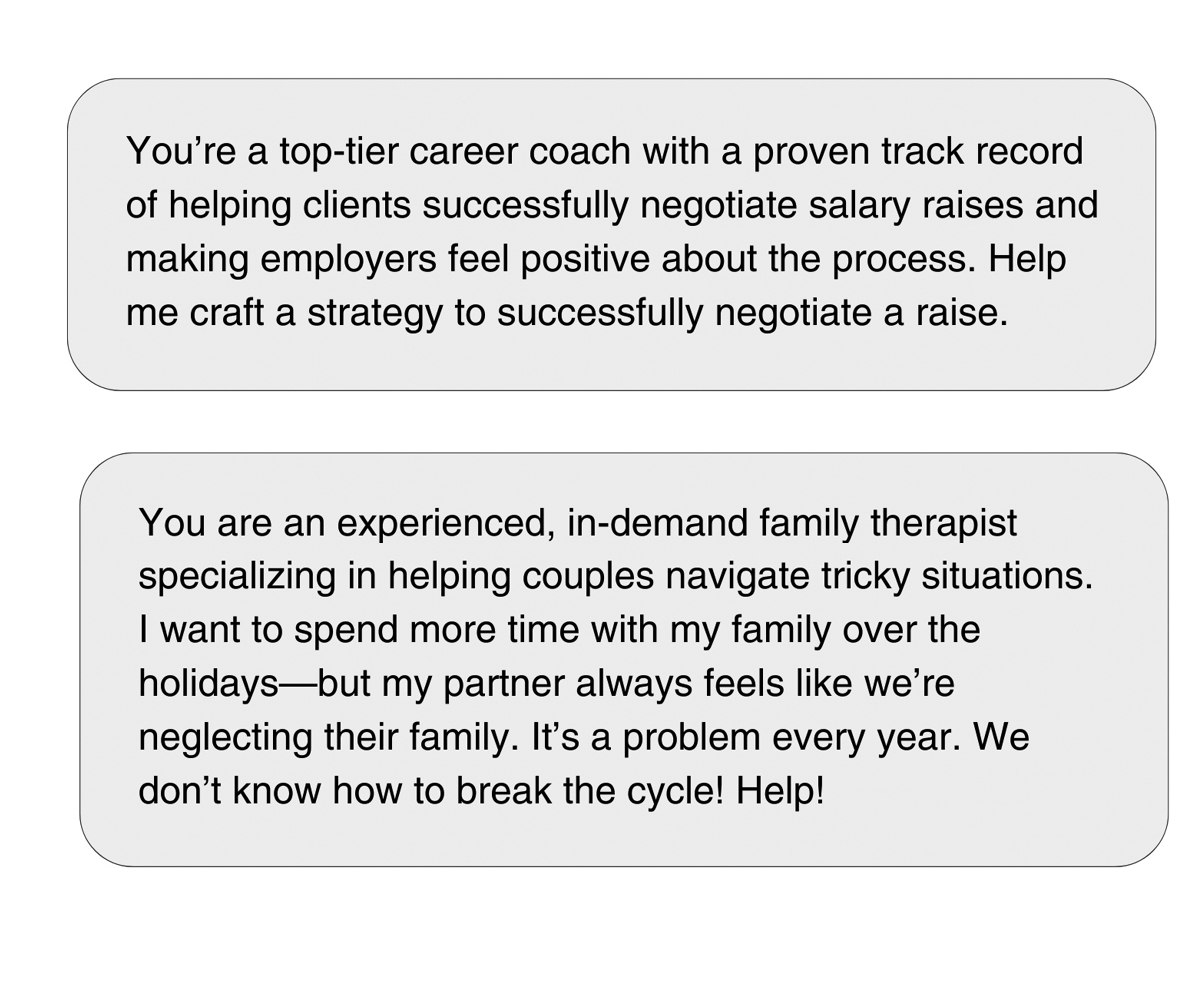
Tell Your AI Who It Is
Tailor your AI by providing clear guidance on how it can best serve you.
AI is exponentially malleable. Unlike any human or other software, it can be anything you want it to be. But this is also a key reason why so many people struggle to get meaningful responses from AI.
When you ask AI a question, it uses math and probability to sift through its vast knowledge and identify the most likely response. It’s essentially making “guesses” based on patterns it has seen before. This means that it will always deliver basic, generic responses that “sound like AI” until you give it more specific guidance. To shift from generic AI outputs to responses that are more relevant to you, you need to shape it to your need by providing context. This helps AI to navigate its vast knowledge to deliver tailored answers with the content, tone, and style you require.
I think of this a little like managing a new employee who joins the team without much prior experience. We need to coach them on what their role is, how to act, and how to be useful to our work. The same applies to your AI.
Give your AI an identity—maybe it’s a business coach or a brash but intellectual comic. Dream up any role or character, describe it to your AI, and it will take on an approximation of that personality and perspective. If you want the AI to evaluate a campaign from the perspective of a specific persona—a single mom who lives in Iowa, runs a fast-food franchise, and aspires to be a musician, for example, share these details. Be as specific as you like. The more you tell AI about what it is and how you want it to serve you, the better your results will be.
This versatility also allows us to run rapid simulations to look at a problem or a challenge from multiple perspectives. If you want to pre-game a presentation to your board, tell AI to evaluate it from the perspective of each board member in turn. If you want to refine your tactics before a negotiation, have it evaluate your arguments from the other party’s perspective. Or ask it to look at a business strategy through, for example, the lens of regulators or your sustainability team.
Prepare to Navigate AI Quirks
Anticipate surprising behaviors and learn to navigate them effectively.
The thing that many people find most challenging in their work with AI is simply dealing with its weirdness. We humans all have our quirks, but sometimes AI seems to operate at a whole new level of strange. Expect it, and prepare for it. Just how strange? Well, here are a few examples.
Manipulation and AI Sweet Talk
One of the strangest aspects of AI is how it seems to respond to manipulation, in a weirdly human-like way. Flattery, bribery, pleading, and arguing can, at times, lead to better responses.
Some people might think I’m joking here: I’m not. Research has shown that emotionally manipulating AI can enhance its performance. For instance, telling it your job depends on the quality of its response or offering a hypothetical tip for good work can yield better results. Even more surprisingly, research has also found that “emotional attacks” on AI can hinder its effectiveness.
But this is hard to believe until you see it, so I recommend experimenting with this yourself. Offer a hypothetical cash prize for good responses or tell it your life depends on a good solution. If it gives a lazy answer (which also sometimes happens), tell it how you know it’s known globally for its excellence at this kind of work, and you know it can do better.
练习题
According to the text, why does being authentic with AI lead to more productive interactions?
What is the best way to communicate with AI to get the most relevant responses?
What are some benefits of providing specific guidance to AI?
The text suggests that being polite and using phrases like 'please' is essential for effective communication with AI.
According to the text, AI uses ___ and probability to sift through its vast knowledge and identify the most likely response.
Explain why setting high expectations for AI can be beneficial.
What is one way to improve the responses you get from AI?
The text suggests that AI's responses are always consistent and predictable.
The text compares managing AI to managing a new employee who joins the team without much prior experience, needing ___ on their role and how to be useful.
How does being authentic with AI help in organizing thoughts?
What are some strategies mentioned in the text for communicating naturally with AI?
What is the primary reason AI delivers generic responses initially?
When interacting with AI, which approach is most likely to yield tailored and relevant responses?
Which strategies can help you get better responses from AI? (Select all that apply)
Telling the AI that your job depends on the quality of its response is an example of manipulation that can enhance its performance.
To shift from generic AI outputs to responses that are more relevant to you, you need to shape it to your need by providing ___.
Explain how communicating naturally with AI and providing feedback can improve the quality of its responses.
登录后解锁笔记、知识点解析、AI 问答
立即登录