正在学习
A. Refine Your AI Collaboration (5)
A. Refine Your AI Collaboration (5)
Many providers have features that allow you to save and reuse customized instructions across a team. For example, ChatGPT allows you to create custom “GPTs” that follow your specific guidelines and data. Claude has self-contained workspaces that include their own chat history and knowledge bases called “Projects.” Approaches such as these require no programming knowledge and can be set up in minutes, helping teams to develop repeatable workflows.
You can enhance the value of AI by connecting it to other software, allowing for automated actions such as creating tasks or sending notifications. While some integrations still require technical expertise, many platforms are making it easier to link AI with various tools, and significant advancements in user-friendly AI automation are on the horizon. An entire market space called “AI Agents” is getting a lot of investment from venture firms and tech companies and will supercharge much more of this integration, as well as evolve the kind of tasks AI can do on our behalf.
As always, proceed with caution. AI can hallucinate, and more subtly, it can overly influence your thinking if not used mindfully.
No technology is truly neutral, as it reflects the design decisions of its creators and, in AI’s case, its training data. However, I’ve found that people can be more receptive to alternative viewpoints or approaches when presented by AI rather than by another human. This likely stems from several factors. Despite its inherent biases, AI is often viewed as more impartial than humans because it lacks personal agendas or emotional investments. (AI doesn’t carry the baggage of past interactions or office politics.) It could also help neutralize egos, as accepting a different viewpoint from AI may feel less like “giving in” to a colleague’s opinion. In these early stages, it’s possible the novelty of AI plays a role as well, as people may be more curious and open to considering an unexpected AI suggestion than that of a colleague.
| Using Custom Chatbots to Support Your Team |
|---|
| Teams can easily create custom chatbots tailored for specific tasks. A great place to start is by experimenting with OpenAI’s “GPTs.” Additionally, many software providers are beginning to offer the ability to create not only custom chatbots but also AI agents, which are rapidly evolving to manage more sophisticated and complex workflows. There is a world of inspiration online to see how others have approached this; it can take just a few minutes to set up and doesn’t require programming knowledge. It’s a great way to experiment with getting value out of the tools, but (as always) start with a clear business need to focus your work. For example, create a chatbot that analyzes call transcripts to spot patterns and craft customer service responses. Or make a “documentation specialist” that transforms complex product information into user-friendly guides, a meeting bot that identifies action items and assigns tasks, or an “empathy engine” that adopts different customer personas to evaluate your product and marketing strategies through their unique perspectives. |
The AI Learning Journey for Teams
I’ve found a few approaches to be especially helpful to teams, which I’ve put together in a Team Learning Journey. It works best when team members are also on their own personal AI journeys: individual learning supports the team’s collective growth and helps establish a common language across the team. Ideally, use this approach in tandem with the A3 Framework detailed in Chapters Thirteen through Fifteen.
Consider this chapter only an introduction. Building your team’s AI muscle is a substantial undertaking that warrants significant time, attention, and support. When working with organizations, I manage this as an extended process involving multiple workshops, ongoing communication, collaborative discovery of team needs, supported experimentation, and thoughtful change management. However, while the full implementation is beyond the scope of this book, you can use this guidance to begin shaping your approach.
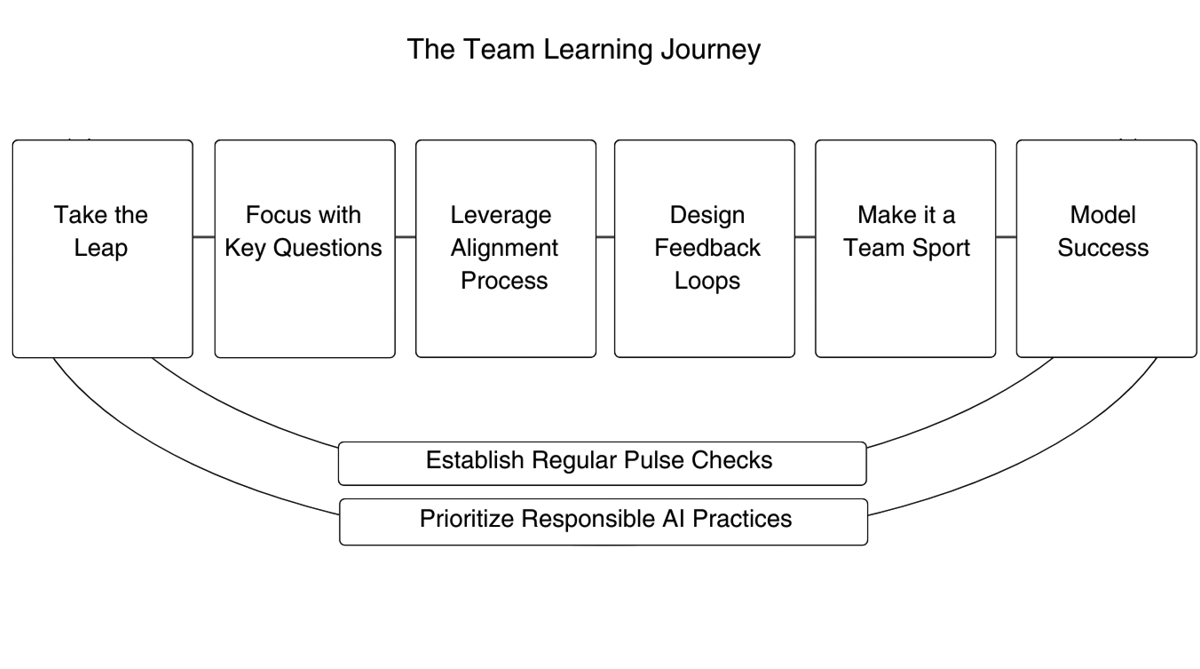
Take the Leap: Don’t wait for perfect clarity—start your AI journey now. Many teams hesitate, but delay comes with tradeoffs: the opportunity cost of waiting rises every quarter as competitors gain AI experience. And your employees may already be using “shadow AI” without guidance, which means they—and you—are missing out on valuable learning opportunities. Take action now, even if you don’t feel fully ready. Waiting for the perfect moment to start may mean never actually beginning.
Focus with Key Questions: Develop and continually refine a set of guiding questions that your team can use as a north star to focus their research and exploration. Be as specific as possible, drilling down to reveal underlying dimensions. A simple but powerful technique is to repeatedly ask “Why is this really important?” for each question. This approach makes for a useful work session on its own. The discussion often uncovers crucial aspects that need exploration: the deeper you dive, the more you’ll learn on your journey to find answers. If you’re doing this step right, you’ll never run out of questions. Instead, you’ll constantly evolve existing ones and generate new ones as your understanding grows. Regularly revisit these questions as a team to maintain alignment and adjust your focus as needed.
Leverage the Alignment Process: Adapt Step Two, Align, from Chapter Fourteen to a team context. Begin with a collective assessment of your team’s needs. Then, have pairs or small groups choose an AI Challenge to tackle. Encourage regular sharing of discoveries and insights, and promote exchanges among team members to get feedback on their progress. This approach creates a collaborative environment where everyone benefits from the team’s expanding collective AIQ.
练习题
Which of the following is NOT a feature of Claude's self-contained workspaces?
What is the main benefit of connecting AI to other software?
What factors contribute to people being more receptive to alternative viewpoints when presented by AI rather than by another human? (Select all that apply)
AI agents are a market space that is receiving significant investment and will supercharge the integration of AI with other tools.
Teams can create custom chatbots tailored for specific tasks using OpenAI’s ___.
What is the purpose of a Team Learning Journey for AI?
Which of the following is an example of a custom chatbot for teams?
What are some benefits of building your team’s AI muscle? (Select all that apply)
Waiting for the perfect moment to start your AI journey is recommended to avoid mistakes.
To focus your team’s research and exploration in AI, develop and continually refine a set of guiding questions that act as a ___.
How can following AI community discoveries benefit your team?
What is the two-minute rule for AI exploration?
A team wants to create a custom chatbot to analyze customer call transcripts and generate responses. What two key factors should they consider to ensure successful implementation?
Which of the following strategies can help a team build their AI capabilities while maintaining human oversight? (Select all that apply)
Explain how a team can benefit from creating a custom chatbot that adopts different customer personas to evaluate their product and marketing strategies.
登录后解锁笔记、知识点解析、AI 问答
立即登录