正在学习
A. Refine Your AI Collaboration (3)
A. Refine Your AI Collaboration (3)
Even small changes such as taking the stairs instead of the elevator or drinking more water require this kind of attention to turn into automatic behaviors. Turning to AI requires the same kind of intentional effort and diligence. Many people have shared with me that they were putting off using the tools until they “had time to really dig in.” Dedicated time is hard to come by in our busy, modern lives. Instead of pushing off exploration until the mythical “later” that may never come, I tell people to apply the two-minute rule instead and keep it up for a month. They invariably come out of that month with a lot of energy and excitement about what they’ve found, and often have learned to consult these new thought machines as naturally as they check their smartphone.
The great news is that two minutes can get you pretty far in AI. It’s enough time to think of one thing you want help with, develop a quick prompt, and then run that prompt through a tool or two and give the results a quick look to see if they are helpful. Do a different kind of prompt experiment every day for a month, and you’ll have a solid start to your discovery process. Over time, turning to AI for help will become as natural a habit as turning to a search engine.
B. Bring AI into Your Routine
Take your use of AI further by practicing ways to bring it more actively into your day. Here are three easy-to-implement recommendations to deepen your practice of turning to AI.
The Daily Question: At the start of every day, ask yourself “How can AI help me today?” Be curious about whether and how it can help you with something, even if you aren’t sure it’s capable yet. I keep a list in my notes app on my phone so I always have a starting point when I want to run a new experiment, even if I don’t have time to work on it that day. I’ve found this process helps people expand their thinking about where and how they can use AI to get a boost.
The AI Bake-Off: Let me share one of my most effective strategies for staying at the front edge of AI while building your daily practice: what I call the AI “bake-off”—a simple but powerful approach to testing multiple AI tools against each other. Pitting the tools against each other continually gives you a front-row seat to see their evolving strengths and weaknesses up close, and helps you quickly identify which tool is best for what kind of tasks.
The best part is that it adds mere seconds to incorporate an AI bake-off into your routine. Pick your favorite two to three tools and keep a browser tab open for each. When you hit a struggle in your work—perhaps you are grappling with writing a sentence or encounter a concept you don’t understand—throw it to the tools. Put in a prompt to one, copy it, and while it’s running, hit one or two more with the same or similar prompt. It’s typically easy to see which is returning the best results, and that’s the one I focus on for each particular task, ignoring the rest until the next bake-off.
By running the same prompts through multiple models simultaneously, you are continually assessing which tool performs best for your particular needs at any given time. The models are advancing rapidly, so their relative capabilities can shift from one day to the next.
Companies are doing bake-offs too. While initially, corporations may have been experimenting with a single model or two, now many are testing multiple models so that they can be thoughtful about which use cases they channel to which model (for example, weighing cost versus performance for a specific use case) and to tap into changes as the whole space continues to move rapidly.
The Open Invite: Invite AI to the table for every brainstorm. This could be personal—like figuring out where to take your next vacation—or professional, like working on the next quarter’s marketing campaigns. It’s a great way to discover more value from AI as a thought partner. During brainstorms, I’ve found it valuable to have AI running on a side screen, continuously processing our discussion according to my pre-set instructions. It’s like having an ever-present, low-key participant who’s always ready with ideas. While we might only use a small fraction of what it generates, this constant stream of AI-produced thoughts can significantly enrich our ideation. It’s there when we need a quick glance for inspiration or a fresh perspective, offering possibilities without interrupting the flow of human conversation.[i]
C. Make It a Practice to Tap into the AI Pulse
The AI space is vibrant with innovation and critical discussions on responsible AI, but it’s hard to know where to start because there are so many people talking about the space and so much content to wade through. To help you tap into AI and engage with the latest innovations, insights, and discussions, I’ve provided a curated list of resources that I’ve found to be particularly effective. I make it a practice to “time box” a segment of each day for catching up on new developments or experimenting with new tools and approaches. However, for most people, a weekly update is probably enough. As you develop familiarity with these learning communities, you’ll find that you can get a lot of content even if you can devote only a few minutes to this kind of regular practice.
The A3 Framework: Your Foundation for Continuous Learning
AI is always evolving. Your needs are ever-changing. This is why the journey to getting AI to better serve you never really ends.
It’s not about reaching a destination—it’s about keeping pace with possibility.
Now that you are familiar with all three steps of the A3 Framework, you are better equipped to keep pace with possibility. Through purposeful Activation, you’ve expanded your understanding of AI’s potential. Through strategic Alignment, you’ve matched AI capabilities to your specific needs. And through consistent Amplification—including the regular learning habits we just discussed—you’ve learned how to integrate AI into your life. This progression has moved you closer toward the AI Boosted zone, the highest level of AIQ, where you intuitively engage with AI as a partner to enhance your creativity and performance.
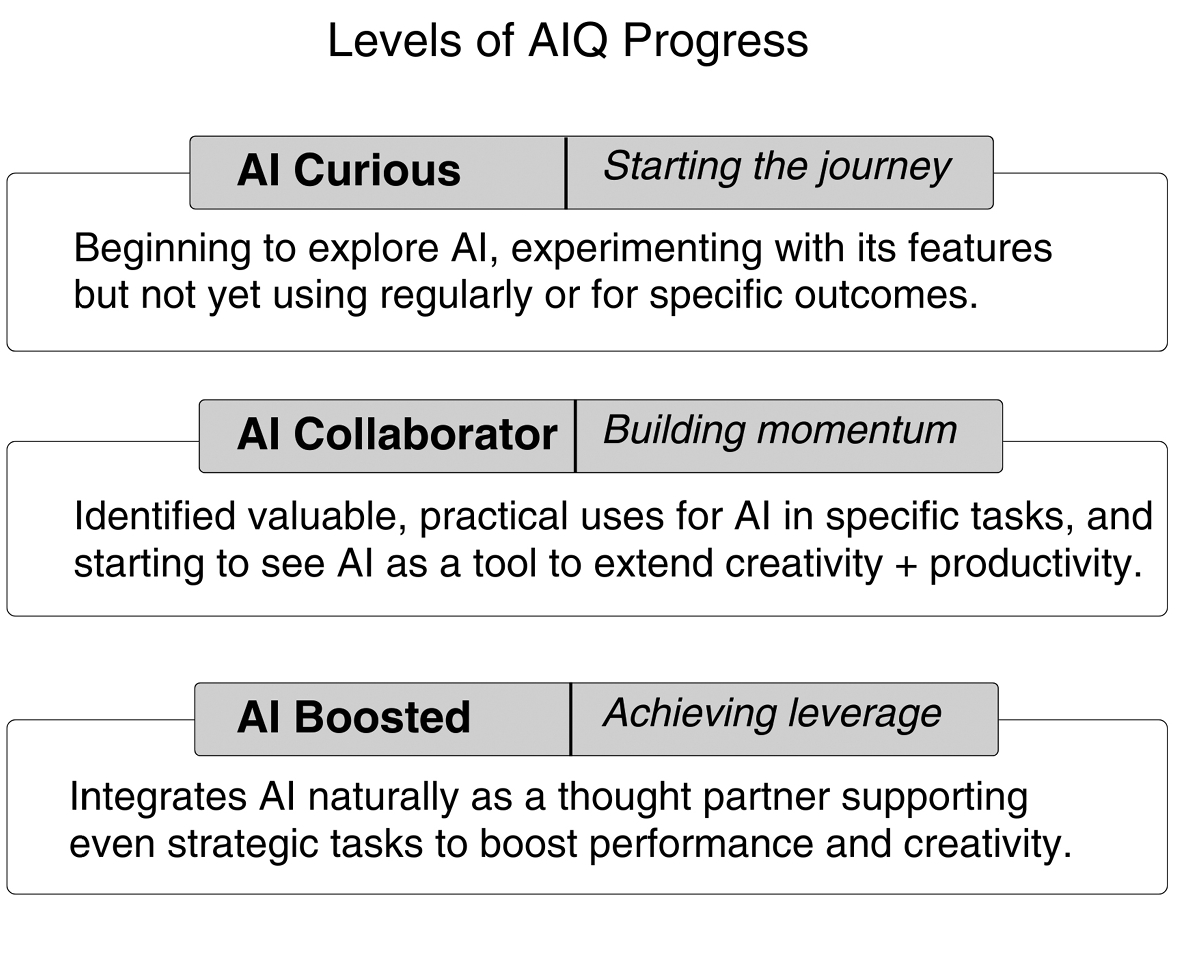
The A3 Framework is an enduring foundation to help you systematically explore and integrate emerging AI developments as they appear. As you continue to develop your personal AIQ, you’re also uniquely positioned to guide others on their journey. This brings us to our next critical challenge: how to elevate the collective AIQ of a team.
iYou’ll find more on how to leverage AI as a team in Chapter Sixteen.
Notes
练习题
According to the two-minute rule, what should you do to start exploring AI effectively?
What can you achieve in two minutes with AI?
What are the benefits of the Daily Question practice for AI use? (Select all that apply)
The AI Bake-Off strategy involves testing multiple AI tools against each other to identify their strengths and weaknesses.
Incorporating an AI Bake-Off into your routine adds mere ___ to your work process.
Explain how companies benefit from doing AI Bake-Offs.
What is the purpose of the Open Invite practice for AI in brainstorming?
What are some recommended practices for tapping into the AI pulse? (Select all that apply)
The A3 Framework suggests that the journey to getting AI to better serve you has a clear endpoint.
How does the two-minute rule align with the concept of exploring various facets of AI challenges?
What are the benefits of incorporating AI into your daily routine? (Select all that apply)
The AI Bake-Off strategy helps you quickly identify which tool is best for ___ kind of tasks.
Which strategy combines the concept of applying the two-minute rule for AI exploration with the idea of amplifying AI beyond the initial breakthrough?
Which of the following practices can help in exploring various facets of an AI challenge and also align with the AI Bake - Off strategy?
The Daily Question practice for AI use and the concept of developing an AI habit both emphasize the importance of regularly incorporating AI into daily routines.
To hone your prompt for better AI results and also use the AI Bake - Off strategy effectively, you should not only experiment with different prompts but also test these prompts across ___.
Explain how the concept of developing data for AI assistance can be combined with the AI Bake - Off strategy.
登录后解锁笔记、知识点解析、AI 问答
立即登录