正在学习
A. Refine Your AI Collaboration (1)
A. Refine Your AI Collaboration (1)
Get better at extracting value from AI in service of your AI Challenge with these three refinements.
Hone your prompt: Whatever prompt or series of prompts got you to your breakthrough, don’t consider it fully baked—ever. Just like a chef continually tinkers with a recipe, continue to experiment and refine your prompts to see what gets you better results and how different prompts work in different tools. Also, because the tools are constantly changing, you may find a prompt that was working well suddenly returns low-quality results. Don’t assume this is definitive—it may change again. Revisit tools—don’t write them off after one bad experience.
One of my favorite tactics is to get AI involved in honing my prompts. Simply tell it your challenge, your current prompt, and some thoughts on what kind of results would be more valuable to you—and ask it to give you suggestions to get you better results. Some software providers are even baking this kind of prompt help right into the tools.
But it’s also helpful to revisit your research on a regular basis to see whether others have made and shared new approaches to solve AI Challenges that are similar to yours. As you know, this is a learning moment for everyone, which also means that there are a lot of people continuing to find and share their successes along the way.
Develop your data: Data is a basic fuel of AI. By being thoughtful about additional data that could help AI help you, you could get better results. The models are already operating with the benefits of the vast data they hoovered up in their training. Ask yourself: what data can you access that could help AI deliver better results for you? For example:
Task Data That Could Help AI Help You Draft social media posts in my unique tone Examples of your own writing, social media engagement metrics, successful past posts, brand guidelines, target audience profiles, and competitor analysis Develop easy start guides and customer service scripts for my product launch Product manuals, descriptions of customer personas, meeting notes, beta testing feedback, FAQs, competitor product guides, and user journey maps Identify product improvements and prioritize feature development User feedback data, usage analytics, customer support tickets, market research reports, competitor feature lists, and industry trend analyses Create a personalized nutrition plan Food diary, health metrics (weight, blood pressure, etc.), fitness goals, allergies/intolerances, food preferences, and favorite recipes Design a custom garden plan Soil test results, sunlight exposure data, local climate information, plant preferences, yard dimensions, water availability, and photos of the space
AI chatbots can ingest quite a bit of background explanation, files, templates, and other forms of data to guide them in developing responses. This data and guidance that you input into AI is your “context window,” but you can think of this as the immediate memory of the system. Context windows have been rapidly expanding so that you can input the equivalent of up to hundreds of pages of text (and even more is available to corporate customers), which makes it possible for AI to review entire technical documents, long literary works, and lengthy financial reports.
For many tasks, it’s certainly not necessary to use that much data, and as of this writing, the models can get “confused” at times from large amounts of content. Breaking the work into smaller tasks and collaborating with the AI step by step goes a long way to keeping the quality of responses high as you work with more data.
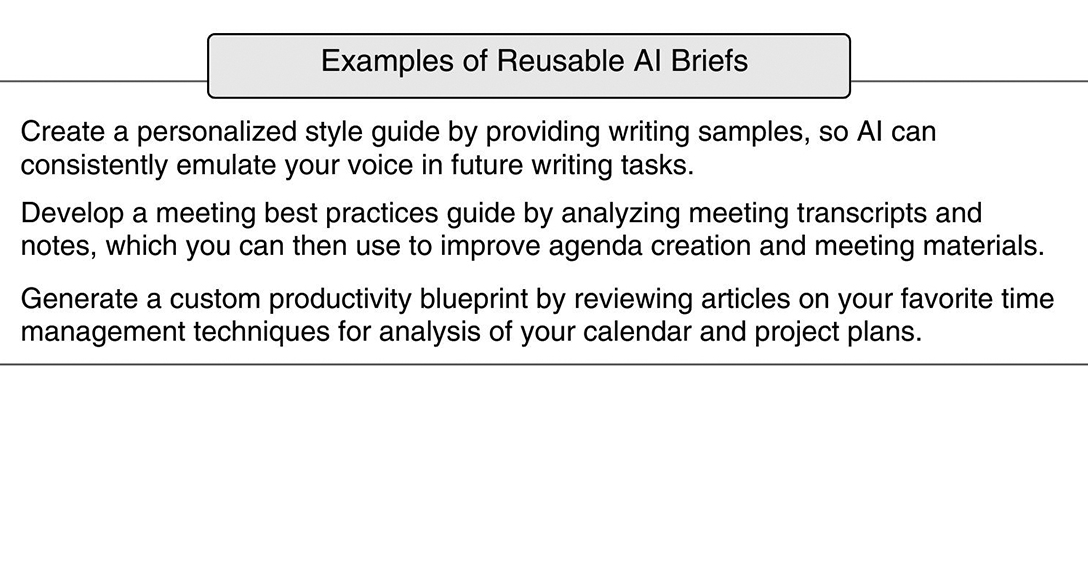
Sometimes it’s valuable to take an extra step and have the AI synthesize data into a guide or template that can be quickly uploaded in future AI chats. These “Reusable AI Briefs” give you a moment to review and check AI’s “thinking,” collaborate on refinements, and provide an efficient method for guiding your AI in future interactions.
Retest: Regularly test your AI Challenge across different tools and with new releases. AI models evolve rapidly, and your preferred tool today may be outperformed next quarter (or next week!). Stay proactive by experimenting with each new release to see whether it yields better results for your specific needs. This ongoing evaluation ensures you’re always leveraging the most effective AI solution for your challenge.
| Don’t Feed the AI: Keep Your Private Data Out of LLMs |
|---|
| It’s very important that you are not giving the Large Language Models (LLMs) any data that is private or proprietary. Some LLM providers explicitly state that they may use your inputs to train and improve their models, and anything you paste into a chatbot—whether financial data or customer communications—is essentially outside of your or your company’s control. As a general rule: never input non-public corporate information into public LLMs, consult your organization’s policies before using AI for work-related tasks, and collaborate with your IT department to ensure you’re operating in a safe environment. |
B. Streamline for Repeat Success
Here are my favorite tactics to streamline a breakthrough so it’s easier and faster to execute it again.
Capture your findings: Save your effective prompts and instructions in a file for easy access and sharing with others. Believe me, when you’re moving fast, they quickly get scattered or lost, and something as simple as having quick access to your prompts makes it more likely you will continue to use them. This can be as simple as a Microsoft Word document, a Google Document, or an Airtable for easy sharing, or it can be a more involved database. I often use Notion to help me organize my work, with different sections for AI Challenges in different stages of development and links to my Reusable AI Briefings.
This step is especially important for teams, where you may have multiple people working simultaneously to identify and find solutions to AI Challenges. To address this need, a new category of tools is emerging: prompt management platforms. These platforms help teams centralize and organize prompts, track iterations, share successful strategies, ensure consistency, and maintain version control.
练习题
What should you do if a prompt that was working well suddenly returns low-quality results?
What is the best way to improve your prompts for AI?
What are some tactics to refine your prompts for better AI results? (Select all that apply)
You should write off an AI tool after one bad experience with a prompt.
Just like a chef continually tinkers with a ___, continue to experiment and refine your prompts to see what gets you better results.
How can you involve AI in refining your prompts?
What kind of data can help AI deliver better results for drafting social media posts in your unique tone?
What is the role of data in AI assistance?
What types of data can help AI develop easy start guides and customer service scripts for a product launch? (Select all that apply)
Data is not important for AI to deliver better results.
Data is the basic ___ of AI.
How can you determine what data to provide AI for a specific task?
What is the “context window” in AI?
What can happen if you input too much data into AI?
What are some ways to manage large amounts of data when working with AI? (Select all that apply)
The context window of AI is fixed and cannot be expanded.
Breaking the work into smaller tasks and collaborating with AI step by step helps keep the quality of responses high when working with more ___.
What is the purpose of creating reusable AI briefs?
Why should you regularly test your AI Challenge across different tools and with new releases?
What might happen if you do not retest your AI Challenge with new releases?
What are some reasons to retest your AI Challenge across different tools and releases? (Select all that apply)
Retesting your AI Challenge is unnecessary because AI models do not change frequently.
AI models evolve ___, so regularly test your AI Challenge across different tools and with new releases.
Why is it important to stay proactive in experimenting with new AI releases?
Why is it important to keep private data out of Large Language Models (LLMs)?
What should you do before inputting non-public corporate information into public LLMs?
What are the risks of inputting private data into LLMs? (Select all that apply)
It is safe to input non-public corporate information into public LLMs without consulting anyone.
Never input non-public corporate information into public LLMs without consulting your organization’s ___ and collaborating with your IT department.
What precautions should you take before using AI for work-related tasks involving private data?
Which of the following combinations demonstrate integrating knowledge points effectively? (Select all that apply)
How can combining the development of data (kp_001_A_002) with understanding AI's jagged frontier (kp_014_003_011) improve your AI collaboration?
When refining your prompt for better AI results, which of the following is NOT a recommended approach?
Which of the following are examples of data that could help AI assist in drafting social media posts in your unique tone? (Select all that apply)
It is safe to input non-public corporate information into public Large Language Models (LLMs) for AI assistance.
When working with AI, breaking the work into smaller tasks and collaborating with the AI step by step helps to keep the quality of responses high, especially when dealing with large amounts of ___.
Explain how you can use AI to help refine your prompts for better results.
登录后解锁笔记、知识点解析、AI 问答
立即登录