正在学习
14. Step Two: Align (2)
14. Step Two: Align (2)
- What are your unique strengths, and what would help you amplify or leverage these strengths further?
- Which tasks or responsibilities consistently drain your energy or frustrate you?
- With which personal or professional goals have you struggled to make progress?
- When and where do you feel blocked?
- Where do you experience bottlenecks or feel limited by your current resources, capabilities, or knowledge?
- What aspirations or dreams have you put on hold due to constraints or barriers?
B. Choose Your First AI Challenge
Now that you’ve compiled a list of potential areas from which to explore AI’s value, it’s time to prioritize and select a single challenge to focus on. While it may be tempting to tackle multiple needs, concentrating on one specific area allows for a deeper discovery process and increases your chances of achieving a real breakthrough. After succeeding with one use case, you can return to reuse the process and tackle more needs.
Choose your mission carefully: you’ll be investing considerable time and effort into cracking whichever challenge you select. The point is not only to get something truly useful from this initial deep dive, but also to gain experience and learn a process that you can keep repeating to unlock more value over time.
I encourage you to choose a challenge slightly beyond what you expect AI to handle. While basic administrative help is useful, try to go for something that will require finding a way to have AI really “think” with you . . . something that will demonstrate its “creative” and “strategic” side.
If a specific need or aspiration from your list strongly resonates with you, trust your instincts and proceed to the next part. However, if you’re having trouble deciding, evaluate your options across these dimensions—the one that scores most highly will be the one most likely to yield valuable results.
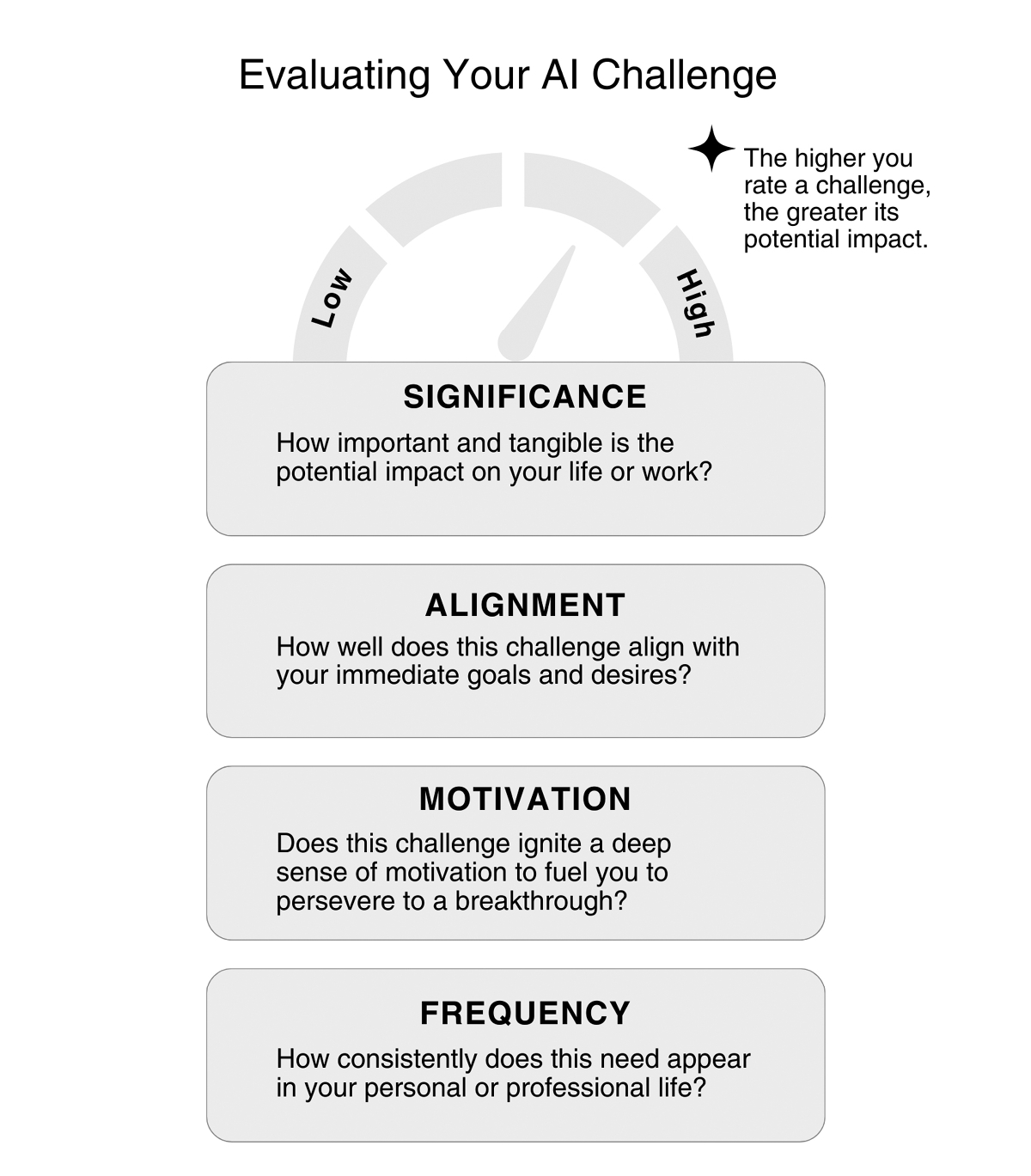
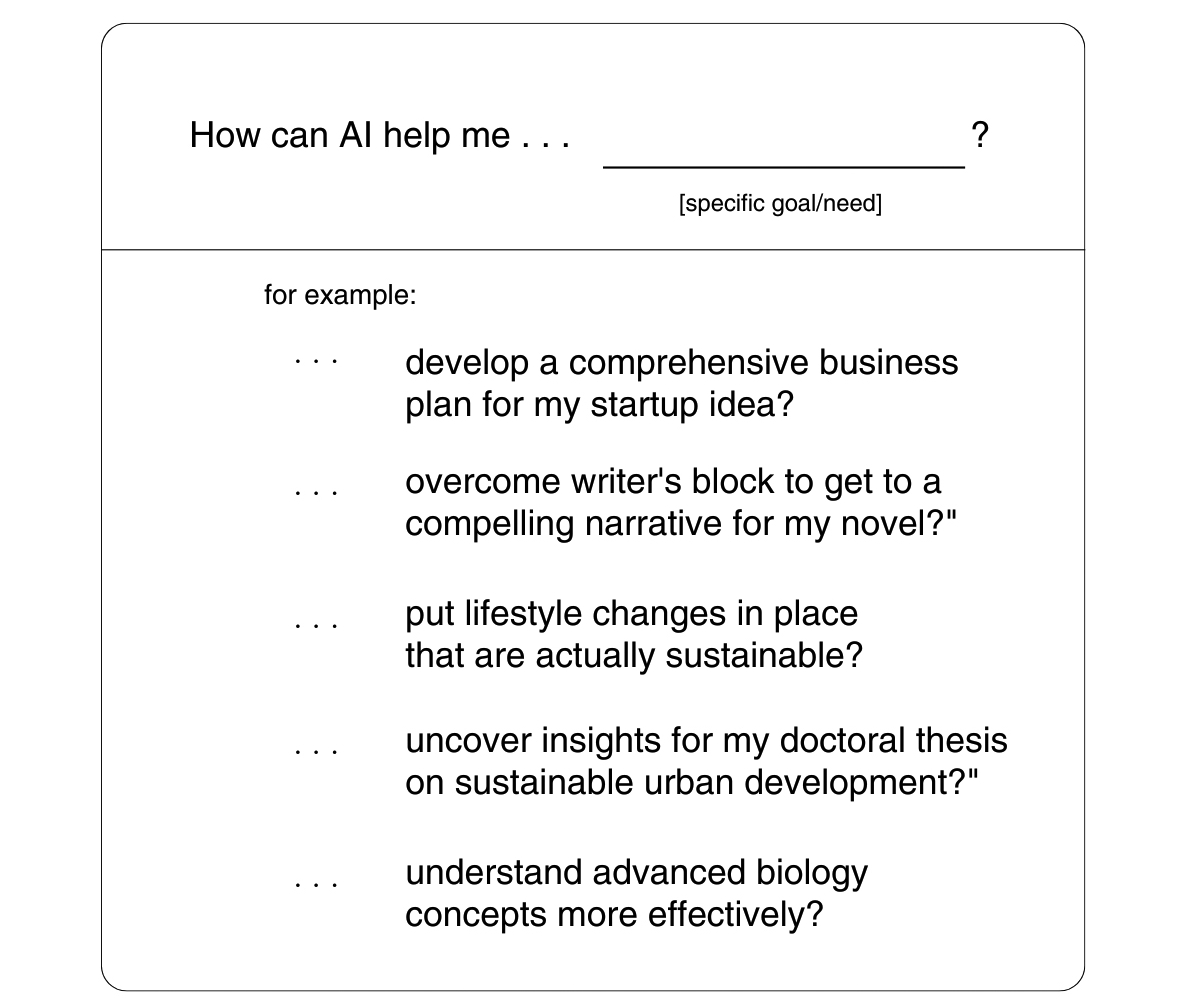
Once you’ve chosen your challenge, focus your work by framing it as an AI Challenge using this template:
C. Imagine Your Ideal Cognitive Partner
Before diving into the experimentation stage, I’ve found it’s useful for people to take a moment to first deliberately stretch their imagination about the role AI can play. I encourage you to temporarily set aside the fact that this is a book about AI, and visualize a hypothetical human collaborator that has the ideal blend of skills, expertise, and traits to address your specific need. I know this exercise can feel unconventional or even silly, but deliberately starting your thinking from “human help” can push your expectations of what software can do for you.
Imagine a versatile, highly capable partner who can think creatively, strategize, and provide support that’s uniquely tailored to your needs. Consider the following questions:
- What specific roles or responsibilities would they fill to help you overcome your challenge?
- What skills would they need—or what knowledge domains must they possess—to be truly valuable to you?
- How would they amplify your strengths or compensate for your weaknesses or knowledge gaps?
- What unique perspectives or approaches would be helpful for them to bring to the table?
Use what you learned to add more texture to your AI Challenge by following this template:
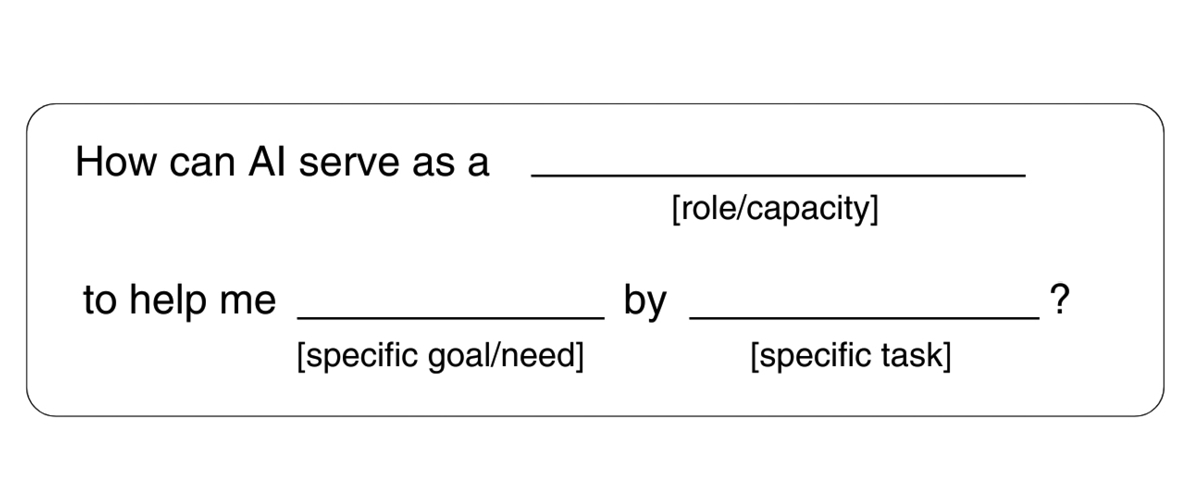
Consider getting even more targeted by breaking your challenge into sub-challenges, each representing a single component of the work. Remember, the more deeply you understand your AI Challenge, the more likely you will be to achieve a successful breakthrough.
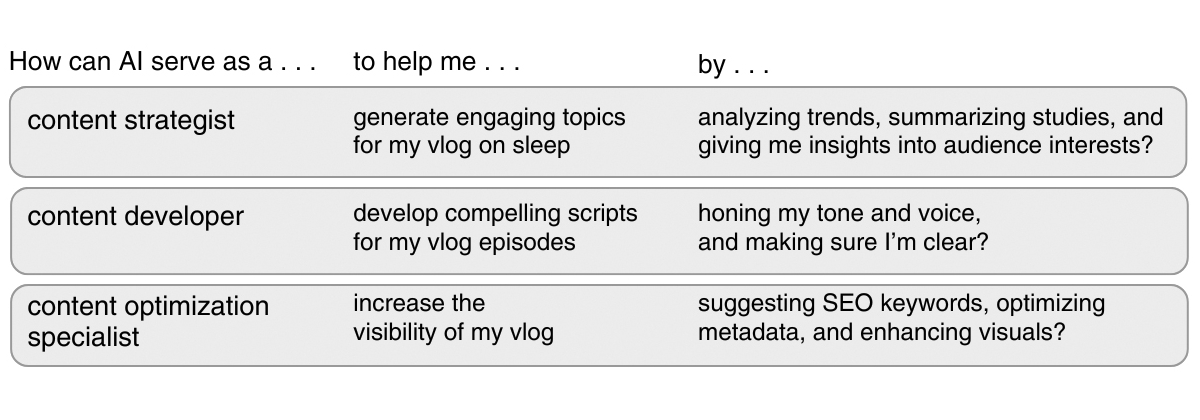
For example, you could break down the AI Challenge “How could AI help me to finally launch a successful vlog?” into more specific AI Challenges such as:
“. . . define my niche and audience,”
“. . . create a name and brand,”
“. . . develop compelling content and a publishing schedule,” or
“. . . promote my vlog.”
Then, imagine the ideal cognitive partner for each component.
To illustrate, here are a few more specific AI Challenges addressing different content needs for our vlog example:
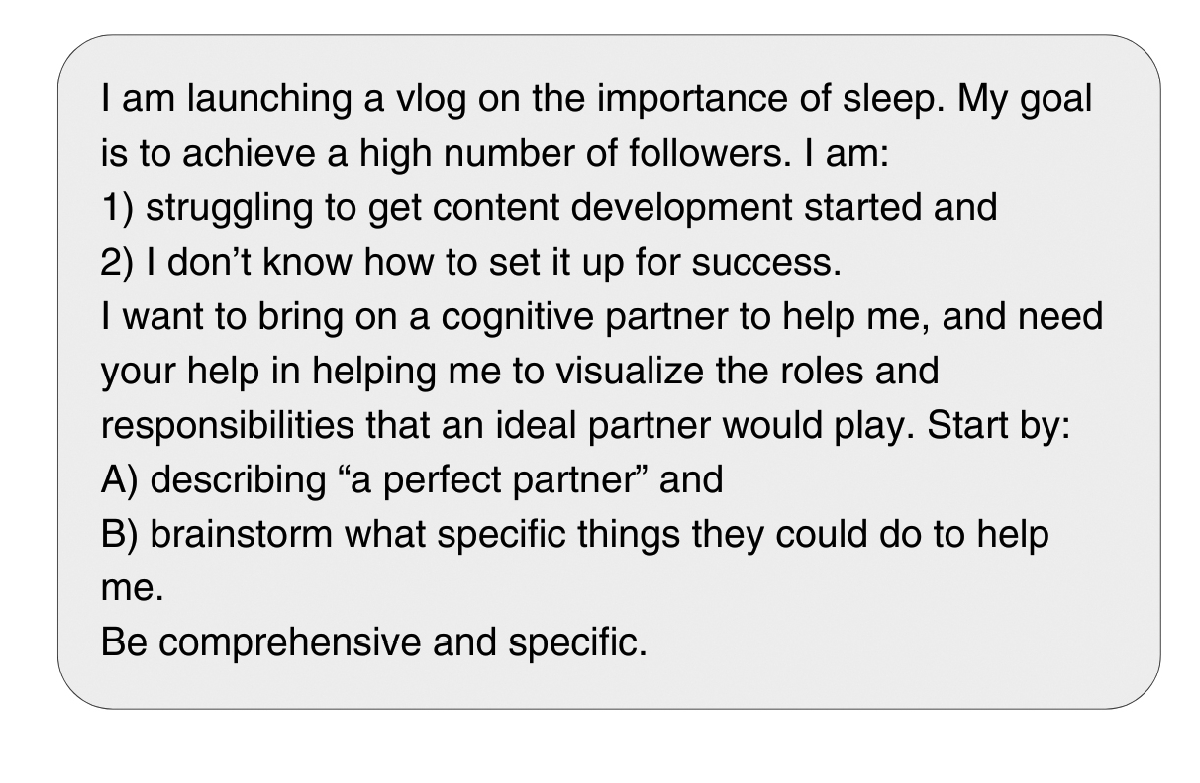
Pro tip: get help from AI through this entire process. Simply select a tool, describe your challenge, and start a dialogue on what’s hard about it for you. Ask AI to help you break your challenge down into smaller parts. Have it brainstorm what an ideal cognitive partner would be like. You can even throw it the list of questions I asked you at the beginning of Part C. The more specific you are, the more targeted and useful the AI’s responses will be.
练习题
Which of the following is NOT a question to identify areas for AI alignment?
When choosing your first AI challenge, what is the recommended approach?
What are the benefits of choosing a challenge slightly beyond what you expect AI to handle? (Select all that apply)
What aspects should you consider when imagining your ideal cognitive partner? (Select all that apply)
After succeeding with one AI use case, you should not return to reuse the process and tackle more needs.
It is not necessary to add texture to your AI Challenge by following a template.
When breaking down an AI Challenge like “How could AI help me to finally launch a successful vlog?”, one possible sub - challenge could be “___ my niche and audience.”
To get help from AI in the process, you can ask it to help you break your challenge down into smaller parts and brainstorm what an ideal cognitive partner would be like. You can also throw it the list of questions from the beginning of Part ___.
Explain why it is useful to imagine a hypothetical human collaborator when thinking about the role AI can play.
How can breaking an AI Challenge into sub - challenges help in achieving a successful breakthrough?
When choosing your first AI challenge, it's important to select a challenge that is slightly beyond what you expect AI to handle. Why is this recommended?
When imagining your ideal cognitive partner to address your AI challenge, which of the following aspects should you consider? (Select all that apply)
Breaking down your AI challenge into sub-challenges is a recommended strategy to gain a deeper understanding of the problem and increase the likelihood of a successful breakthrough.
When selecting your first AI challenge, it's crucial to concentrate on one specific area to allow for a deeper discovery process and increase your chances of achieving a ___.
登录后解锁笔记、知识点解析、AI 问答
立即登录