正在学习
Keeping It Human in a Digital World (14)
Keeping It Human in a Digital World (14)
Use formatting: Format to help you get your points across. Number steps, clearly label top priorities, put key copy in brackets, and even capitalize words or repeat key points for emphasis.
Express yourself clearly: Use simple words over ambiguous ones. Avoid vague language and be specific about your expectations and desired outcomes.
Be explicit: Steer clear of double negatives—clearly state what to “avoid” instead.
This is a bit of an art, as is all AI prompting. Experiment to find what works best for your specific needs. You’ll likely notice that communicating clearly with AI mirrors how we strive to be understood by other people. When refining complex prompts, I often ask myself, “How could I explain this more clearly to a stranger?”
Align Success Criteria
Collaborate with AI to define how it can make its responses more useful to you.
Taking a little time to collaborate with your AI on what defines a “great” response can get you much faster to useful results. Do you want poetry, prose, or code? Do you want quick, billboard-length answers? Do you want answers in a table or an infographic? Is there formatting that will make it easier to make use of its response? Especially when working with AI on recurring tasks, take the time to really align on how its responses are formatted to minimize additional work on your part. Here are approaches to pull from to set clear criteria for success:
Define tone: What kind of response will be most useful to you? Should it be communicated in simple or sophisticated language? Will it be responding with a specific voice or character? Who is your audience? What tone will resonate most with them?
Specify structure: What structure should the AI use to present its responses? Do you have any requirements for how it formats the response?
Outline scope: Are there angles or topics that the AI should cover in its response? Perspectives to consider or avoid?
Set boundaries: What constraints or boundaries do you want the AI to have? Do you want it to be concise? Avoid repetition? Consider the question from only a single perspective? Do you want it to wait for your additional background material before responding?
Consider removing limits: Alternatively, do you want to see how the AI could push your thinking by removing constraints altogether? Asking it to “be creative” and make assumptions along the way can signal AI to take new directions.
Consider putting the AI to work on designing the best way to present its results. Start by providing context and requesting a sample response. Then, engage in a dialogue to refine the format. You might, for example, ask for additional columns in a table or bold text to make it easier for you to see changes. When you’ve discovered a particularly useful presentation style, ask the AI to describe this approach “in complete detail.” Save this description to your library of prompts so you can more easily replicate this approach when you want something similar in the future.
Break It Down
Organize tasks into steps to avoid confusion.
When my kids were little, I learned to break down instructions step by step to increase the chances they wouldn’t get confused or miss something. AI also benefits from this approach. Today’s AI can stumble when overwhelmed with a barrage of requests, potentially missing details, becoming confused, or executing tasks in the wrong order. When you encounter these issues, try the following:
Break the task into smaller parts: Introduce one step at a time, or explicitly instruct the AI to “think step by step”. This technique is particularly useful for tasks that require multi-step reasoning, problem-solving, or complex analysis because it helps the AI find (and combine) the most relevant information more effectively.
Signal with formatting: If a single step has multiple substeps, use formatting to make it more likely the AI will understand you clearly. For example, number steps, or use brackets to identify a specific type of content.
Pace the interaction: Slow it down so it doesn’t leap ahead and do something you didn’t ask for (and may not even want). This also gives the AI time to “think,” which often improves results. Try telling your AI to wait for a response or its next instruction before proceeding.
| Getting Used to AI Conversations |
|---|
| No matter how digital our lives have become, having an actual conversation with AI can still feel strange at first. Here are examples of prompts my clients have used to start strong and steer conversations toward deeper territory—adapt them to your work, projects, and goals. |
Notes
1 E. M. Woodin, “A two-dimensional approach to relationship conflict: Meta-analytic findings,” Journal of Family Psychology, 325-335, 2011, https://doi.org/10.1037/a0023791.2 Cheng Li, Jindong Wang, Yixuan Zhang, et al., “Large Language Models Understand and Can be Enhanced by Emotional Stimuli,” 2023, https://doi.org/10.48550/arXiv.2307.11760.3 Alex Tamkin, Amanda Askell, Liane Lovitt, et al., “Evaluating and Mitigating Discrimination in Language Model Decisions,” December 6, 2023, https://arxiv.org/pdf/2312.03689.pdf.
- Step One: ActivateGetting to Know AI Through the Power of Play
Deepen your understanding of AI’s capabilities through purposeful play with diverse tools and modes of communication.
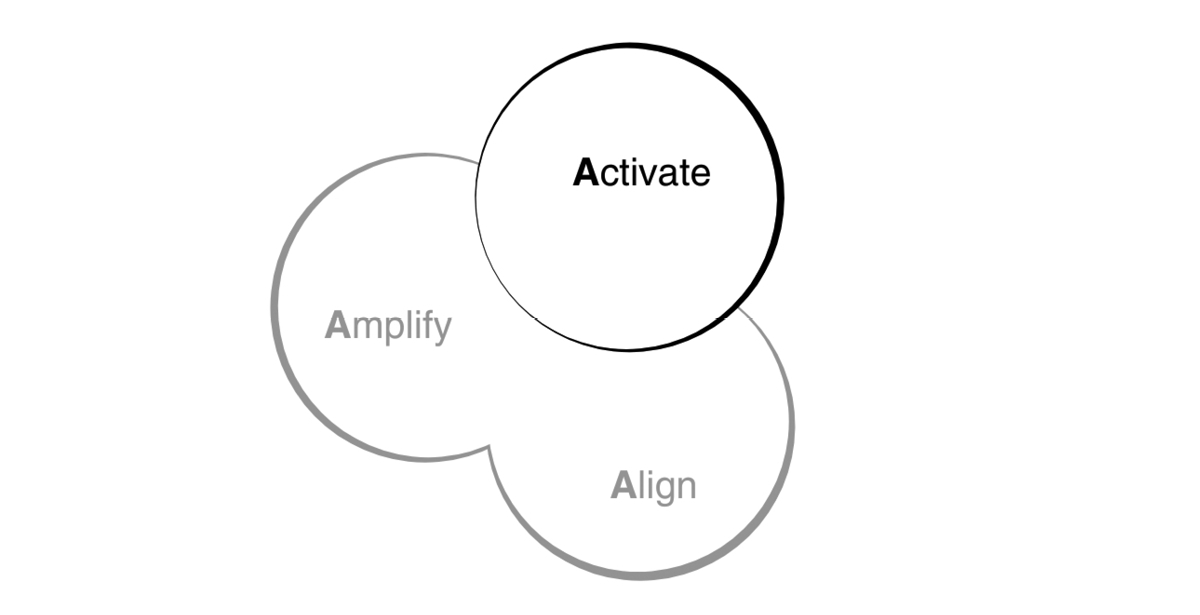
It’s time to dive into the first step of the A3 Framework, Activate: a hands-on exploration that will broaden your understanding of the capabilities AI now offers you. And here’s the good news: this step is a lot of fun. You’ll get to play with a range of tools—and I’ll walk you through it all to make it easy.
Adopting this mindset of play triggers creativity and curiosity. It’s the perfect way to explore the broad capabilities AI now offers because it encourages experimentation, idea generation, and flexible thinking, all of which are helpful when trying something new.
So why did I open this book with a story about my failed attempt to use play to get my own family to see the value of AI? Because it illustrates that the way we play matters.
In my research, I observed a pattern: early adopters frequently explored new tools and releases by toying with them—testing bizarre prompts, crafting unexpected challenges, and inventing quirky tasks just to see what surprises would unfold. And then—critically—it was easy for them to make connections between even strange experiments and “big picture” real-world impact.
练习题
Which formatting technique is NOT recommended for conveying points effectively?
What is the best approach to ensure AI understands complex multi-step tasks?
Which of the following are recommended techniques for defining useful AI responses? (Select all that apply)
It is recommended to use double negatives when communicating with AI to make instructions more clear.
When defining the tone for AI responses, consider who your audience is and what tone will resonate most with ___.
Explain why it is important to break down complex tasks into smaller parts when working with AI.
Which of the following is a recommended way to signal substeps to AI?
Setting boundaries for AI responses is not necessary as AI can handle any task without constraints.
To avoid overwhelming AI with complex tasks, it is recommended to ___ the interaction and introduce instructions gradually.
Describe how collaborating with AI to design response presentation can improve the usefulness of its responses.
When collaborating with AI to define useful responses, which of the following is NOT a recommended approach?
Which of the following strategies are recommended when breaking down tasks for AI to avoid confusion? (Select all that apply)
It is recommended to set boundaries for AI responses to ensure they are concise and avoid repetition.
When defining the tone for AI responses, it is important to consider the ___ and what tone will resonate most with them.
登录后解锁笔记、知识点解析、AI 问答
立即登录