正在学习
Keeping It Human in a Digital World (13)
Keeping It Human in a Digital World (13)
| The Bizarre Ways People Boost AI Performance |
|---|
| People are testing all kinds of approaches to get AI to give better answers, and some of the results are downright bizarre. One study found that framing math problems within a Star Trek scenario significantly improved AI performance on sets of 50 questions, while for sets of 100 problems, casting the AI in a political thriller where “the life of a president’s advisor hangs in the balance” proved most effective. These findings can simultaneously provoke eye-rolls and curiosity, but they underscore the importance of experimenting to find what actually works for you. This doesn’t mean you need to channel Captain Kirk when talking to your AI (unless that genuinely appeals to you). If there’s a particular style or persona you find more engaging or helpful, by all means, demand it. However, don’t feel pressured by those who claim to have magic spells for prompt crafting. What’s truly important is that you feel natural in your conversation with AI and use an approach that suits you best; keep trying new things (within your comfort zone) to see how it changes your results. One day, my frustration hit boiling point and I blurted out (or rather typed) this: |
| To my surprise, AI immediately and dramatically changed its approach, leaving me shaking my head but with a great answer. |
Adapt as AI Does
Stay informed and adjust your strategies as AI technologies and capabilities continue to advance.
It has become humanly impossible to keep up with AI innovation. The field simply moves too fast, with thousands of companies seeking to innovate, and a handful of highly sophisticated players pouring billions of dollars into the race to earn—and maintain—a leadership position. Industry-shifting news comes out all the time—and sometimes we have several significant announcements in the same week. This is overwhelming to those of us who spend all our time in the space, so how do you handle this torrent of change and expanding capabilities when you have other demands on your time?
This is a battle for everyone, but don’t give up: you can tap into significant developments with a little bit of effort. I’ve found these practical strategies to be most helpful for those who are trying to balance an interest in AI with the demands of a busy life:
- Practice meeting real-world needs: The most effective way to understand AI is to prioritize hands-on time with the tools, but make sure you focus that time on understanding how to get the tools to be more useful in helping you meet your routine daily demands.
- Spend a little, get a lot more: While free tools offer significant learning opportunities, I strongly recommend allocating a modest budget for subscriptions to more powerful models with exclusive features, or domain-specific tools relevant to your area of focus. This small investment can dramatically enhance your AI experience and results.
- Follow credible voices: Follow a small group of trusted AI experts and thought leaders to help you separate signal from noise and keep you abreast of significant advancements without overwhelming you. To help you get started, I’ve compiled a list of recommendations on my website, ThinkwithAI.org.
- Understand you’ll refine and adjust: A prompt that got you just what you wanted one day may suddenly work very differently. Expect to continually tinker to keep getting good results.
- Explore new developments firsthand: When a major AI breakthrough hits the headlines, make it a priority to experience it firsthand. You can learn a lot from even twenty minutes with a new model or feature. Test some of your go-to prompts to gauge whether responses have improved, or craft new prompts specifically designed to make use of the latest features or capabilities. After a week or two, when early adopters have had time to conduct their own experiments and share their findings, carve out some time to see what they’ve discovered, and use these insights to refine your techniques.
- Get experience before you judge: Know capabilities are always evolving, and do not make judgments about the usefulness of AI until you not only have a good deal of hands-on experience, but have seen firsthand how the models and functionality change over time.
The Art of Prompting: Secrets of the AI Whisperers
This next section serves as a practical guide to help you experiment effectively with prompt writing, a core skill that helps build AIQ. We’ll cover the key tactics to quickly get better responses from AI. For more advanced techniques to refine your prompts once you’ve mastered these basics, you’ll find recommendations for additional resources on my website.
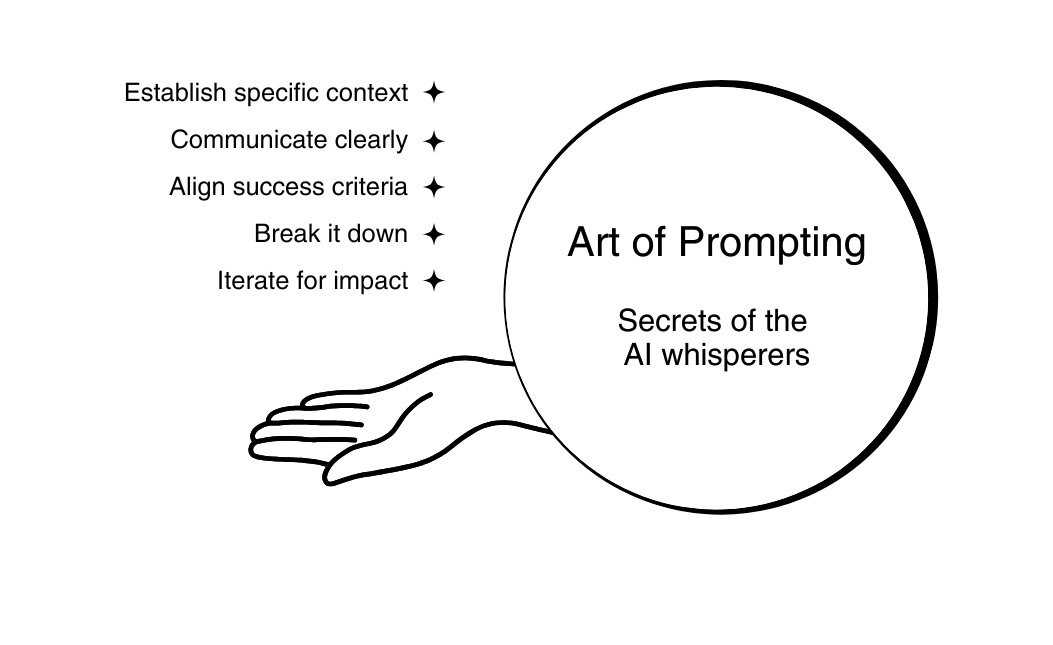
Establish Specific Context
Set the stage with key details that focus AI on what matters most.
As we discussed earlier, AI is a general tool that will provide generic, basic answers until you give it context. The more context you provide, the better responses you will get. For example, include this kind of context in your prompt:
Define your goals: What goals do you have? What are you seeking to achieve?
Assign a role: What should the identity or persona of the AI be when it does its work? What role do you want the AI to play?
Detail background material: What kind of research do you want your AI to do? Are there documents it should read or charts you are uploading for it to review?
You can give more context and background to “train” the AI in the way you want it to work and the kind of responses you want to see. This could include:
- Uploading style guides, employee manuals, or project briefs.[i]
- Uploading examples of your writing, or work you are proud of.[ii]
- Sharing your relevant expertise. For example, if you’re asking AI to help with marketing strategies, you could provide an outline of an effective marketing plan you’ve used. If you’re seeking assistance with personalized meal plans, you might upload a transcript from a podcast interview that discussed nutrition guidance you want to abide by. Or, if you’re working on a creative writing project, you could share a framework you’ve found effective for character development.
Communicate Clearly
Provide direct and unambiguous directions.
Just like humans, today’s models can get confused by long, rambling requests. The more directly and clearly you communicate to AI, the better its responses will be.
Be coherent: Organize your thoughts logically and avoid convoluted phrasing.
练习题
According to the text, which scenario improved AI performance on sets of 100 math problems?
The text suggests that it is important to feel natural in your conversation with AI and use an approach that suits you best.
The text suggests that you should keep trying new things within your ___ to see how it changes your results with AI.
Which of the following are practical strategies for keeping up with AI innovation mentioned in the text?
Explain why providing context is important for getting better AI responses.
Which of the following is NOT a suggested way to establish specific context for better AI responses?
The text suggests that you should allocate a modest budget for subscriptions to more powerful AI models with exclusive features.
The text suggests that you should ___ new developments firsthand when a major AI breakthrough hits the headlines.
Which of the following are mentioned as ways to boost AI performance in bizarre ways?
Why is it important to stay informed and adapt to AI advancements?
Which approach is most consistent with the concept of establishing specific context for better AI responses and being authentic with AI?
Which of the following strategies are recommended for keeping up with AI innovation and also involve treating AI as a partner?
To get better responses from AI, you should ___ it with detailed context and treat it as a thought partner that learns over time.
Explain how staying informed about AI advancements and experimenting with different AI models can help you find the most suitable AI interaction style.
登录后解锁笔记、知识点解析、AI 问答
立即登录