正在学习
Keeping It Human in a Digital World (7)
Keeping It Human in a Digital World (7)
1 David Autor, Caroline Chin, Anna Salomons, and Bryan Seegmiller, “New Frontiers: The Origins and Content of New Work, 1940–2018,” National Bureau of Economic Research Working Paper, August 2022, https://www.nber.org/papers/w30389. 2 “Global influencer marketing market size from 2016 to 2022 (in billion U.S. dollars),” Statista. 3 Matt Levine, “Marc Andreessen Answers the Tech Valuation Question,” Bloomberg, May 22, 2017, https://www.bloomberg.com/opinion/articles/2017-05-22/marc-andreessen-answers-the-tech-valuation-question. 4 Nick Bilton, “Bubble? What Bubble?” New York Times, July 10, 2011, https://www.nytimes.com/2011/07/10/magazine/marc-andreessen-on-the-dot-com-bubble.html. 5 Ashish Vaswani, Noam Shazeer, Niki Parmar, et al., “Attention is all you need,” 2017, https://doi.org/10.48550/arXiv.1706.03762. 6 Clifford Stoll, “Why the Web Won’t Be Nirvana,” Newsweek, February 26, 1995, https://www.newsweek.com/clifford-stoll-why-web-wont-be-nirvana-185306. 7 Alexander Bick, Adam Blandin, and David Deming, “The Rapid Adoption of Generative AI,” Federal Reserve Bank of St. Louis Working Paper 2024-027, September 2024, https://doi.org/10.20955/wp.2024.027. 8 Anson Ho, Tamay Besiroglu, Ege Erdil, et al., “Algorithmic progress in language models,” 2024, https://doi.org/10.48550/arXiv.2403.05812. 9 Benedict Evans, “The AI summer,” July 9, 2024, https://www.ben-evans.com/benedictevans/2024/7/9/the-ai-summer.
Part Three:Thinking 2.0

- How to Think with AI
Early adopters are discovering extraordinary ways to enhance their work and lives by thinking with AI. While many people haven’t progressed beyond basic, one-off tasks, these pioneers have woven AI into the fabric of their daily lives—and are getting results every day.
What sets them apart? How do they unlock deeper levels of human-AI collaboration? How do they integrate AI into their creative, problem-solving, and decision-making processes? And critically, what can we learn from their methods to develop a practical approach that works for everyone?
A year ago, I embarked on a mission to decode how early adopters developed their ability to Think with AI. My research cut across industries and sectors, and every level of business and technical expertise—from corporate executives to middle managers to freelancers. Despite their varied backgrounds, each had developed high AIQ and were continually discovering new ways to leverage AI for breakthrough results.
As clear patterns emerged, I began collaborating with AI newcomers to test which early adopter practices most helped people succeed. It quickly became clear that simply mimicking early adopter behavior—which requires hunting out new innovations, wading through glitchy user experiences, testing unpolished products, leaning into new releases, and rapidly iterating through wide-ranging experiments—proved frustrating or overwhelming for many people. They needed a more structured approach that would lead them more directly to AI’s most meaningful applications in their work and life. Through testing and refinement, I distilled the process down to the core elements needed to develop an ability to Think with AI.

The Path to AIQ: The A3 Framework
The result is the A3 Framework, a structured learning journey designed to boost your personal AIQ, or AI Quotient, which is your ability to use AI to enhance your own creativity and performance. The framework transforms the chaotic, time-intensive experimentation of early adopters into focused, purposeful exploration that consistently produces “aha” moments and lasting breakthroughs, regardless of your age, profession, or technical background.
Step One, Activate: Expand your understanding of AI’s potential through purposeful exploration.
Step Two, Align: Match AI’s capabilities to your specific needs and goals, iterating rapidly to achieve breakthroughs that matter to you.
Step Three, Amplify: Integrate AI into your daily routines, creating compound benefits over time.
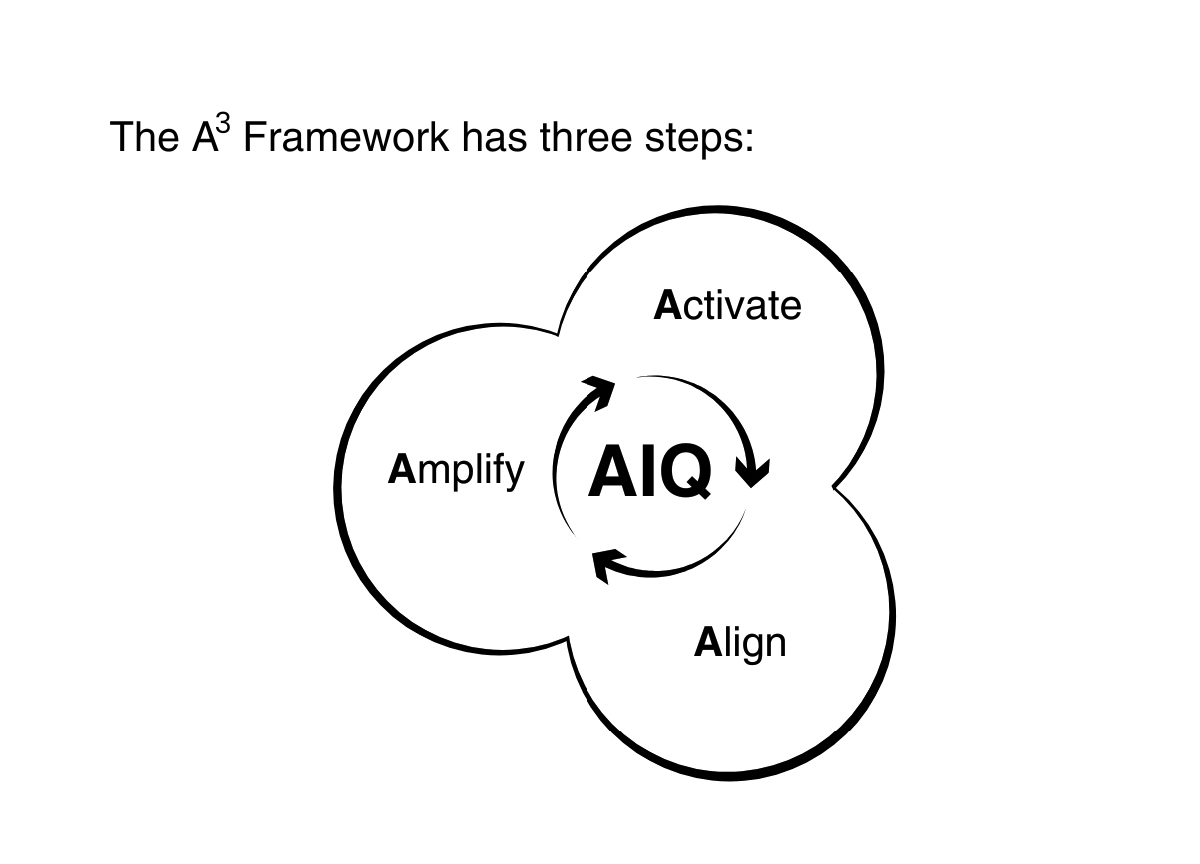
This journey transforms AI from a mere novelty into a valuable resource that delivers real impact in your life. What emerges isn’t just AI proficiency—your personal AIQ becomes a measure of your enhanced problem-solving ability, your expanded creative capacity, and your amplified professional impact.
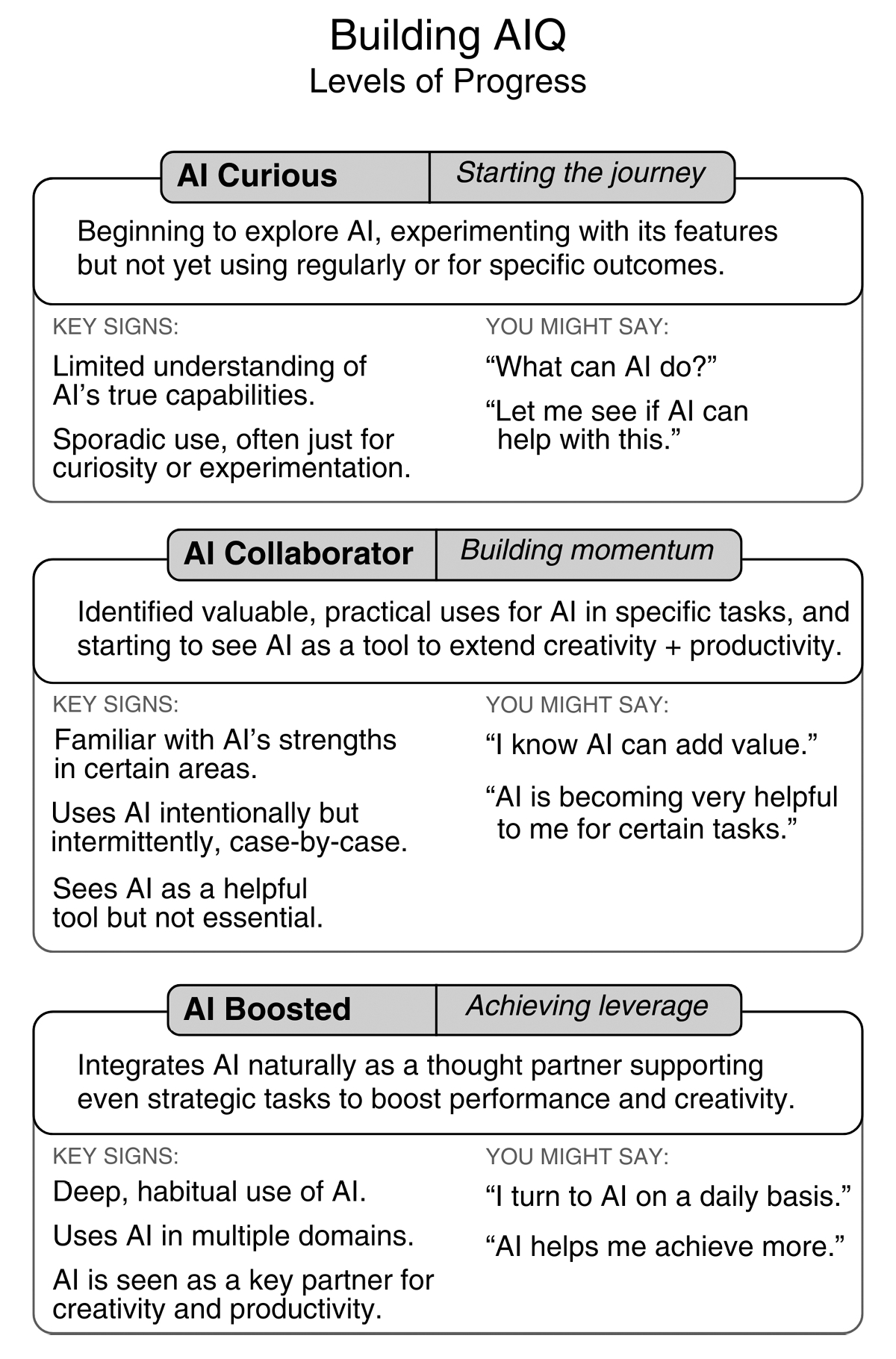
Building personal AIQ happens in stages. I’ve mapped three levels of progression to help you recognize where you are today and envision what’s ahead. Each level marks a meaningful shift: from initial exploration, through purposeful application, to amplifying your capabilities in creative and powerful ways.
Preparing to Seize Your AI Advantage
练习题
According to the text, what is a key difference between early adopters of AI and many other people?
What was the main focus of the research mentioned in the text?
What challenge did many people face when trying to mimic early adopter behavior with AI?
The A3 Framework is designed to randomly explore AI capabilities without a specific goal.
The outcome of the A3 Framework journey is to transform AI from a novelty into a valuable resource that delivers real impact in life.
The first step of the A3 Framework is to ___.
Building personal AIQ happens in ___.
What are the three steps of the A3 Framework for boosting personal AIQ?
What are some of the challenges faced by companies in the earliest stage of the AI era? (Select all that apply)
Explain the significance of the Transformer Architecture in the context of AI acceleration.
How does the text suggest that the early stages of powerful technology, like AI, are often characterized?
Which of the following statements are true about the impact of AI on jobs and industries? (Select all that apply)
According to Amara's Law, how do we typically perceive the impact of a new technology in the short run versus the long run?
Which of the following are key steps in the A3 Framework for boosting personal AIQ? (Select all that apply)
The Dotcom Bust demonstrates that failed technologies will never succeed in the future, as evidenced by companies like Pets.com that never recovered.
The A3 Framework transforms chaotic experimentation into ___ exploration that produces lasting breakthroughs.
How does the A3 Framework's 'Align' step address the uncertainty about AI's future described by Sam Altman?
登录后解锁笔记、知识点解析、AI 问答
立即登录