正在学习
Keeping It Human in a Digital World (5)
Keeping It Human in a Digital World (5)
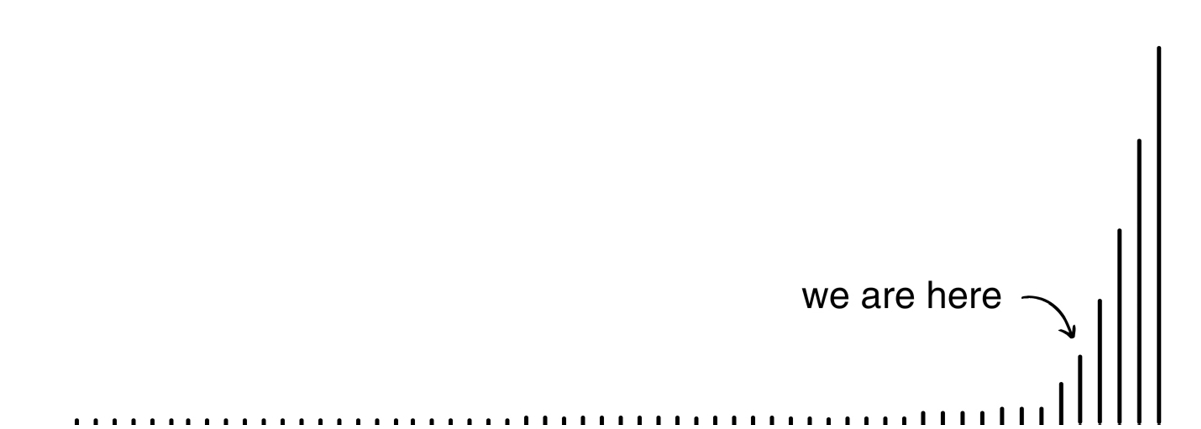
In our modern world, change is accelerating, which can make it even harder to recognize from within the midst of the transformation. Researchers estimate that sixty percent of the jobs we have today didn’t even exist in 1940. Just thirty years ago, few imagined a world in which a small online bookseller, Amazon, would become one of the most powerful companies in the world. Or that billions of people would spend hours every week on something called social networking, and that it would spawn an entirely new influencer marketing industry projected to reach twenty-four billion dollars in 2024.
AI is the next wave of technology surging towards us with great speed, and all indications are that it will also carry a transformative impact.
The Next Leap: Cognitive Efficiency
The Industrial Revolution was triggered by significant evolutions in mechanical efficiency. The new capabilities of machines led to widespread transformation across industries, sectors, and job functions.
Now we are at the dawn of a new kind of revolution—the cognitive revolution—where we have access to a significant leap in cognitive efficiency. Once again, the new capabilities of machines are poised to trigger widespread change. We can expect volatility in the labor landscape across every sector. People in all kinds of jobs and industries will discover or invent new ways of using AI that will make some jobs obsolete, others change dramatically, and new types of work emerge. Once again, we struggle to predict the exact implications. You can, however, count on disruption: this will be a bumpy ride.
But What About All the Bloopers and Glitches?
When you hear about chatbots going rogue, AI systems making embarrassing mistakes after highly publicized rollouts, or image generators creating absurd visual errors, it certainly doesn’t look as if this is going anywhere. But this disconnect is actually a familiar pattern. Roy Amara, former President of the Institute for the Future, articulated it in what’s known as Amara’s Law:
We tend to overestimate the effect of a technology in the short run and underestimate the effect in the long run.
In the early stages of a technology, the vision often outpaces reality, leading us to overestimate its immediate capabilities. It’s only after both the technology and our understanding of how to use it have matured—a process that can take considerable time—that we can truly grasp its potential. This future impact is what we tend to underestimate.
Venture capitalist and tech pioneer Marc Andreessen claims that every idea that failed in the dotcom bust would work today, explaining, “There are no bad ideas, only early ones.” If you were around in the dotcom boom, you’ve likely seen this firsthand. In the 1990s, I ordered pet food from Pets.com, convenience store items from Kozmo.com, and groceries from Webvan—up until they all went bust amid headlines proclaiming the end of an era. Fast forward to today, and delivery trucks roam all day long, dispensing similar online goods and services directly to the houses in my neighborhood.
This transformation from bust to ubiquity didn’t happen overnight. It required the maturation of several key elements, as Andreessen explains: the evolution of broadband, widespread adoption of personal computers, development of robust e-commerce infrastructure, and a sophisticated online advertising ecosystem. Crucially, we also needed a fundamental shift in how consumers and businesses interact with technology to bring about real change.
While we now have substantial infrastructure to support AI—powerful cloud computing, vast datasets, sophisticated hardware—other elements need to mature to support sustainable business models (which remain unclear) and to make AI work better for us. This evolution will take time, and like the dotcom era, we’ll see casualties as some companies fail to navigate these early stages. However, this doesn’t spell AI’s demise; it’s a natural progression in the lifecycle.
These dynamics explain why the early stages of powerful technology often feature a collision of contrasting perspectives. “Visionaries” paint pictures of massive potential that can sound like science fiction to contemporary ears. Meanwhile, critics point to the technology’s glitchy, immature state and dismiss it as hype. We tend to get caught between these contrasting narratives, where it becomes especially challenging to understand what’s really happening.
| Why the Web Will Fail |
|---|
| Amara’s insight about underestimating technology is vividly illustrated by a now infamous 1995 Newsweek article. Back when there was a lot of breathless excitement about the future of a web that just wasn’t delivering, Clifford Stoll wrote: “Visionaries see a future of telecommuting workers, interactive libraries and multimedia classrooms. They speak of electronic town meetings and virtual communities. Commerce and business will shift from offices and malls to networks and modems . . . Baloney. Do our computer pundits lack all common sense? The truth is no online database will replace your daily newspaper, no CD-ROM can take the place of a competent teacher and no computer network will change the way government works.”He continues: “How about electronic publishing? Try reading a book on disc. At best, it’s an unpleasant chore: the myopic glow of a clunky computer replaces the friendly pages of a book. And you can’t tote that laptop to the beach. Yet Nicholas Negroponte, director of the MIT Media Lab, predicts that we’ll soon buy books and newspapers straight over the Internet. Uh, sure.” Stoll’s critical mistake serves as a poignant reminder of how challenging it can be to envision the future from the early stages of a technology. |
We’re Just Getting Started
Zoom out, and it’s clear we’re just at the start of a rapid surge in AI innovation. There are several reasons why what we’ve experienced so far only scratches the surface of what lies ahead.
练习题
According to the text, what percentage of today's jobs did not exist in 1940?
What is the main focus of the cognitive revolution as described in the text?
According to Amara's Law, which of the following are true about technology's impact?
The dotcom bust ideas would not work today according to Marc Andreessen.
The early stages of powerful technology often feature a collision of contrasting perspectives.
The transformation from the dotcom bust to ubiquity required the maturation of several key elements, including the evolution of ___, widespread adoption of personal computers, development of robust e-commerce infrastructure, and a sophisticated online advertising ecosystem.
Explain why the early stages of powerful technology often see a collision of contrasting perspectives.
Which of the following is an example of a company that went from a small start-up to a major global player as mentioned in the text?
Which of the following are mentioned as reasons for the transformation from dotcom bust to ubiquity?
What does Amara’s Law suggest about our perception of technology's short-term and long-term effects?
According to Amara's Law, how do we typically perceive the effects of a new technology in its early stages versus the long run?
Which of the following factors contributed to the transformation of the dotcom bust ideas into ubiquitous services today? (Select all that apply)
The Industrial Revolution and the cognitive revolution both led to widespread changes across industries and job functions, but the cognitive revolution is expected to cause less volatility in the labor landscape.
Clifford Stoll's 1995 article failed to foresee the potential of the internet, dismissing ideas like online publishing and ___ as impractical.
登录后解锁笔记、知识点解析、AI 问答
立即登录