正在学习
Body Changes, Lostness, Risk Formulas, and Exploration
Body Changes, Lostness, Risk Formulas, and Exploration
 You spend a few good years on top and then without warning you start rolling down the other side of the hill. Those few solo gray hairs turning into an ensemble cast. Not only does your hair begin to recede, but to your disbelief, so do your gums. Seriously, that’s possible? Cracked molars, knee, back, hamstring, thyroid problems—the rubber-band-ness of your body begins to stop snapping back into place. A night on the town or two-hour football game now taking a week to recover from. And as I watch my hair retreat like a cowardly army, I’m keeping my fingers crossed. Because going bald is like playing the lottery. You don’t know if your head’s a winner until you’ve scratched it all off. Your 20s are about experiencing the first signs of Retroactive Puberty—just when you’ve become used to your body, it starts going through changes again.
 I spent oh so many years in my 20s feeling like I was playing a never-ending game of hide-and-seek with myself, and at some point I was going to jump out and yell, “Surprise, you found me!” Then I figured out the secret—I will never feel like myself again. Because I was holding on to a Me that I could no longer be. Like that photograph Michael J. Fox holds in Back to the Future, Old Me was fading fast and not even an epic guitar solo could bring it back. It’s like our Self-Bust that we spent years creating has in fact Busted all over the ground, and instead of spending our 20s down on our knees trying to find the dusty and dirty pieces to glue back together, we should just work on building a new sculpture. And once we’re done with this new masterpiece, it will be time to start another. You will have lots of versions of yourself over your lifetime. Stop trying to download YOU 1.5 when you need to start developing YOU 3.3. Let’s leave the Old-Me’s in the Me Hall of Fame where they belong and work on creating the new.
I, _____________, am a twentysomething and I am exploring. Or I’m lost? I’m not sure which one. I brought supplies. I prepared. I thought I knew the way, but I think I took a left when maybe it was supposed to be a right? Or a left, then a right, then a left? Or right, right, left … oh I dunno. Nothing looks familiar. The birds circling above me seem to be growing in numbers. And I’m scared, to be honest. Actually, I think FREAKED OUT would be more accurate. I don’t have a map, my mom, Pocahontas, or a furry little animal to show me the way back home. But wait, where’s home? What’s home? That’s why I went exploring in the first place—to find that place where I could unpack my clothes and start my life. How can I go back to something that I set out to discover? How can I go back to something that no longer exists?
Home is the New World. I will find it or die trying.
Okay, not really die trying. That sounded dramatic, so I wrote it. No, really, I was dying waiting. I was dying when my nights were spent watching B movies to forget about my D+ life. Sure I’m scared now. More than ever. But I’m also alive now too. I have a certain focus. A certain kind of adrenaline and drive fueling me, compelling me to keep moving forward. Yeah, I’m lost. But maybe that was the whole point.
Being lost might be the exact spot that I can be found.
Because getting lost is the first part of exploring. All explorers get lost.
The biggest difference between exploring and aimless wandering is that explorers get lost on purpose, with purpose, for a purpose.
Explorers only find something greater if they first lose sight of the familiar. I will not go on this journey alone. Lewis had Clark. Neil Armstrong had Buzz Aldrin. Explorers always have a party—a support group to help, guide, and save. I’m calling in reinforcements. Then when morning comes I’ll move forward. All explorers have to get lost. That’s when they make their biggest discoveries.
I, __________, am a twentysomething and I am exploring.
But can you remember a story of someone perishing while rappelling into the Grand Canyon? Yeah, me neither. Probably because everyone who is rappelling is a trained professional or is with a trained professional. It’s the same with pursuing a dream. Don’t do it alone. Pursue your dream with the help of someone who has done it before. You want someone who knows what they are doing holding the end of the rope as you dangle off the cliff, right?!
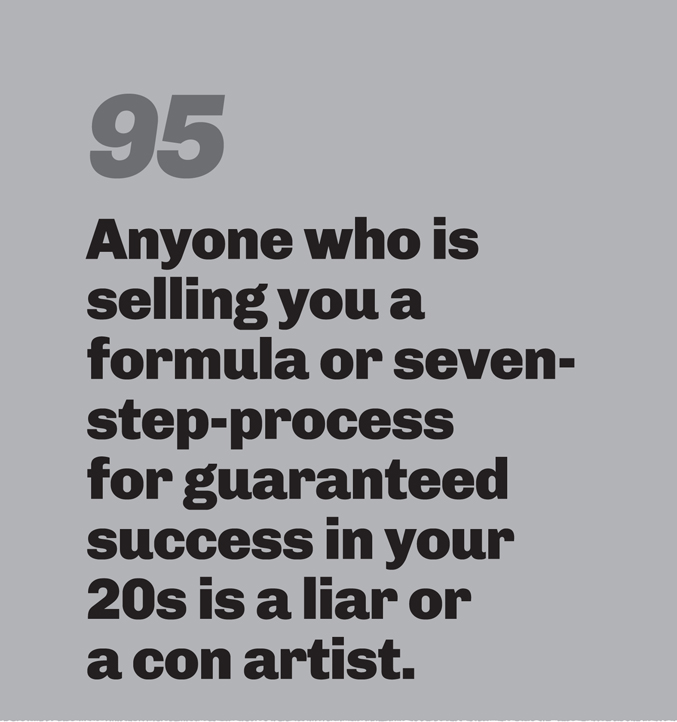
(Unless it’s coming from me. Then you’d be crazy not to snag it for $19.99.)
练习题
Which option best captures the section’s idea of “Retroactive Puberty” and its connection to identity in your twenties?
According to the section, what most clearly separates exploring from aimless wandering?
If someone is pursuing a risky dream, which response best matches the advice in the section?
Which statements accurately reflect the section’s view of personal change and exploration? Select all that apply.
Which ideas are presented as part of healthy exploration in the section? Select all that apply.
The section teaches that a seven-step process can guarantee success in your twenties if it comes from an experienced person.
The section suggests that instead of trying to restore an old self, people should keep building new versions of themselves throughout life.
The section calls the first surprising body changes of the twenties “___.”
Why does the section advise people not to pursue a dream alone, and how does this connect to the earlier idea that intentional refresh prevents burnout?
How does the section’s distinction between purposeful exploration and aimless wandering relate to the earlier advice about making wise, substantial marriage decisions rather than impulsive ones?
A person says, “I miss the old version of me, so I’m trying to get back to exactly who I was before marriage and adulthood changed everything.” Which response best integrates the current section’s idea of self-change with the prior section’s idea about marriage?
Which actions best show the difference between purposeful exploring and careless impulsiveness when making major life choices?
Because the current section describes bodies in the twenties as beginning to recover more slowly, it supports the prior advice that intentional refresh can help prevent burnout.
In both pursuing a dream and exploring an uncertain life direction, the text suggests you should not go alone; you should seek ___ from others who can help guide you.
登录后解锁笔记、知识点解析、AI 问答
立即登录