正在学习
Human Strengths in an Age of AI
Human Strengths in an Age of AI
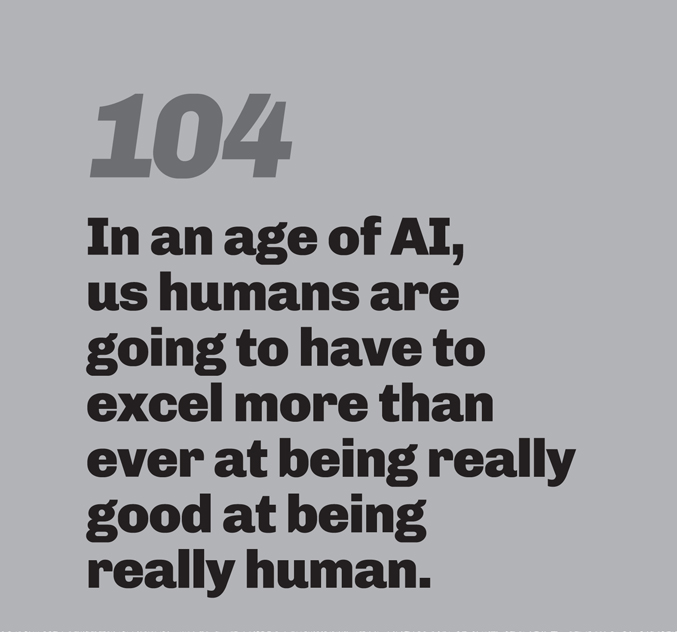
I sit here now at just the beginning of this AI revolution. When you read this, who knows what, where, and dare I say who, AI is and is not. When I graduated college, the talk was all about work being outsourced. Now with AI, it seems the work is all being insourced … or just replaced by a freakishly smart chatbot. The computer we use to work on now doing the work for us. We’ve had many revolutions where machines replaced humans and entire industries were collapsed or created.
Just as the machines replaced the artisans time and time again in history, it seems AI is here to replace the systems and structures that we have depended on for so long. Today artisans are still valuable in many cultures for their ability to create something truly unique that is not based on efficiency but on heart, hands, and soul.
Will the artisans, the human creators, still have a place in this AI world? I believe so. In a world of AI that will make everything “perfect,” “streamlined,” and “efficient” in the most “machinely” way possible, what will be our place, role, and differentiation that will allow us to be successful? I think we have to really embrace our humanity and, quite frankly, become better at it. How do we do that?
Our Strengths as Humans
Let’s start with our strengths as freethinking humans—our ability to solve problems, come up with new ideas, create something from scratch, ask good questions, communicate with other humans in a way that makes them feel valued and seen as people. The ability to empathize and care for someone. To hug someone in pain. To encourage someone who has lost hope, in a way they didn’t know they needed or how to ask for. It’s our ability to think and feel beyond prescribed parameters that sets us apart from AI.
We have to operate from the depths.
Living and working on the surface is not going to cut it anymore. The busy work that we used to complain about in the office will silently go away as it will efficiently be completed by a system without us. Now more than ever you need to operate from your God-given gifts as a creator. To come up with ideas birthed from who you are, from your talents, values, skills, and your story. The world still needs your signature sauce, the blend of flavors you bring to the world.
This substance comes from our strengths as humans, but it also comes from our weaknesses.
Our Weaknesses as Humans Will Help Us Succeed?
More than ever, we have to understand and embrace our “weaknesses” as humans. It will be our imperfections, our vulnerability, our honesty, our struggle to make the mess meaningful that will be our marketability of sorts. Messes aren’t efficient. But every creative person knows you sometimes have to make a mess to make something magnificent. It’s hard to empathize with someone when you don’t understand the mistakes you’ve made.
Efficiency rarely correlates with deeper connection.
Many of the greatest discoveries and inventions came from the greatest mistakes. It’s in our stumbling, searching, and working through our problems and pain that we learn and come up with a pathway forward. For ourselves, and sometimes for others, to follow. This all means that we cannot take the easy way out. Because the easier, more efficient way might not be the better one in this AI world.
Are we living in freedom or are we being controlled?
It’s going to be increasingly easier and more persuasive to take all our issues to AI to answer for us. To abdicate our gifts to think independently and to let AI “solve” all the problems for us. Yet, I feel increasingly convicted by the fact that we can’t let the algorithms take over our lives. We have to still work at thinking independently from the system. We can’t be mentally and emotionally controlled by AI.
We must harness our gift and ability of awareness. We must continue to work our brains and our abilities to think independently and critically on the big questions and concerns at hand. In a world where we become increasingly dependent on AI, we become even more increasingly lazy in our thinking. We grow our minds when we work a problem over and struggle to come up with a solution. Those times when we can’t solve the problem are especially important to our learning. If you always had the teacher’s manual in front of you for every test, you would never struggle to learn the material.
Sure, we can ask AI to give us information to help us work a problem. Yet, just like any tool, we have to be intentional to be the ones using it, not it using us. To use AI effectively, we have to be disciplined and diligent not to use it at times. To take our questions outside, in prayer. To read a book with an open mind of continued learning. To seek physical conversations with others, even those who disagree with us.
I asked the AI system Grok what sets humans apart from AI, and it said that AI “operates on algorithms, data, and logic, excelling at pattern recognition and task efficiency, but lacking true awareness or emotional depth. Humans also have moral agency and social bonds that AI can simulate but not embody.”
It is in the struggle of the questioning, in not knowing the answer, that’s where our “emotional depth” is dug. If we only seek the easy answer, like only eating a candy bar when you’re hungry, you will be missing out on the hard-earned substance of true mental, emotional, and spiritual sustenance that comes in the waiting and not knowing, in struggling to understand.
The humans who thrive will be those who can still think, empathize, and harness their God-given gift of being a human. We have to go where no human has gone before—to embrace more than ever our humanity. You have to pick up the proverbial shovel on your own and dig, not knowing what you will discover.
How deep will your well be if you only ask AI to dig it for you?
练习题
According to the section, what major shift does the AI revolution create in the nature of work?
Which choice best describes why the author believes human creators and artisans will still matter in an AI-driven world?
What does the author mean by saying humans must not let AI “use us”?
Which statements accurately reflect the section’s claims about human strengths in an age of AI? Select all that apply.
The section argues that imperfections, vulnerability, mistakes, and struggle can become part of a human creator’s value rather than merely weaknesses to hide.
According to the section, the easiest and most efficient way is always the best way because efficiency automatically creates deeper connection.
The author says the world still needs your “___,” meaning the unique blend of talents, values, skills, and story that you bring.
In 1–3 sentences, explain how the author thinks people should relate to AI without losing their humanity.
Which actions would best match the author’s advice for developing human depth in an AI world? Select all that apply.
The section suggests that AI can simulate social bonds and moral agency, but it cannot embody them in the same way humans do.
Which response best combines the section’s advice about thriving in an AI world with the earlier lesson from Dr. Seuss’s creative constraints?
Which statements accurately integrate the current section’s view of human value in an AI age with prior lessons about change, failure, and creativity?
True or false: The current section’s claim that humans should not abdicate independent thought to AI supports the earlier idea that the most important secrets are the ones people figure out for themselves.
In an AI age, the author suggests that humans should bring their unique “signature sauce” from their talents, values, skills, and story; this connects with the earlier advice to focus on what feels beautiful and important by showing the world something deeply ___.
登录后解锁笔记、知识点解析、AI 问答
立即登录