正在学习
Quarter-Life Crisis and the Danger of Comfortable Work
Quarter-Life Crisis and the Danger of Comfortable Work
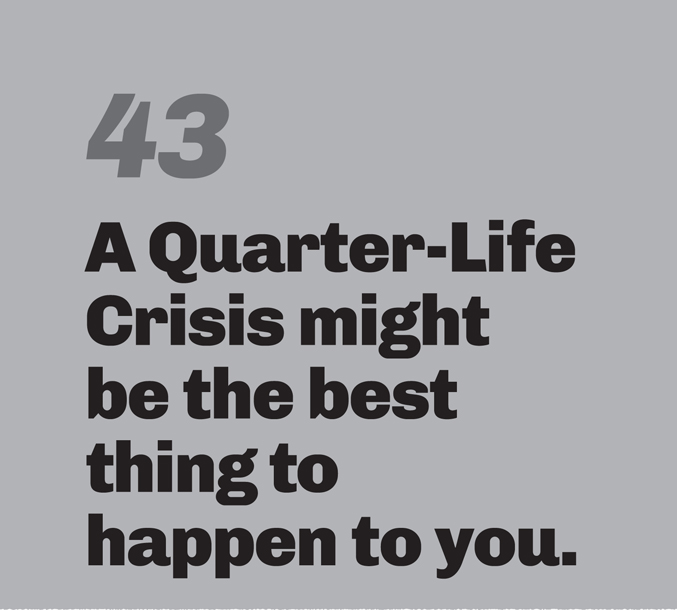
Yes, this turbulent season in your 20s where you feel like you’re getting the insides ripped out of you like crab legs at a Las Vegas buffet. Yes, this season will be the most important season of development in your entire life.
Let me explain.
LIFE LIVED LINEAR
Growing up, we lived life so linear.
Middle school. High school. College. Grad school. Cubicle job.
Climb that step so you can climb the next and the next and the next …
don’t question. don’t look back. don’t turn.
Climb you fool. Climb!
higher.faster.farther.further.
We earn degrees, corner offices, 401(k)s—but is plodding up a stairwell the way we want to live?
TIME TO EXPLORE
A Quarter-Life Crisis is simply when you finally stop climbing the stairs and start exploring the unknowns of the 15th floor.
The door locks behind you.
You strain your eyes but can only make out a dimly lit hall that appears to never end. You feel stuck in a Stephen King novel and at any second, train headlights might start hurtling toward you.
No syllabus.
No textbook.
No professor with a flashlight to shed light on all the answers.
No, just you and an endless number of rooms.
All you can do is start opening doors.
And it’s a tad terrifying, if you’re honest.
Because exploring the dark has always been that way.
Because you’ll enter rooms that smell like mothballs and musty attics.
Because you’ll get lost and there’s no assurance that you’ll ever find your way out.
VALUE OF A QUARTER-LIFE CRISIS
But the more rooms we go in, the more the maze begins to make sense.
Exploring in the dark is not easy. But our eyes begin to adjust.
We start learning how to really see.
We learn how to fail.
And struggle.
And persevere.
We learn that sometimes life will dismantle you so that you can be rebuilt.
We learn how to explore again like we’re eight years old in the field behind our house.
We might look back to our life on the stairwell and realize it wasn’t much of a life after all.
So yes, I’d rather we experience crisis now and have the rest of our lives to live than when we’re 55 with so much of our lives already cashed in.
I’ll take my quarter-life crisis now rather than when three kids, a mortgage, and spouse are at stake.
Really our quarter-life crisis is a period of transition when everything that used to be familiar becomes very unfamiliar.
And if we don’t learn how to explore now, then we’ll really be lost later.
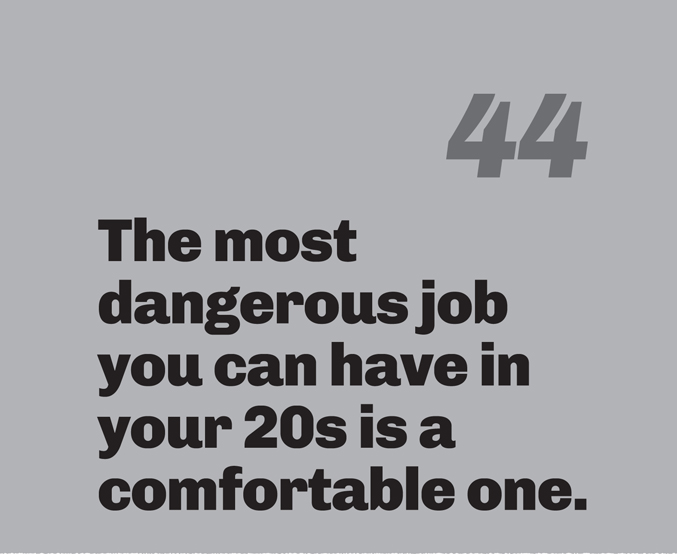
Comfortable is quicksand—the job you never wanted becoming the job you can’t escape.
Worse than no job, frustrating job, or a demanding job, is a job that demands nothing. Like taking basket weaving your senior year. Sure you’ll get an easy A, but what did you miss out on in return?
There is a stark cost for time wasted on comfortable.
You don’t learn. You don’t refine who you are or what you’re capable of. Remove challenges, remove growth.
Here are two signs your job might be La-Z-Boy-esque and it’s time to escape.
- YOU FEEL DRAINED BY DOING NOTHING
If you come home absolutely drained from work and need to watch 2–4 hours of TV a night to escape. Then you think back to your day and realize you really did nothing at work. You’re really just drained because you’re experiencing the effects of Mushy Mind.
You’re drained because you’ve mastered how to spread one hour of actual work over a span of eight.
Being drained by comfortable is an uncomfortable way to start living. Because it’s incredibly hard to escape. Like a carousel ride that never stops spinning.
Jump and roll.
- “WE WANT TO PROMOTE YOU” IS THE PHRASE YOU FEAR MOST.
If the idea of being promoted makes you more nauseous than the time you ate cotton candy and three churros before jumping on the Spinning Teacups of Terror, then why are you working there?
I can hear lots of “but Paul, you still don’t understand …”
No, I do understand.
Comfortable is your drug. I’m checking you into a clinic.
Quit comfortable before it’s too late.
练习题
According to the section, why can a quarter-life crisis be valuable rather than merely destructive?
Which image best captures the author's criticism of the traditional linear life path?
In the section on comfortable work, why is an undemanding job described as especially dangerous?
Select all statements that accurately reflect the author's view of exploring during a quarter-life crisis.
The author suggests that a quarter-life crisis is a transition in which what used to feel familiar becomes unfamiliar, and learning to explore during this season can prevent deeper confusion later.
According to the author, feeling drained after doing very little at work may be a sign of comfortable work because the person has learned to stretch a small amount of real work across an entire day.
The author compares comfortable work to ___ because it is the job you never wanted becoming the job you cannot escape.
How do the author's warnings about comfortable work connect with the earlier idea that people should create opportunity rather than wait for it?
Which signs would the author most likely interpret as evidence that a job is misaligned or too comfortable?
Explain how the author connects being lost or uncertain in your twenties with personal development and perseverance.
Which response best combines the author’s view of a quarter-life crisis with the earlier idea that being lost can precede being found?
Which actions best integrate the warning against comfortable work with the earlier call to create opportunity rather than wait for it?
A quarter-life crisis, as described in the current section, supports the earlier claim that people should ask who they want to be rather than simply keep climbing a predetermined path without questioning.
The author’s claim that comfortable work removes challenges and growth connects with the earlier lesson that overcoming requires ___.
登录后解锁笔记、知识点解析、AI 问答
立即登录