正在学习
From Complaining to Creating
From Complaining to Creating
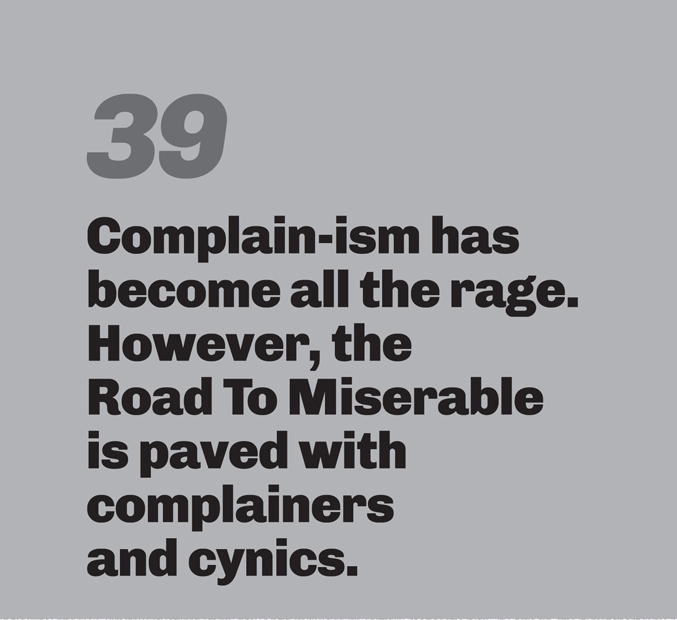
Complaining is like a rash—too easy to catch, and tough to get rid of.
I speak from experience. I’m a recovering “complain-a-holic” who’s still trying to find the cure.
And I don’t think it’s just me. It seems that complaining, with a heavy dose of cynicism, has become our national pastime. It only takes three minutes on social media, talk radio, or the news stations to know that if you’re not complaining about something, you’re a bit of an outsider.
Complaining has become our social currency, our shared language used to form a mutual—if somewhat bitter—understanding of the world we live in. We complain about our unbearable jobs, the slow Wi-Fi, our leaders in the office and around the world, and the waiter who brought only one basket of bread. The entire night!
But can we really be blamed? For twentysomethings who walked off the graduation stage and didn’t exactly see those doors of opportunity being flung open at just the mere glimpse of our bachelor’s degree, how can we not complain? For many, life has been more sour than sweet. How do we not sing woes when trying to reap from fields ravaged with locusts and wildfire? Isn’t lament a biblical concept?
Yet, even though the outlook may be bleak for many at first, there are those who are choosing not to wallow but to walk confidently forward—a band of people who have chosen to follow another word, forcing cynicism on a raft and shoving it out to sea.
That word? Create.
Complaining and creating have a direct correlation. The more you create, the less you complain. The more you complain, the less you create. It’s a pretty simple formula.
Instead of standing by the problem pointing out everything that’s wrong, create a solution.
Instead of ingraining an attitude of discontent, start working toward a new way forward. Create a movement, a relationship, a tool, or a conversation.
Do it big. Do it small. Just do something.
Complaining is passive and powerless.
Creating is proactive and powerful.
People gravitate toward Passionate Pursuers. On the other hand, people run like the plague from Complacent Complainers.
It’s up to us to create opportunity—instead of waiting for one to float straight to us.
What if we simply replaced moments where we had every “right” to complain, and created something instead? What would our world look like?
What if instead of termites, each one of us fighting to take our bite from the crumbling wood, we resembled millions of ants working together to rebuild our smashed hills?
For the hundreds of thousands of young people rising up today, the potential is astounding to do the same—to pick up the torch of the Creator and make beautiful things in a broken world.
Create. Make. Do. Rinse. Repeat.
Create. Make. Do.
练习题
Which statement best captures the author’s view of complaining in this section?
According to the passage, what is the relationship between complaining and creating?
Which response best applies both this section and the prior idea that people should prove their potential rather than wait to be discovered?
Which actions reflect the author’s call to choose creation over cynicism? Select all that apply.
The author presents complaining as both socially contagious and widely accepted as a shared language for understanding the world.
In the passage, creating is described as passive and powerless, while complaining is described as proactive and powerful.
The passage says that people gravitate toward ___, while they run from Complacent Complainers.
How could building an online presence connect the prior section’s career advice with this section’s message about creating rather than complaining?
A recent graduate is frustrated that employers are not noticing their potential. Based on the current section and the prior section on online presence, which response best replaces complaining with creating?
Which actions combine the idea of creating instead of complaining with the prior advice about proving professional potential?
True or false: If a coworker immediately says, “That won’t work,” the current section would support simply joining the cynicism, because workplaces are naturally awkward anyway.
Instead of passively waiting for a company to discover your potential, the combined lesson of the online-presence section and the current section is to ___ opportunity through visible, constructive work.
登录后解锁笔记、知识点解析、AI 问答
立即登录